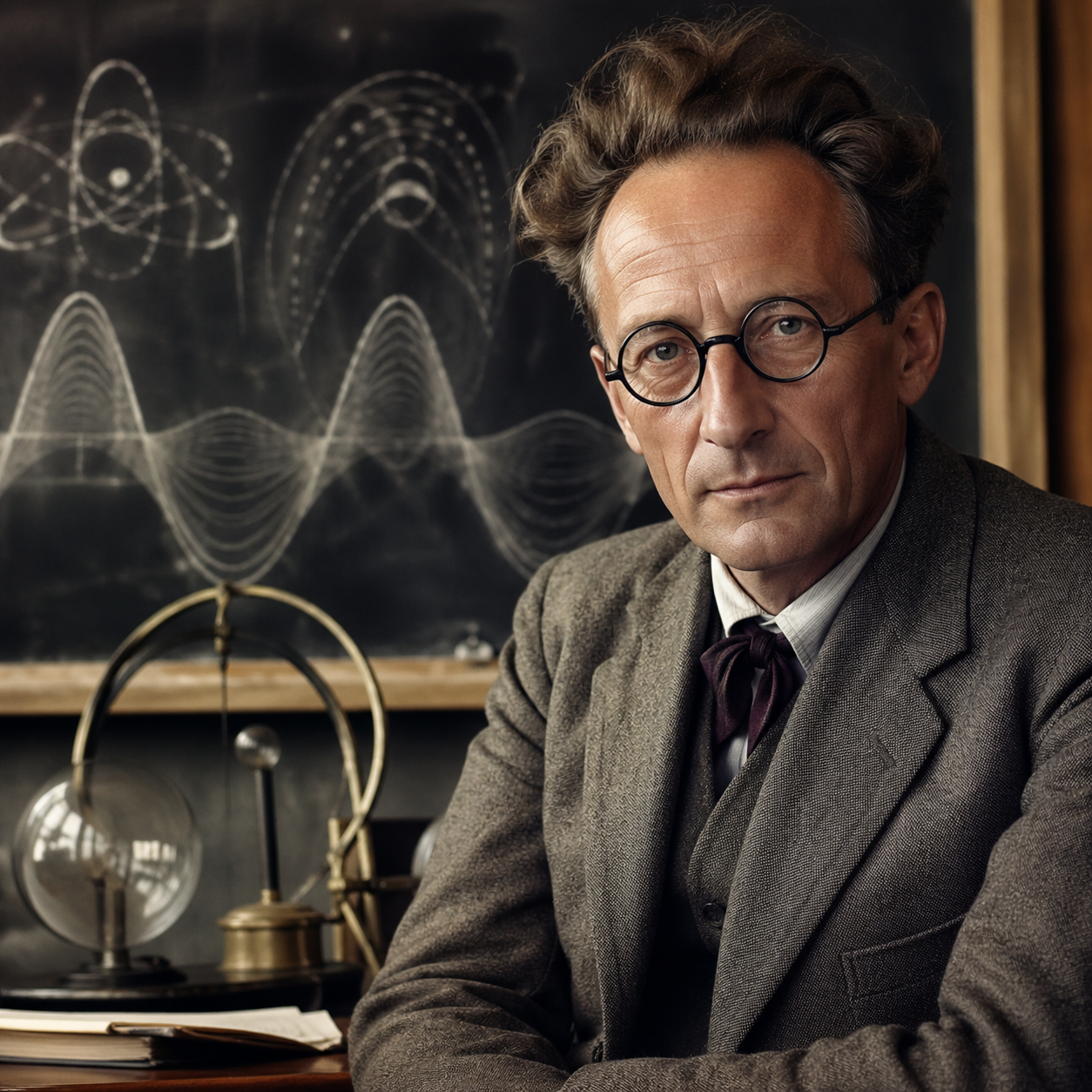
Erwin Schrodinger — "The human mind is a universe in itself."
The human mind is a universe in itself.
The human mind is a universe in itself.
Click any product to generate a realistic preview. Up to 3 at a time.
* Initial load can take up to 90 seconds — revising the preview in another color is nearly instant.
"Consciousness is a singular of which the plural is unknown."
"The best way to escape from the problem is to solve it."
"We are all part of the same cosmic dance."
"The most beautiful thing we can experience is the mysterious."
"The fundamental laws of physics are statistical. They do not determine precisely what will happen, but only the probability of what will happen."
Austrian physicist who shared the 1933 Nobel for the wave equation that bears his name and the famous cat thought-experiment. Closely associated with Werner Heisenberg (matrix-mechanics rival who reached the same physics by different math) and Albert Einstein (his pen-pal on quantum interpretation). For an intellectual contrast, see Niels Bohr, Danish physicist and architect of the Copenhagen interpretation — Schrödinger's cat thought-experiment was specifically designed to ridicule Bohr's 'observer-dependent reality' reading of quantum mechanics — Schrödinger thought the Copenhagen interpretation was absurd; the cat was meant as reductio ad absurdum.
Found in 1 providers: grok
1 source checked
The mind contains infinite complexity, depth, and self-referential structure comparable to the cosmos itself. Consciousness isn't a simple input-output machine but an entire world of perception, abstraction, and subjective experience. Just as the universe operates by layered physical laws, the mind operates through layered cognition, emotion, and awareness—vast, mostly uncharted, and capable of modeling reality from within itself.
Schrödinger, who formulated wave mechanics and the famous cat paradox, was obsessed with consciousness as a scientific problem. His 1944 book 'What is Life?' and later 'Mind and Matter' explored how subjective awareness arises from physical processes. He studied Vedanta philosophy seriously, believing consciousness was singular and universal—making the mind-as-universe metaphor deeply personal, not merely poetic.
Mid-20th century quantum mechanics had shattered classical determinism, revealing a universe fundamentally shaped by observation and probability. As physicists grappled with the observer's role in collapsing wave functions, the boundary between mind and physical reality became philosophically urgent. Simultaneously, neuroscience was embryonic, leaving consciousness philosophically wide open—making grand claims about the mind's scope intellectually credible rather than merely rhetorical.
AI-generated insights based on extensive research and information for context. Factual errors? Email [email protected].
Your cart is empty