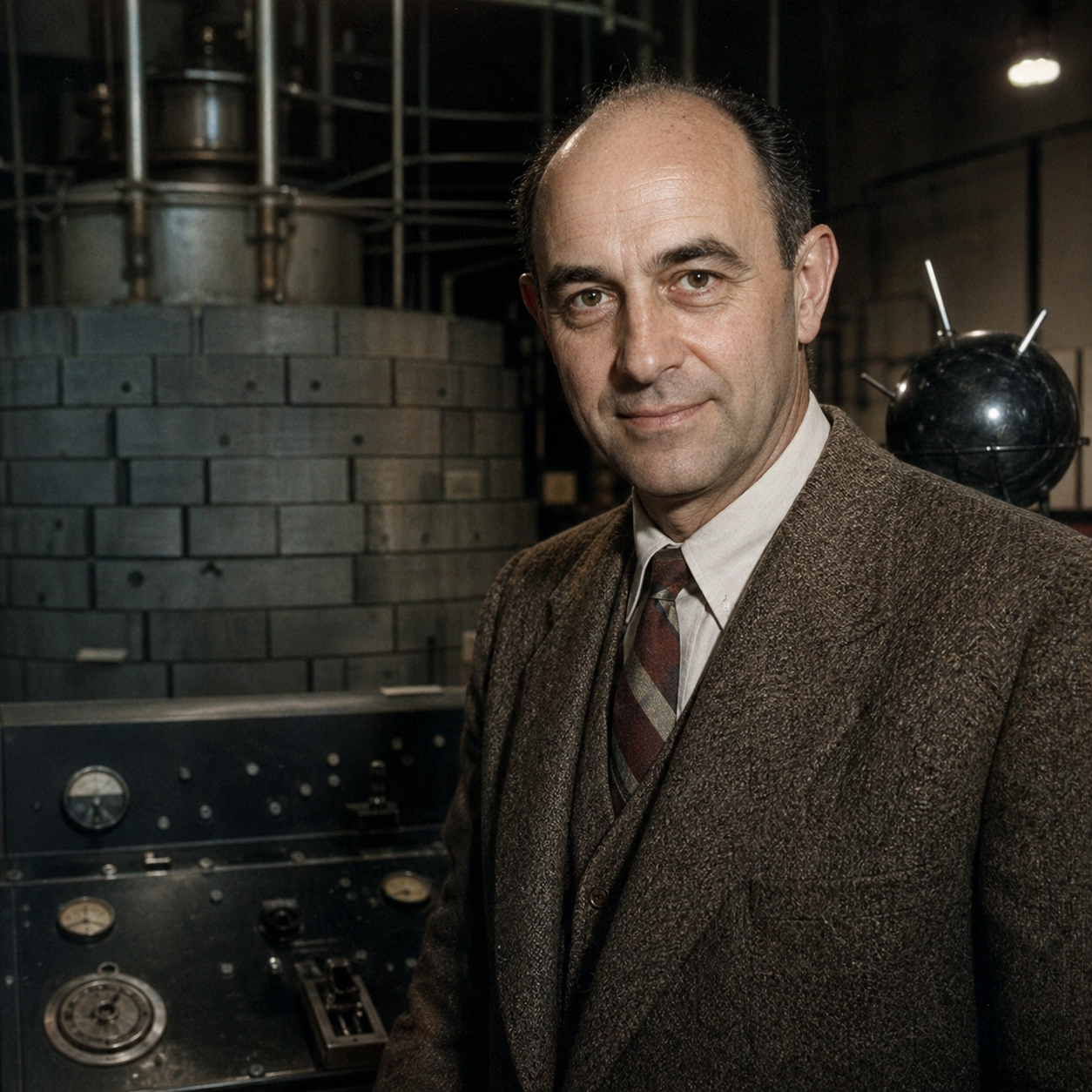
Enrico Fermi — "The fundamental problem is that the world is not simple. It is complex, and we a…"
The fundamental problem is that the world is not simple. It is complex, and we are trying to understand it with simple ideas.
The fundamental problem is that the world is not simple. It is complex, and we are trying to understand it with simple ideas.
Click any product to generate a realistic preview. Up to 3 at a time.
* Initial load can take up to 90 seconds — revising the preview in another color is nearly instant.
"The universe is a strange and wonderful place, and we are only beginning to understand it."
"I remember my friend Johnny von Neumann used to say, 'with four parameters I can fit an elephant and with five I can make him wiggle his trunk.'"
"It is not possible that such a small difference in the atomic weights of hydrogen and helium could have such tremendous consequences."
"The problem with statistics is that you can prove anything with them."
"I hope it works."
Found in 1 providers: grok
1 source checked
Reality resists reduction. Humans naturally reach for clean, elegant explanations, but the world stubbornly refuses to fit neatly into them. The gap between a simplified model and actual complexity is not a flaw in our tools — it is the defining obstacle of any intellectual pursuit. Truly understanding something means wrestling honestly with that mismatch, not pretending the model is the thing itself.
Fermi was famous for Fermi estimation — producing accurate answers to impossible questions using minimal data and rough approximations. Yet he also designed and built Chicago Pile-1 (1942), the world's first nuclear reactor, where small errors in neutron behavior could cascade catastrophically. He lived this tension daily: simple tools, staggering reality. His career proved elegant approximations can illuminate deep truths even when they never fully capture the whole system.
Fermi worked during the 1930s–1950s, when quantum mechanics had just dismantled the comfortable simplicity of Newtonian physics. Electrons behaved as both waves and particles; uncertainty was fundamental; radioactive decay was probabilistic. The Manhattan Project then revealed that unlocking nuclear energy required managing staggering complexity — isotope separation, criticality calculations, chain reactions. Scientists of Fermi's generation confronted daily how inadequate simple mental models were against nature's actual behavior at atomic scales.
AI-generated insights based on extensive research and information for context. Factual errors? Email [email protected].
Your cart is empty