Francis Crick — "The genetic code is not an arbitrary code, but one which was determined by the l…"
The genetic code is not an arbitrary code, but one which was determined by the laws of physics and chemistry.
The genetic code is not an arbitrary code, but one which was determined by the laws of physics and chemistry.
Click any product to generate a realistic preview. Up to 3 at a time.
* Initial load can take up to 90 seconds — revising the preview in another color is nearly instant.
"The brain is a machine assembled not to understand itself, but to survive."
"The central dogma of molecular biology."
"The scientific community is usually quite conservative."
"The structure of DNA is a double helix."
"You, your joys and your sorrows, your memories and your ambitions, your sense of personal identity and free will, are in fact no more than the behavior of a vast assembly of nerve cells and their asso…"
Found in 1 providers: deepseek
1 source checked
The genetic code — the system that translates DNA sequences into proteins — wasn't random. The specific way DNA triplets map to amino acids was constrained by the physical and chemical properties of molecules. Certain pairings were stable and functional; others simply weren't. Life's deepest instruction manual reflects nature's underlying rules, meaning biology is not an accident but a predictable outcome of the same laws governing all matter in the universe.
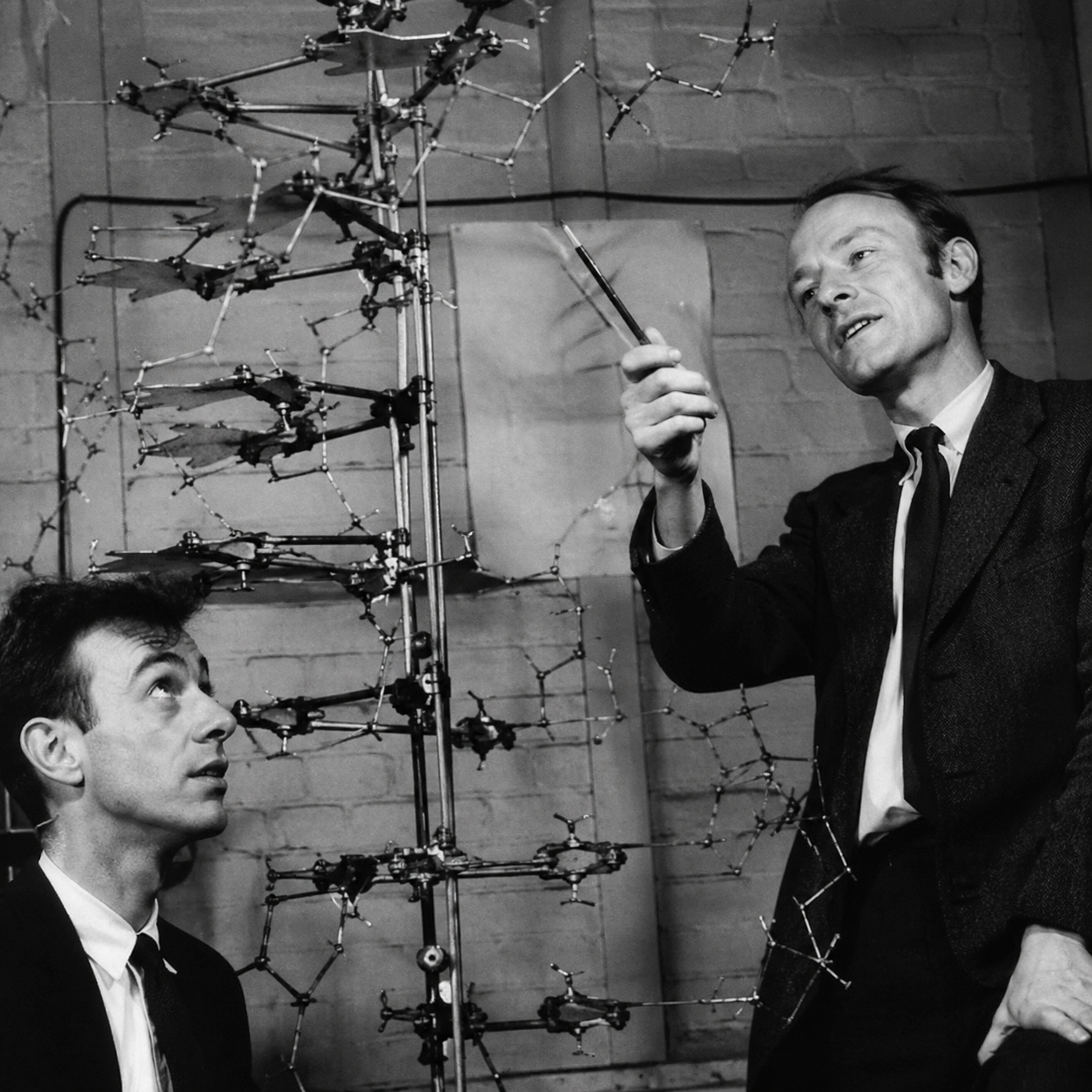
Crick trained as a physicist before pivoting to biology, convinced that life obeys the same deterministic laws as inert matter. His 1953 discovery with Watson of DNA's double helix showed heredity has a physical structure. He later formulated the Central Dogma — information flows from DNA to protein — and obsessed over the genetic code's logic. This quote captures his lifelong conviction: biology is applied chemistry, not mysterious vitalism separate from physics.
During the 1950s–60s, scientists were actively deciphering the genetic code — which of 64 DNA triplets encodes which amino acid. Nirenberg and Khorana won the 1968 Nobel for this work. A fierce debate asked whether the codon-to-amino-acid mapping was chemically inevitable or an evolutionary frozen accident. Crick, who ironically coined the frozen-accident idea himself, here argues for chemical determinism — a tension that defined molecular biology's foundational decade.
AI-generated insights based on extensive research and information for context. Factual errors? Email [email protected].
Your cart is empty