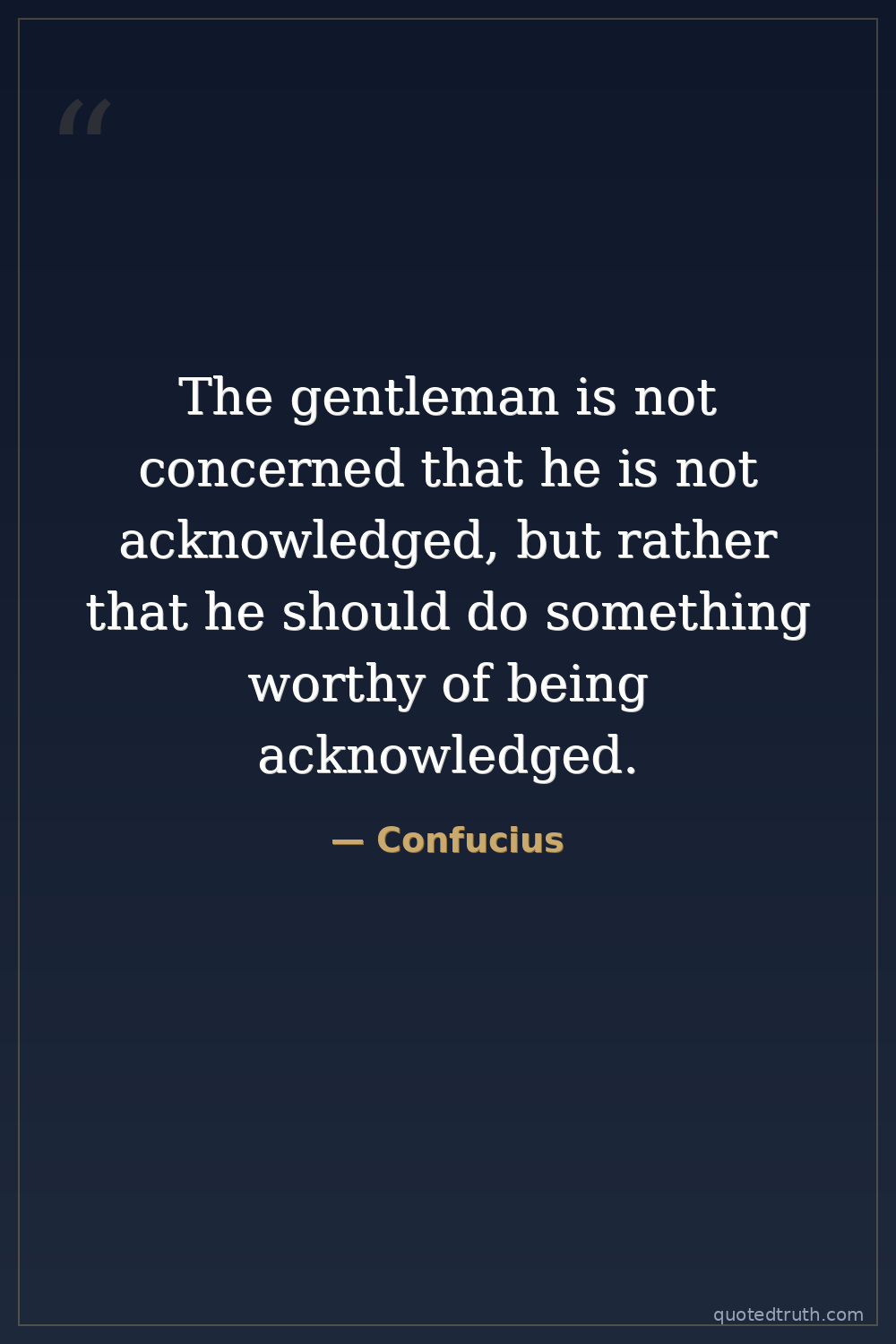
Confucius — "The gentleman is not concerned that he is not acknowledged, but rather that he s…"
The gentleman is not concerned that he is not acknowledged, but rather that he should do something worthy of being acknowledged.
The gentleman is not concerned that he is not acknowledged, but rather that he should do something worthy of being acknowledged.
Click any product to generate a realistic preview. Up to 3 at a time.
* Initial load can take up to 90 seconds — revising the preview in another color is nearly instant.
"Wheresoever you go, go with all your heart."
"The student of virtue has no time for idleness."
"To know what you know and what you do not know, that is true knowledge."
"You cannot open a book without learning something."
"The Master said, 'The superior man, extensively studying all learning, and keeping himself under the restraint of the rules of propriety, may thus likewise not overstep what is right.'"
Chinese philosopher and teacher whose teachings (compiled by his students in the Analects) became the foundational ethical framework of East Asian civilization for 2,500 years. Closely associated with Mencius (his most-influential follower a century later). For an intellectual contrast, see Laozi, near-contemporary Chinese sage and Tao Te Ching author — Confucius systematized social order through ritual and family hierarchy; Laozi's Taoist effortless-action philosophy argued such systems were the disease, not the cure. The two founding poles of Chinese moral philosophy — every East Asian moral tradition since has positioned itself between them.
The standard scholarly entry points to Confucius's work: Philip J. Ivanhoe (Georgetown, Chinese philosophy) — Confucian Moral Self Cultivation (2000); Edward Slingerland (UBC, Asian Studies) — Effortless Action: Wu-wei as Conceptual Metaphor (2003); Tu Weiming (Harvard, Confucian scholar) — Confucian Thought: Selfhood as Creative Transformation (1985). These are the works graduate seminars cite when teaching Confucius.
Analects 15.19 (similar to an earlier quote, but distinct nuance)
Date: c. 5th century BCE
EducationalFound in 1 providers: grok
1 source checked
True character isn't measured by how much recognition you receive but by whether your actions actually deserve recognition. Instead of worrying about being overlooked, unappreciated, or underrated, focus your energy on becoming genuinely excellent at something meaningful. Reputation is a byproduct of substance, not a goal to chase. If you lack recognition, the honest question isn't why others aren't noticing you, but whether you've done anything truly worth noticing yet.
Confucius spent much of his life seeking a ruler who would employ his ethical teachings, often without success. Despite repeated rejection from state courts, he kept refining his character and instructing disciples rather than chasing fame. This saying reflects his core concept of the junzi, the exemplary person whose worth comes from inner cultivation, ritual propriety, and moral action, not external titles. He modeled patient self-improvement over status-seeking throughout his traveling years.
During the Spring and Autumn period (roughly 6th–5th century BCE), the Zhou dynasty's authority was crumbling and rival states competed through warfare and political maneuvering. Ambitious scholars roamed between courts selling their services, and reputation often determined survival and office. Confucius pushed back against this opportunistic climate by insisting virtue should precede recognition. In an age obsessed with rank, lineage, and courtly favor, his emphasis on quiet self-worth was a pointed counter-cultural stance.
AI-generated insights based on extensive research and information for context. Factual errors? Email [email protected].
Your cart is empty