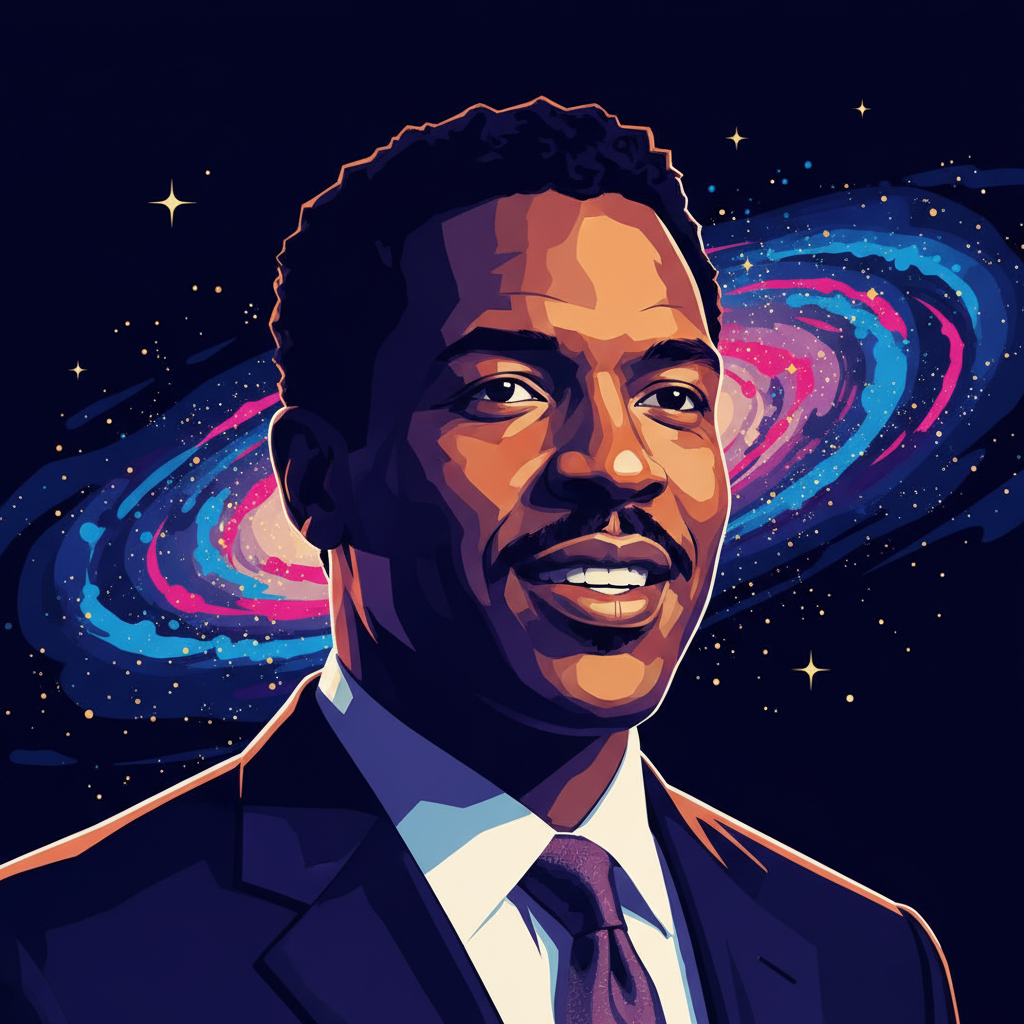
Neil deGrasse Tyson — "The good thing about science is that it's true whether or not you believe in it."
The good thing about science is that it's true whether or not you believe in it.
The good thing about science is that it's true whether or not you believe in it.
Click any product to generate a realistic preview. Up to 3 at a time.
* Initial load can take up to 90 seconds — revising the preview in another color is nearly instant.
"If aliens ever visit us, I think the outcome would be much as when Columbus landed in America, which didn't turn out very well for the Native Americans."
"I don't want to live in a world where people don't understand science. That's a world of darkness."
"I'm often asked if I believe in UFOs. I'm like, 'Yeah, I do. I believe in Unidentified Flying Objects.' It's just that I don't believe they're aliens."
"The universe is not obliged to be beautiful."
"I'm not a philosopher. I'm a scientist. I'm interested in what is, not what should be."
American astrophysicist, Hayden Planetarium director, and Cosmos: A Spacetime Odyssey host who carries the Carl Sagan public-science mantle. Closely associated with Bill Nye (fellow science communicator) and Brian Greene (theoretical physicist and string-theory popularizer). For an intellectual contrast, see Ken Ham, founder of Answers in Genesis and the Creation Museum — Ham's career has been organized around defending biblical 6-day creationism — exactly the science-education position Tyson's mainstream-science communication is structured to refute.
Found in 2 providers: grok,deepseek
2 sources checked
Science's findings hold regardless of personal acceptance or cultural popularity. Gravity, evolution, and climate change operate by the same rules whether someone chooses to believe in them. Unlike opinions or ideology, scientific conclusions are derived from evidence, testing, and replication — processes designed to correct themselves. Belief is irrelevant to whether something is empirically true; reality does not adjust to accommodate whoever refuses to accept it.
Tyson has spent decades as America's most visible science communicator — directing the Hayden Planetarium, hosting Cosmos: A Spacetime Odyssey, and building a massive social media following. He regularly confronts climate denial, flat-earth claims, and creationism with patient but unyielding insistence on evidence. This quote captures his defining mission: not telling people what to think, but reminding them that empirical reality exists independently of their preferences.
Tyson came to prominence during a period of unprecedented science skepticism in American public life. Climate change denial became politically organized through the 2000s. Anti-vaccine movements surged in the 2010s. Social media amplified flat-earth theories and COVID misinformation through 2020–2021. The phrase 'alternative facts' entered the lexicon in 2017. Defending scientific consensus against ideologically motivated rejection became a frontline cultural battle, making this statement both defiant and necessary.
AI-generated insights based on extensive research and information for context. Factual errors? Email [email protected].
Your cart is empty