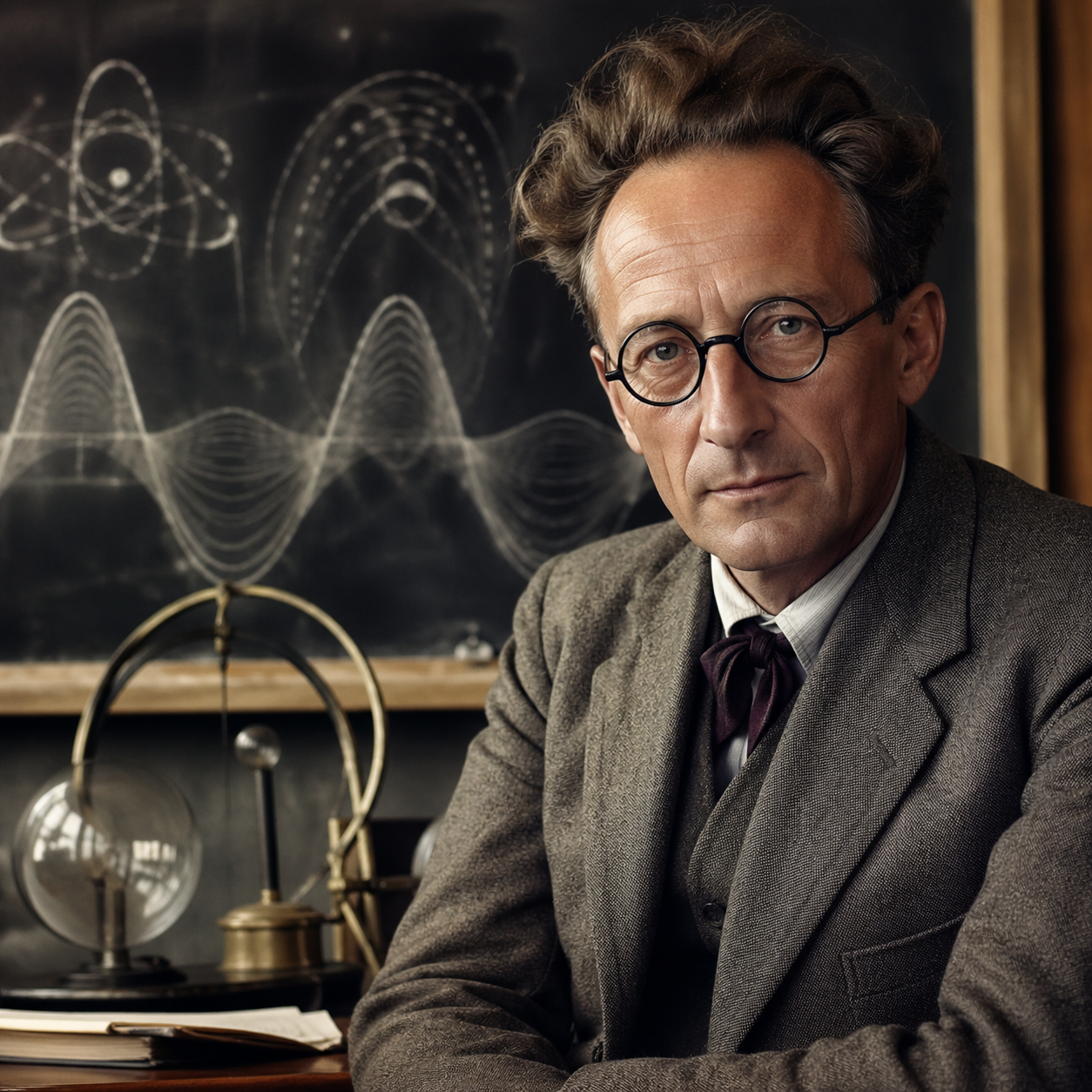
Erwin Schrodinger — "The origin of life is still one of the greatest mysteries of science."
The origin of life is still one of the greatest mysteries of science.
The origin of life is still one of the greatest mysteries of science.
Click any product to generate a realistic preview. Up to 3 at a time.
* Initial load can take up to 90 seconds — revising the preview in another color is nearly instant.
"The fact that life exists and that it is maintained by a continuous stream of 'negentropy' from the outside, is the most profound mystery of all."
"This life of yours which you are living is not merely a piece of the entire existence, but is in a certain sense the whole; only this whole is not so constituted that it can be surveyed in a single gl…"
"We are all part of the same cosmic dance."
"What we observe is not nature in itself but nature exposed to our method of questioning."
"I am no friend of probability theory, I have hated it from the first moment when our dear friend Max Born gave it birth."
Austrian physicist who shared the 1933 Nobel for the wave equation that bears his name and the famous cat thought-experiment. Closely associated with Werner Heisenberg (matrix-mechanics rival who reached the same physics by different math) and Albert Einstein (his pen-pal on quantum interpretation). For an intellectual contrast, see Niels Bohr, Danish physicist and architect of the Copenhagen interpretation — Schrödinger's cat thought-experiment was specifically designed to ridicule Bohr's 'observer-dependent reality' reading of quantum mechanics — Schrödinger thought the Copenhagen interpretation was absurd; the cat was meant as reductio ad absurdum.
Found in 1 providers: grok
1 source checked
Life's emergence from non-living chemistry remains unexplained despite centuries of inquiry. We know the components — molecules, energy, water — but the precise sequence of events that produced self-replicating, metabolizing systems is unknown. Science can describe life's mechanisms with stunning precision yet cannot fully account for how those mechanisms first assembled from raw matter.
Schrödinger's 1944 book 'What Is Life?' directly tackled this mystery, proposing that genes function as aperiodic crystals storing hereditary information — influencing Watson and Crick's discovery of DNA. As wave mechanics' architect, he believed physics and chemistry could explain biological phenomena, making the origin question a natural frontier for his reductionist yet deeply philosophical scientific worldview.
Schrödinger wrote during the 1940s, when quantum mechanics had matured but molecular biology barely existed. The structure of DNA was unknown, biochemistry was primitive, and the Miller-Urey experiment proving organic molecules could form abiotically was still years away. His era stood at the threshold of the molecular revolution, making the origin-of-life question both urgent and genuinely unanswerable with available tools.
AI-generated insights based on extensive research and information for context. Factual errors? Email [email protected].
Your cart is empty