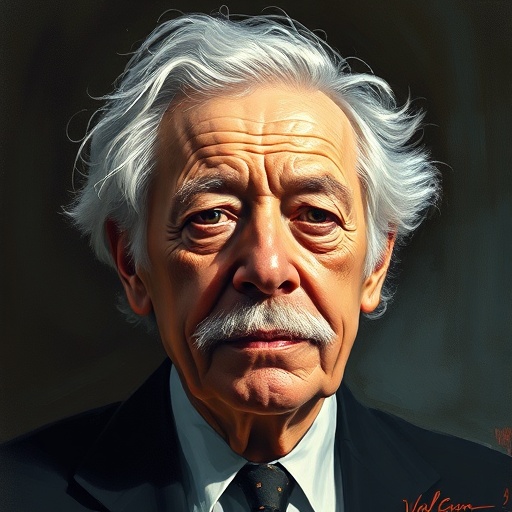
Linus Pauling — "The greatest pleasure in life is doing what people say you cannot do."
The greatest pleasure in life is doing what people say you cannot do.
The greatest pleasure in life is doing what people say you cannot do.
Click any product to generate a realistic preview. Up to 3 at a time.
* Initial load can take up to 90 seconds — revising the preview in another color is nearly instant.
"I might well have become egotistical as a result [of the Langmuir Prize].... But... I think that I just said I shouldn't let this go to my head. I shouldn't think I'm really better than other people e…"
"The most important quality for a scientist is imagination."
"The greatest discoveries of science have always been made by those who were not afraid to challenge the existing paradigms."
"Just one living cell in the human body is, more complex than New York City."
"I believe that every problem has a solution, and that we should never give up on finding it."
Found in 1 providers: grok
1 source checked
Satisfaction comes from proving skeptics wrong — from attempting something others dismiss as impossible or beyond your reach, then succeeding. It reframes doubt and criticism not as discouragement but as motivation. The act of doing what was declared undoable becomes its own reward, more fulfilling than the achievement itself because it simultaneously dismantles a limitation others imposed on you.
Pauling embodied this twice over. He won the Nobel Prize in Chemistry in 1954 for quantum mechanical models of chemical bonding that reshaped structural chemistry, then the Nobel Peace Prize in 1962 for anti-nuclear activism — something the U.S. government actively tried to suppress, revoking his passport. Critics called both pursuits overreach. He did them anyway.
Pauling's most controversial work spanned the Cold War, when scientists were expected to stay politically neutral. His anti-nuclear petitions and criticism of atmospheric testing drew FBI surveillance and State Department hostility. Simultaneously, megadose vitamin C advocacy put him at odds with mainstream medicine. He worked in an era when institutional conformity was enforced, making defiance professionally costly.
AI-generated insights based on extensive research and information for context. Factual errors? Email [email protected].
Your cart is empty