Isaac Newton — "The light which comes from the sun, and from all fire, consists of all the prima…"
The light which comes from the sun, and from all fire, consists of all the primary colours mixed together.
The light which comes from the sun, and from all fire, consists of all the primary colours mixed together.
Click any product to generate a realistic preview. Up to 3 at a time.
* Initial load can take up to 90 seconds — revising the preview in another color is nearly instant.
"I have not been able to discover the cause of those properties of gravity from phenomena, and I frame no hypotheses."
"If I have seen further than others, it is by standing upon the shoulders of giants."
"Oh, Diamond! Diamond! thou little knowest what mischief thou hast done!"
"He that in the study of natural philosophy shall resolve to proceed upon nothing but demonstrations and sound knowledge, hath a very large field of materials of all sorts to divert and employ him."
"Atheism is so senseless. When I look at the solar system, I see the earth at the right distance from the sun to receive the proper amounts of heat and light. This did not happen by chance."
Found in 1 providers: grok
1 source checked
What we perceive as pure white light — from sunlight or flame — is not simple at all. It is actually every color blended together invisibly. Separate it and the full spectrum emerges. This inverts common intuition: white is not the absence of color but the presence of all of them simultaneously. Purity is complexity in disguise, and what seems uniform contains multitudes when examined closely.
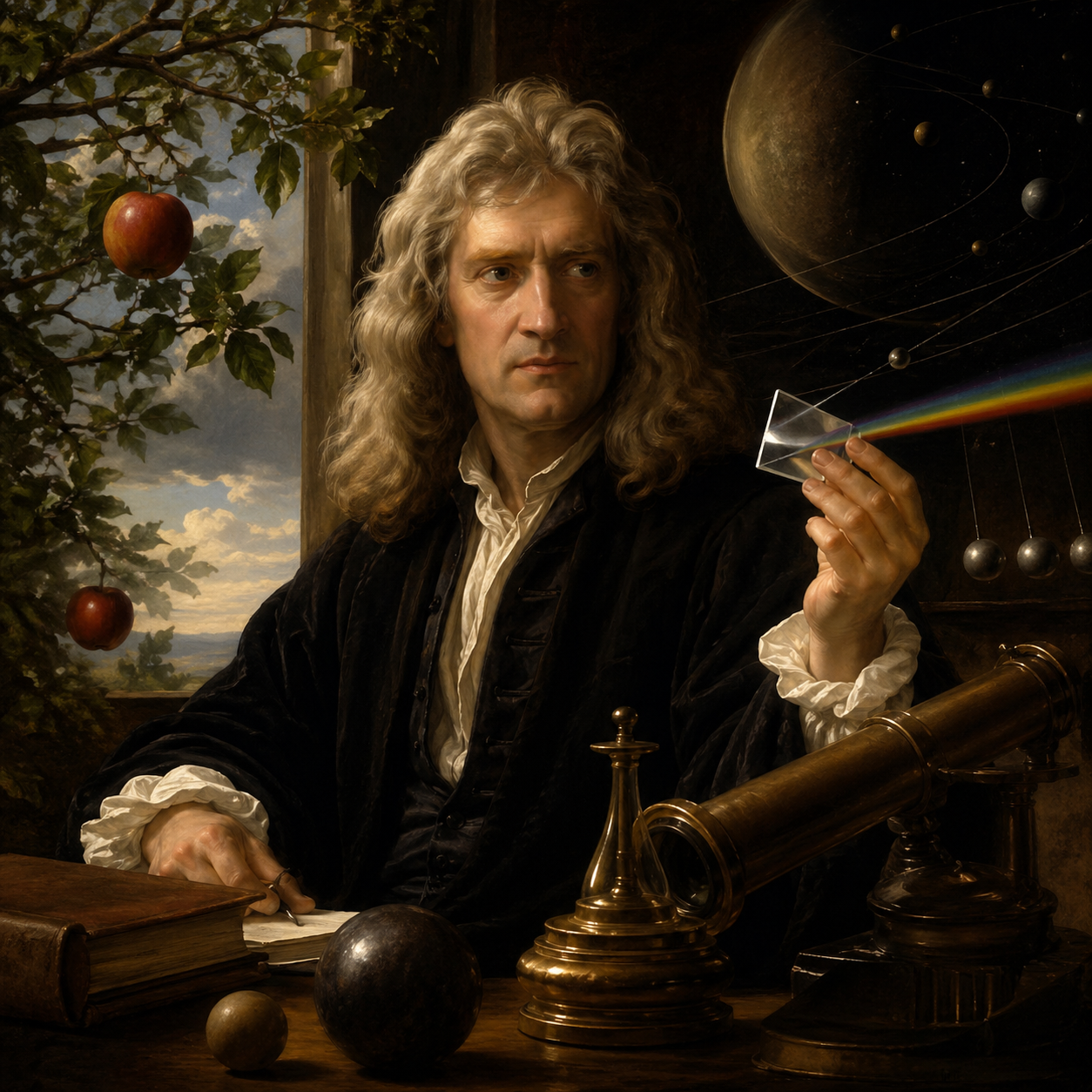
Newton proved this through prism experiments at Woolsthorpe during the 1665–1666 plague years, splitting sunlight into a full spectrum. He published his theory in Opticks (1704) after decades defending it against Robert Hooke, who claimed colors were modifications of white light. For Newton — methodical, fiercely independent, prone to long disputes — this finding encapsulated his belief that nature hides its deepest truths behind surfaces, revealed only through rigorous experimentation.
In the 17th century, Aristotelian cosmology still cast white light as elemental and pure — color was considered a corruption or alteration of it. The Scientific Revolution was dismantling ancient authority through experiment. Newton worked amid intense optical debate: Descartes had proposed a mechanical theory of light, Huygens would develop wave theory, and the Royal Society was newly formed. Newton's composite-light discovery directly challenged inherited dogma during science's most transformative century.
AI-generated insights based on extensive research and information for context. Factual errors? Email [email protected].
Your cart is empty