Alan Turing — "The machine is only as good as the man who programs it."
The machine is only as good as the man who programs it.
The machine is only as good as the man who programs it.
Click any product to generate a realistic preview. Up to 3 at a time.
* Initial load can take up to 90 seconds — revising the preview in another color is nearly instant.
"Science is a differential equation. Religion is a boundary condition."
"I am not concerned with whether a machine has feelings, but whether it can perform tasks that require intelligence."
"The isolated man does not develop any intellectual power. It is necessary for him to be immersed in an environment of other men, whose techniques he absorbs during the first twenty years of his life."
"The problem of consciousness is a hard problem, and I don't know the answer."
"The more we learn about the brain, the more we realize that it is a very complex machine."
Found in 1 providers: grok
1 source checked
Any system—mechanical or computational—is ultimately bounded by the intelligence, care, and judgment of its creator. Technology doesn't originate intentions or make independent decisions; it executes what human minds design into it. A poorly conceived program produces flawed results regardless of the machine's raw power. Human skill, values, and understanding define the ceiling of what any tool can actually achieve.
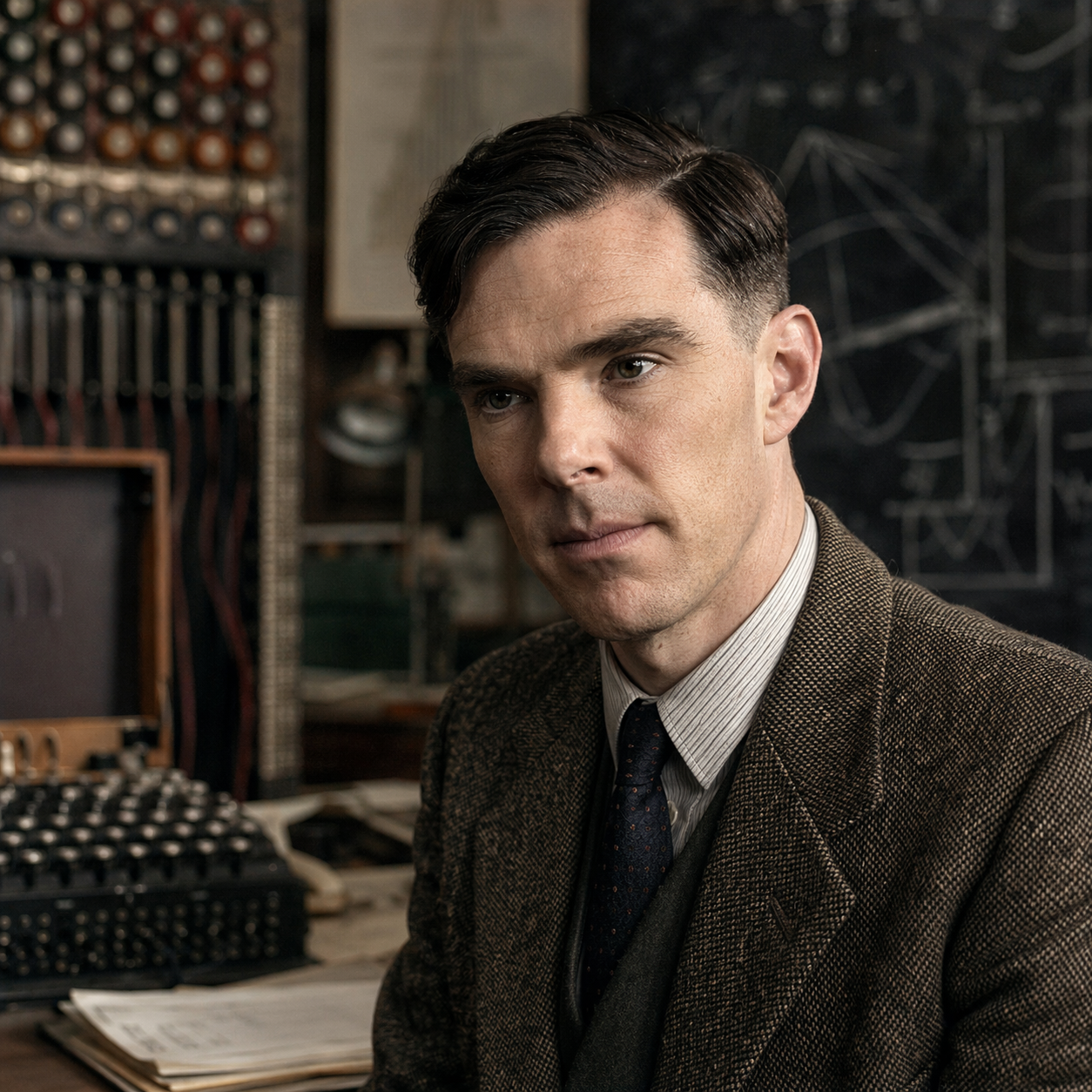
Turing spent his career translating human reasoning into mechanical form. His Bombe, built to crack Nazi Enigma encryption, succeeded purely because of his mathematical insight—the machine was an extension of his mind, nothing more. His landmark 1950 paper introducing the Turing Test grappled explicitly with the gap between machine behavior and human intelligence. He knew better than anyone that computation begins with a programmer's assumptions and limitations.
The late 1940s and early 1950s introduced the first programmable electronic computers—Manchester Baby, EDSAC, ENIAC—to a public that barely understood them. Many feared or mythologized these machines as autonomous, almost magical entities. Cold War anxieties amplified the stakes: computing errors in weapons calculations or codebreaking could have catastrophic consequences. Turing's era demanded the clarification that machines were tools shaped entirely by human design and human fallibility.
AI-generated insights based on extensive research and information for context. Factual errors? Email [email protected].
Your cart is empty