Alexander Fleming — "I had no idea at the time that I was making a discovery that would change the co…"
I had no idea at the time that I was making a discovery that would change the course of medicine.
I had no idea at the time that I was making a discovery that would change the course of medicine.
Click any product to generate a realistic preview. Up to 3 at a time.
* Initial load can take up to 90 seconds — revising the preview in another color is nearly instant.
"The discovery of penicillin was a matter of chance, but the application of it was a matter of hard work."
"The purification of penicillin was a major triumph of chemistry."
"It is not wise to be too dogmatic in science. One must always be prepared to change one's mind."
"We must be careful not to create a race of penicillin-resistant superbugs."
"It is not wise to use penicillin as a prophylactic against every little infection."
Found in 1 providers: grok
1 source checked
Transformative breakthroughs often happen without the discoverer recognizing their magnitude in the moment. Fleming admits that world-changing discoveries can feel routine or accidental while they're occurring. The gap between doing something and understanding its importance can be enormous. True discovery doesn't announce itself — it's quiet, unglamorous, often mistaken for a minor observation. Significance is almost always assigned in retrospect, not in the moment of the act itself.
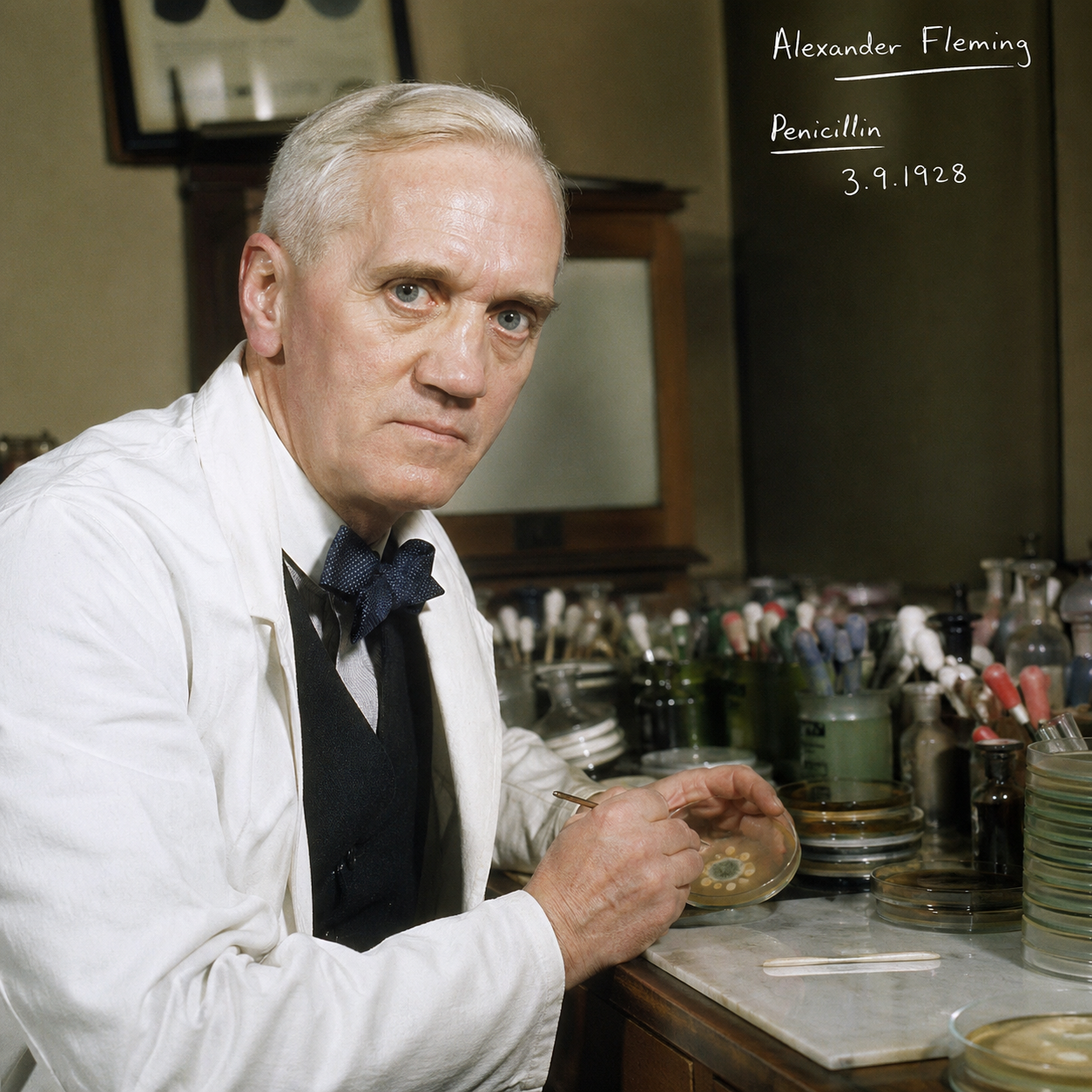
Fleming discovered penicillin in September 1928 when he noticed mold contaminating and killing bacteria on a petri dish he'd left before holiday. He published his findings in 1929 but received minimal attention for years. Florey and Chain developed it into a usable drug over a decade later. This quote captures Fleming's documented humility; he consistently downplayed his role, crediting chance and observation over genius, and shared his 1945 Nobel Prize without claiming sole credit.
Before penicillin, bacterial infections — pneumonia, sepsis, surgical wounds — killed routinely. The 1918 flu pandemic killed more people through secondary bacterial infections than the virus itself. Fleming's 1928 observation arrived in a world where doctors had virtually no antibacterial tools. World War II created desperate demand; mass-produced penicillin saved hundreds of thousands of Allied casualties from 1943 onward. Fleming's quiet lab moment in London preceded medicine's most consequential decade of therapeutic advancement.
AI-generated insights based on extensive research and information for context. Factual errors? Email [email protected].
Your cart is empty