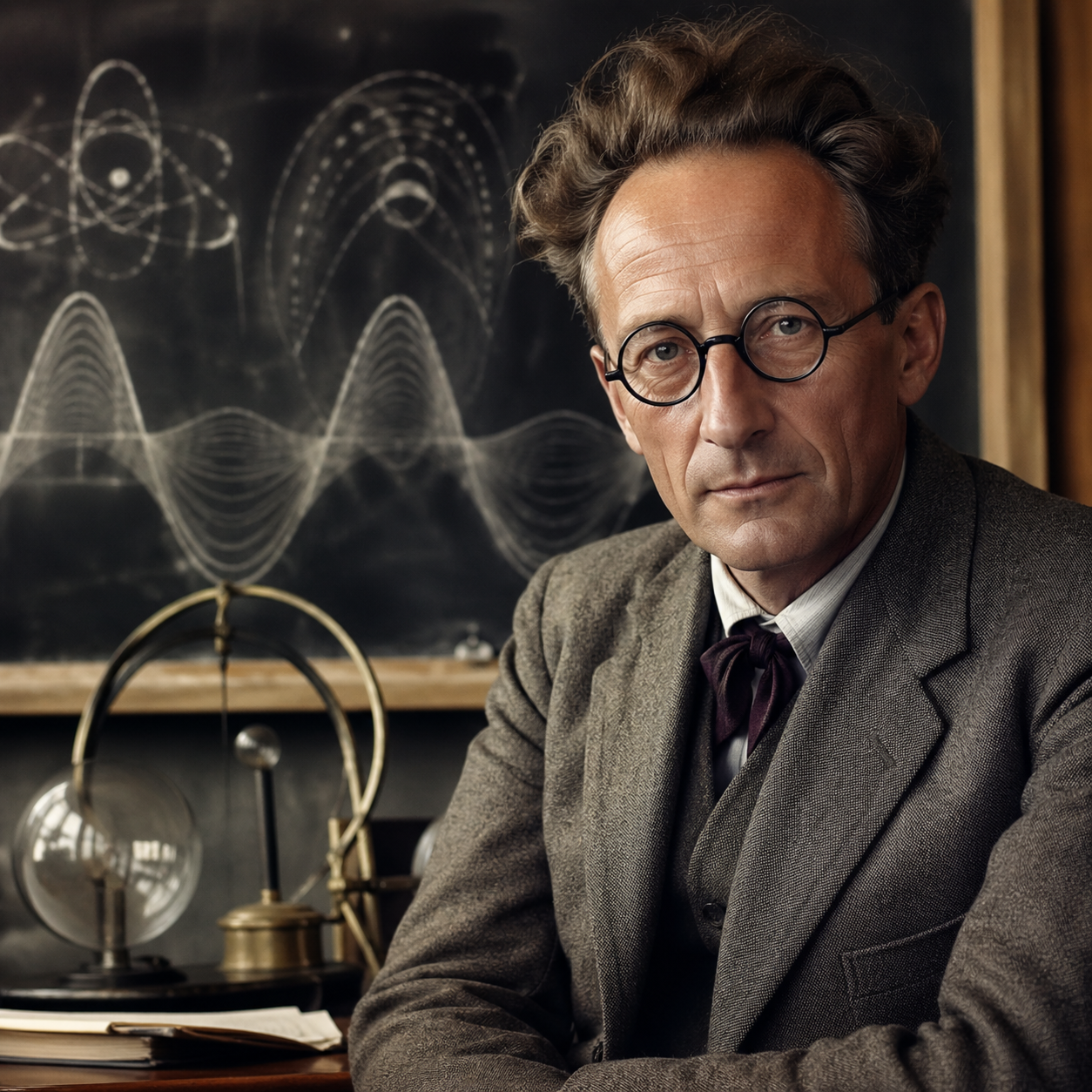
Erwin Schrodinger — "The more precisely the position is determined, the less precisely the momentum i…"
The more precisely the position is determined, the less precisely the momentum is known in this instant, and vice versa.
The more precisely the position is determined, the less precisely the momentum is known in this instant, and vice versa.
Click any product to generate a realistic preview. Up to 3 at a time.
* Initial load can take up to 90 seconds — revising the preview in another color is nearly instant.
"The result of the experiment is that the cat is both dead and alive, like the famous case of the young woman who was both a virgin and a mother."
"The great task of science is to unify all knowledge."
"I am very astonished that the scientific picture of the world around me is very deficient. It gives a lot of factual information, puts all our experience in a magnificently consistent order, but it is…"
"The scientific picture of the world is a simplification, an abstraction, and it is not the whole truth."
"This life of yours which you are living is not merely a piece of the entire existence, but is in a certain sense the whole; only this whole is not so constituted that it can be surveyed in a single gl…"
Austrian physicist who shared the 1933 Nobel for the wave equation that bears his name and the famous cat thought-experiment. Closely associated with Werner Heisenberg (matrix-mechanics rival who reached the same physics by different math) and Albert Einstein (his pen-pal on quantum interpretation). For an intellectual contrast, see Niels Bohr, Danish physicist and architect of the Copenhagen interpretation — Schrödinger's cat thought-experiment was specifically designed to ridicule Bohr's 'observer-dependent reality' reading of quantum mechanics — Schrödinger thought the Copenhagen interpretation was absurd; the cat was meant as reductio ad absurdum.
Popular paraphrase of Heisenberg's Uncertainty Principle, often attributed to him in simplified form. Not his original wording of the principle.
Date: 1927 (Heisenberg's principle)
ShockingFound in 1 providers: grok
1 source checked
Quantum particles cannot have both their position and momentum precisely known at the same time. Pinning down exactly where a particle is forces its momentum into uncertainty, and measuring momentum precisely blurs its location. This isn't a failure of instruments — it's a fundamental feature of nature at the subatomic scale. Reality at that level is inherently probabilistic, not a matter of needing better measurement tools.
Schrödinger developed wave mechanics in 1926, proposing that particles are described by probability wave functions governed by his famous equation. This uncertainty principle flows naturally from wave theory — a spatially localized wave packet inherently contains a spread of frequencies, making momentum indeterminate. His wave function framework mathematically grounds this trade-off, aligning with the irreducible probabilistic nature of quantum observation he spent his career wrestling with.
The 1920s dismantled Newtonian certainty. Schrödinger's wave mechanics, Heisenberg's matrix mechanics, and Bohr's Copenhagen interpretation converged in a decade of radical revision. The uncertainty principle crystallized a deep shift: nature at the quantum level resists deterministic description. This sparked the famous Einstein-Bohr debates over whether physics must abandon causality entirely. Post-WWI Europe, already shaken by upheaval, found its foundational science declaring that even knowledge itself has irreducible limits.
AI-generated insights based on extensive research and information for context. Factual errors? Email [email protected].
Your cart is empty