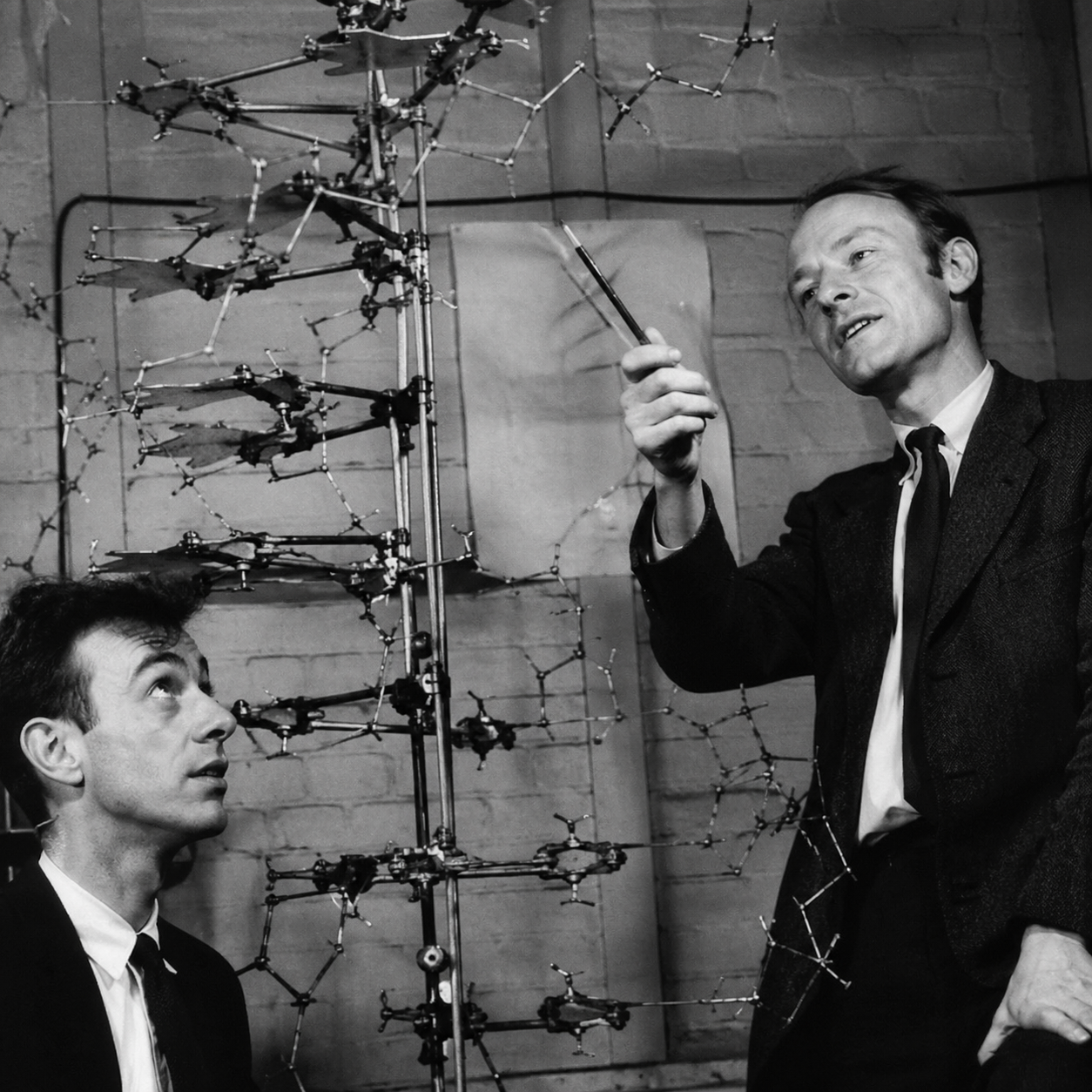
Francis Crick — "The more we learn about the brain, the less room there is for a soul."
The more we learn about the brain, the less room there is for a soul.
The more we learn about the brain, the less room there is for a soul.
Click any product to generate a realistic preview. Up to 3 at a time.
* Initial load can take up to 90 seconds — revising the preview in another color is nearly instant.
"The origin of life appears to be almost a miracle, so many are the conditions which would have had to be satisfied to get it going."
"I enjoy being controversial."
"Our minds are just a lot of neurons firing."
"The genetic material must be able to replicate itself."
"A theory that fits all the facts is bound to be wrong, as some of the facts will be wrong."
Found in 1 providers: grok
1 source checked
Scientific knowledge of the brain progressively replaces supernatural explanations for consciousness, identity, and inner life. As neuroscience maps how neurons generate thought, memory, and emotion, a separate immaterial soul becomes scientifically redundant. What religion once attributed to spiritual essence — will, selfhood, awareness — can increasingly be explained through physical processes. Science doesn't explicitly disprove the soul; it simply leaves no gap requiring one.
Crick spent his later career almost entirely on consciousness, co-writing 'The Astonishing Hypothesis' (1994), which argued consciousness is solely neural activity — this quote distills that thesis. A lifelong atheist shaped by reductionist biology, he believed the mind was fully reducible to physical substrate. His deliberate pivot from molecular biology to neuroscience was itself a declaration: the deepest question of human identity belongs to science, not theology.
Crick made this argument during the 1990s 'Decade of the Brain,' when MRI and PET scans began mapping cognition in unprecedented detail. The Human Genome Project was simultaneously reframing human identity in molecular terms. Western academia was rapidly secularizing, and evolutionary biology had already pressured religious institutions. Neuroscience opened a new front: if the brain fully generates consciousness, religion's most intimate claim — the immortal soul — faced direct scientific challenge for the first time.
AI-generated insights based on extensive research and information for context. Factual errors? Email [email protected].
Your cart is empty