Isaac Newton — "The most beautiful order of the planets and comets could not have arisen without…"
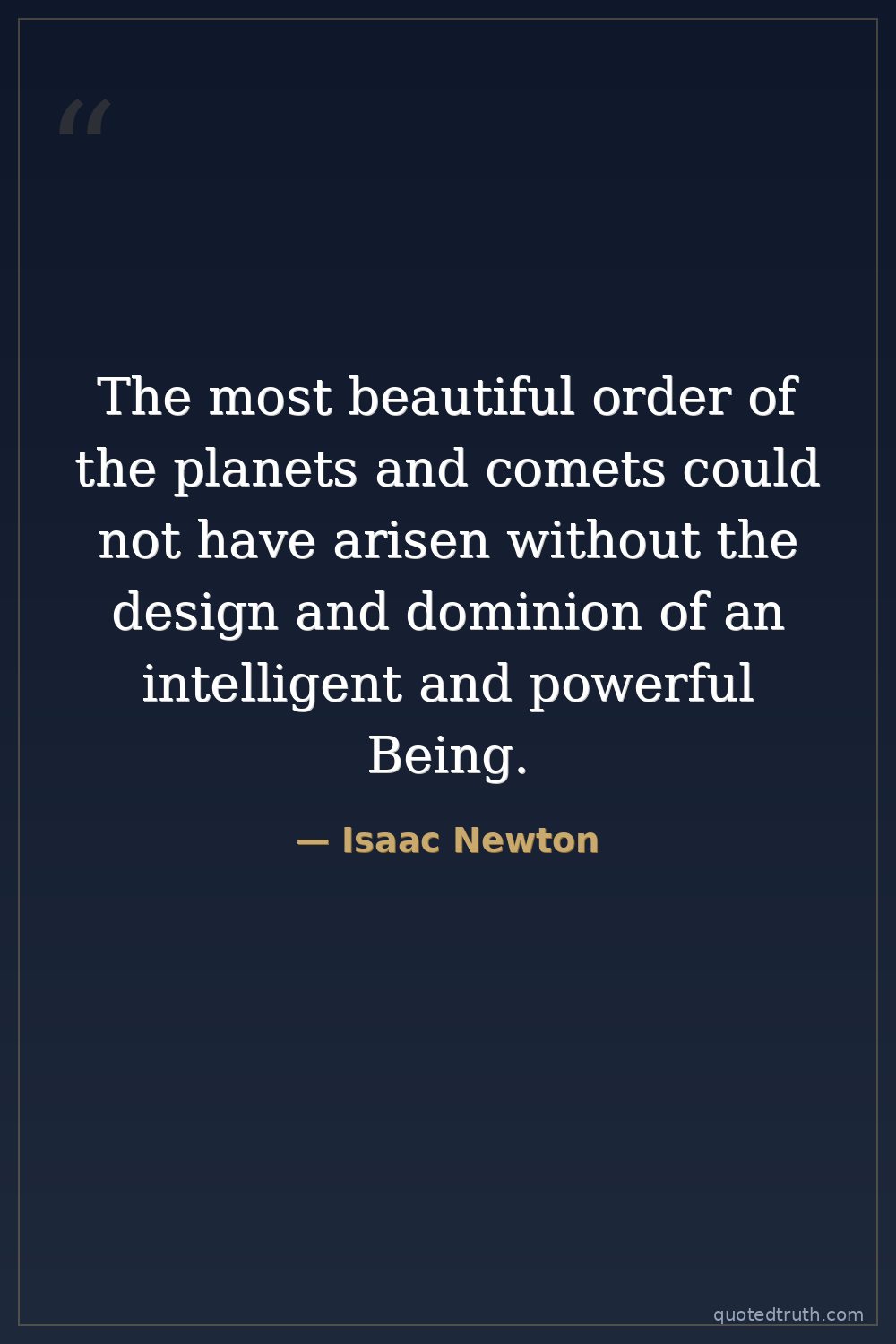
The most beautiful order of the planets and comets could not have arisen without the design and dominion of an intelligent and powerful Being.
The most beautiful order of the planets and comets could not have arisen without the design and dominion of an intelligent and powerful Being.
Click any product to generate a realistic preview. Up to 3 at a time.
* Initial load can take up to 90 seconds — revising the preview in another color is nearly instant.
"The great ocean of truth lay all undiscovered before me."
"Truth is the offspring of silence and meditation."
"We build too many walls and not enough bridges."
"Plato is my friend, Aristotle is my friend, but truth is more my friend."
"I feign no hypotheses."
Found in 1 providers: grok
1 source checked
The precise, harmonious arrangement of planets and comets — orbiting in stable, predictable paths — cannot have arisen from chance or blind physical forces alone. Such elegant order implies an intentional designer: a supreme, intelligent being who established and governs the cosmos. Newton is arguing that natural laws are not a replacement for God but evidence of divine craftsmanship, pointing outward from mathematics toward a purposeful creator behind the machinery of the universe.
Newton spent decades computing planetary orbits and formulating universal gravitation, yet he wrote more on biblical prophecy and theology than on physics. For him, discovering mathematical order in the heavens deepened, not diminished, his faith. He believed God periodically corrected perturbations in planetary motion, seeing celestial mechanics as proof of ongoing divine governance — making this quote a direct expression of how his scientific and religious worldviews were inseparable throughout his life.
Newton lived during the Scientific Revolution, when Copernicus, Galileo, and Kepler had displaced Earth from the cosmic center, alarming religious authorities who feared science was eroding faith. In this charged climate, Newton's synthesis of rigorous mathematics with theology was a deliberate intellectual stance: natural philosophy and Christianity were partners, not rivals. Framing gravitational order as evidence of God's dominion was both philosophically serious and culturally necessary in an era where Church authority still shaped public discourse.
AI-generated insights based on extensive research and information for context. Factual errors? Email [email protected].
Your cart is empty