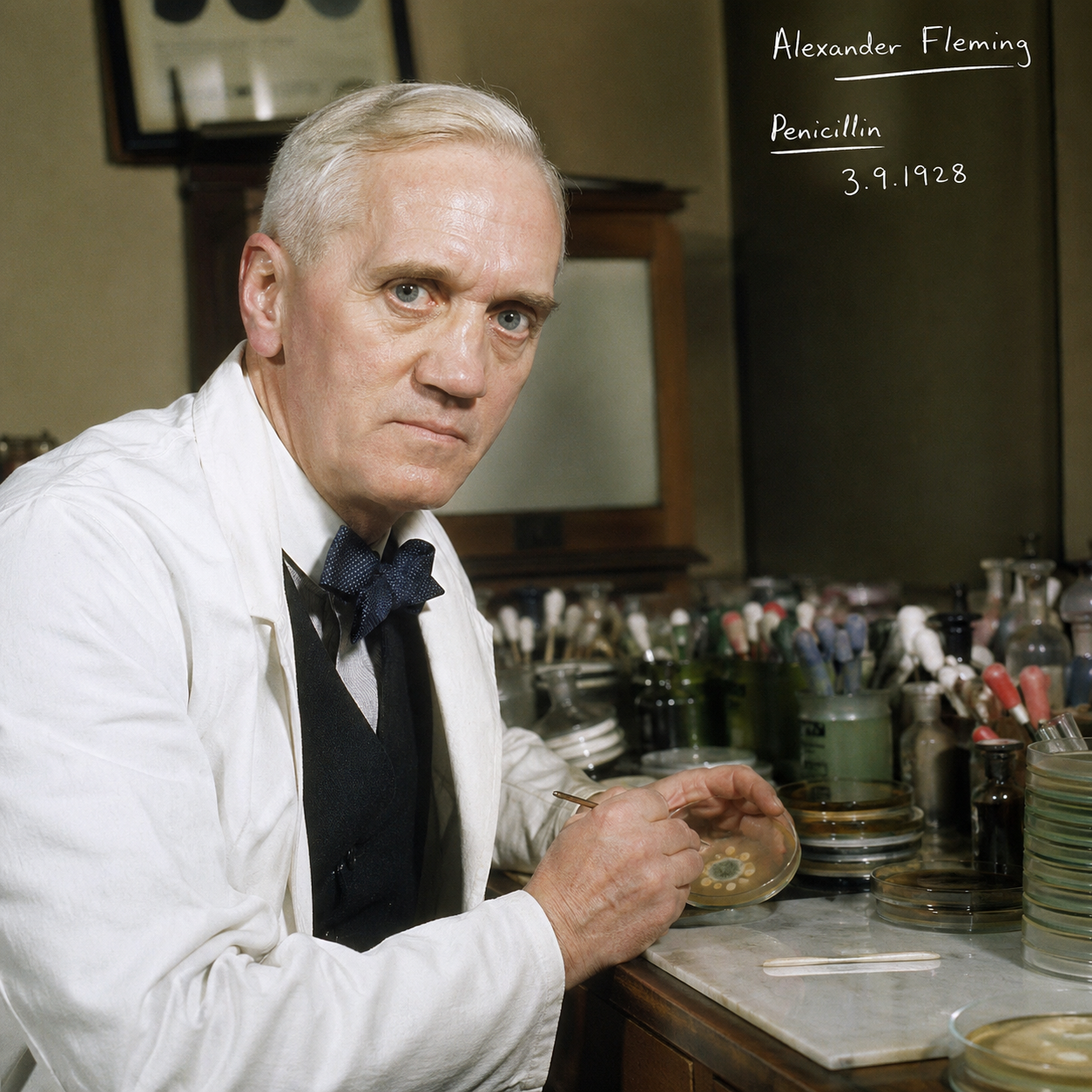
Alexander Fleming — "I am very grateful for the recognition I have received, but the real credit belo…"
I am very grateful for the recognition I have received, but the real credit belongs to the mould.
I am very grateful for the recognition I have received, but the real credit belongs to the mould.
Click any product to generate a realistic preview. Up to 3 at a time.
* Initial load can take up to 90 seconds — revising the preview in another color is nearly instant.
"When I woke up just after dawn on September 28, 1928, I certainly didn't plan to revolutionize all medicine by discovering the world's first antibiotic, or bacteria killer. But I suppose that was exac…"
"The greatest tragedy is the misuse of a good thing."
"Many difficulties were encountered in the early attempts to isolate and purify penicillin."
"It was not easy to convince people of the importance of penicillin in the early days."
"The greatest reward for a scientist is the advancement of knowledge."
Found in 1 providers: grok
1 source checked
Humility and intellectual honesty: despite winning global fame, including a Nobel Prize, Fleming insists the real agent of discovery was the Penicillium mould itself, not his cleverness or deliberate design. He observed something nature had already accomplished. The quote draws a clean line between receiving recognition and deserving it, suggesting that luck and the natural world sometimes outperform human intention and ingenuity.
Fleming discovered penicillin in 1928 when a mould accidentally contaminated a bacterial culture plate — he noticed, rather than engineered, the breakthrough. His entire career in bacteriology was built on acute observation. He shared the 1945 Nobel Prize with Florey and Chain, who developed the drug clinically, yet Fleming received the most public fame. His consistent crediting of the mould over himself reflects a character marked by scientific rigor and genuine personal modesty.
Penicillin transformed World War II medicine, saving hundreds of thousands of soldiers from infected wounds, and the 1940s–50s lionized its discoverers as wartime heroes. Scientific achievement was deeply politicized and nationalized — Britain celebrated Fleming as a symbol of British genius. Against this backdrop of intense hero-worship and credit-claiming, Fleming's deflection to the mould was quietly radical, pushing back against the era's appetite for singular, celebrated inventors at a moment when science was being mythologized globally.
AI-generated insights based on extensive research and information for context. Factual errors? Email [email protected].
Your cart is empty