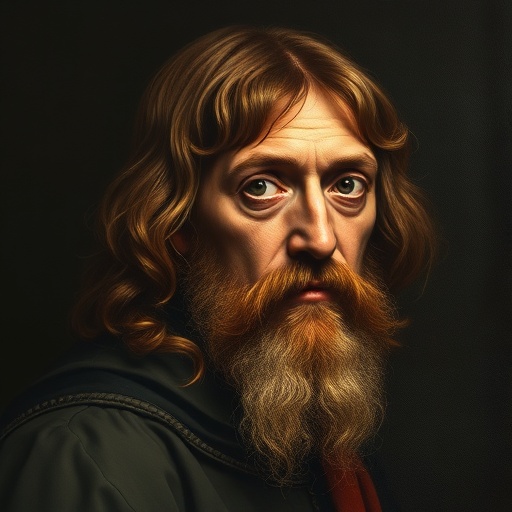
Nicolaus Copernicus — "The movements of the heavens are an ordered dance, and the Earth is a participan…"
The movements of the heavens are an ordered dance, and the Earth is a participant in this dance.
The movements of the heavens are an ordered dance, and the Earth is a participant in this dance.
Click any product to generate a realistic preview. Up to 3 at a time.
* Initial load can take up to 90 seconds — revising the preview in another color is nearly instant.
"First of all, the world is spherical. This is because the sphere is the most perfect figure of all, and it is the form of the world."
"The massive bulk of the Earth does indeed shrink to insignificance in comparison with the size of the heavens."
"The Universe has been wrought for us by a supremely good and orderly Creator."
"Therefore, when I perceived that these and similar doubts arose concerning the order of the parts of the universe and the symmetry of its structure, I began to be vexed that no more definite explanati…"
"For if the earth should move from west to east, the fixed stars would appear to move from east to west."
Found in 1 providers: grok
1 source checked
The universe operates according to precise, mathematical patterns rather than chaos or divine whim alone. Earth is not a stationary spectator but an active mover, orbiting and rotating alongside other celestial bodies in a coordinated cosmic system governed by natural law. Every planet follows predictable paths, making the cosmos a unified, elegant mechanism rather than a collection of separate, unrelated phenomena.
Copernicus spent decades at Frombork Cathedral meticulously observing planetary motion, convinced the prevailing Ptolemaic model was unnecessarily complicated. His heliocentric theory placed Earth among the planets, stripping it of its privileged stationary position. This quote captures his deepest conviction: that mathematical harmony, not Earth's centrality, defines the universe. His De Revolutionibus orbium coelestium embodied this belief, risking ecclesiastical censure to publish it.
In early 16th-century Europe, Ptolemaic geocentrism underpinned both astronomy and Catholic theology. Earth's immobility was doctrinal. Renaissance humanism was simultaneously elevating mathematical reasoning over pure scriptural authority. Copernicus wrote during early printing's explosion, when ideas spread rapidly. His heliocentric reordering emerged just as European explorers were reshaping geographic understanding, making intellectual dislocation of humanity's cosmic position culturally potent and theologically dangerous.
AI-generated insights based on extensive research and information for context. Factual errors? Email [email protected].
Your cart is empty