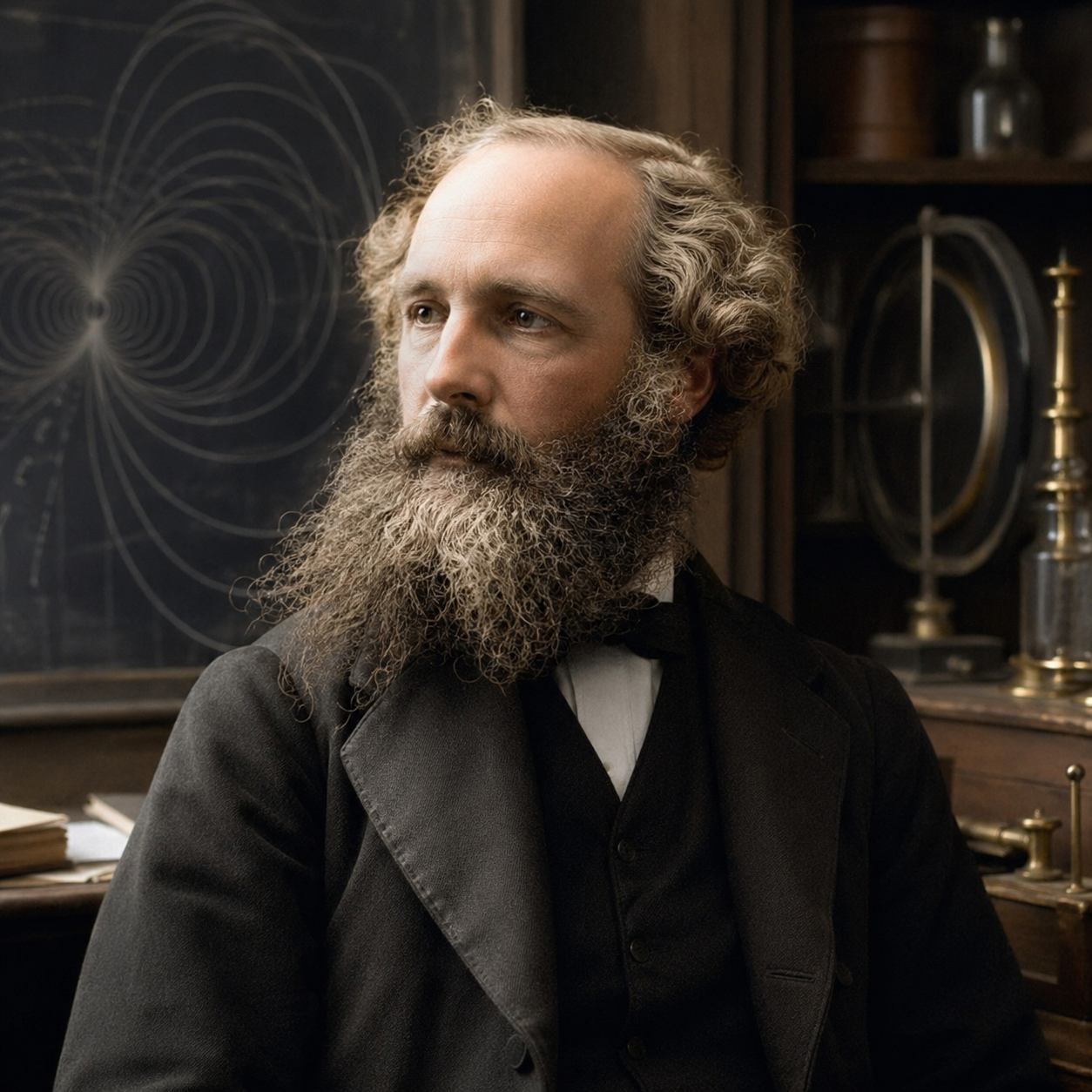
James Clerk Maxwell — "The properties of the ether, if it exists, are certainly very remarkable."
The properties of the ether, if it exists, are certainly very remarkable.
The properties of the ether, if it exists, are certainly very remarkable.
Click any product to generate a realistic preview. Up to 3 at a time.
* Initial load can take up to 90 seconds — revising the preview in another color is nearly instant.
"Every existence above a certain rank has its singular points; the higher the rank the more of them. At these points, influences whose physical magnitude is too small to be taken account of by a finite…"
"The only use of a knowledge of the past is to equip us for the present."
"It is an unscientific habit to give names to things before we know what they are."
"The only way to avoid error is to have no ideas at all."
"Science is incompetent to reason upon the creation of matter itself out of nothing. We have reached the utmost limit of our thinking faculties when we have admitted that because matter cannot be etern…"
Found in 1 providers: grok
1 source checked
Maxwell is pointing out that if there really is an invisible medium filling all of space—the ether—then it must have bizarre, almost contradictory qualities. It would need to be rigid enough to carry light waves at enormous speeds, yet thin enough that planets glide through it without resistance. He is flagging a puzzle: the evidence demands such a substance, but its required traits defy common sense.
Maxwell built the mathematical framework showing light is an electromagnetic wave, and in his era waves were assumed to need a medium. His 1865 equations implicitly relied on the ether, yet his rigorous mind refused to pretend its strange properties were settled. This careful hedging—'if it exists'—reflects his Presbyterian honesty, deep physical intuition, and willingness to hold open questions rather than force premature answers about nature's underlying fabric.
Maxwell worked in Victorian Britain (1831–1879), when classical physics seemed nearly complete but the ether puzzle loomed large. Michelson and Morley would famously fail to detect it in 1887, after Maxwell's death, eventually prompting Einstein's 1905 relativity to abandon the ether entirely. Maxwell wrote during an age of confident mechanical models, yet his quote captures the mounting unease among physicists that the universe's medium might be stranger than Newtonian intuition allowed.
AI-generated insights based on extensive research and information for context. Factual errors? Email [email protected].
Your cart is empty