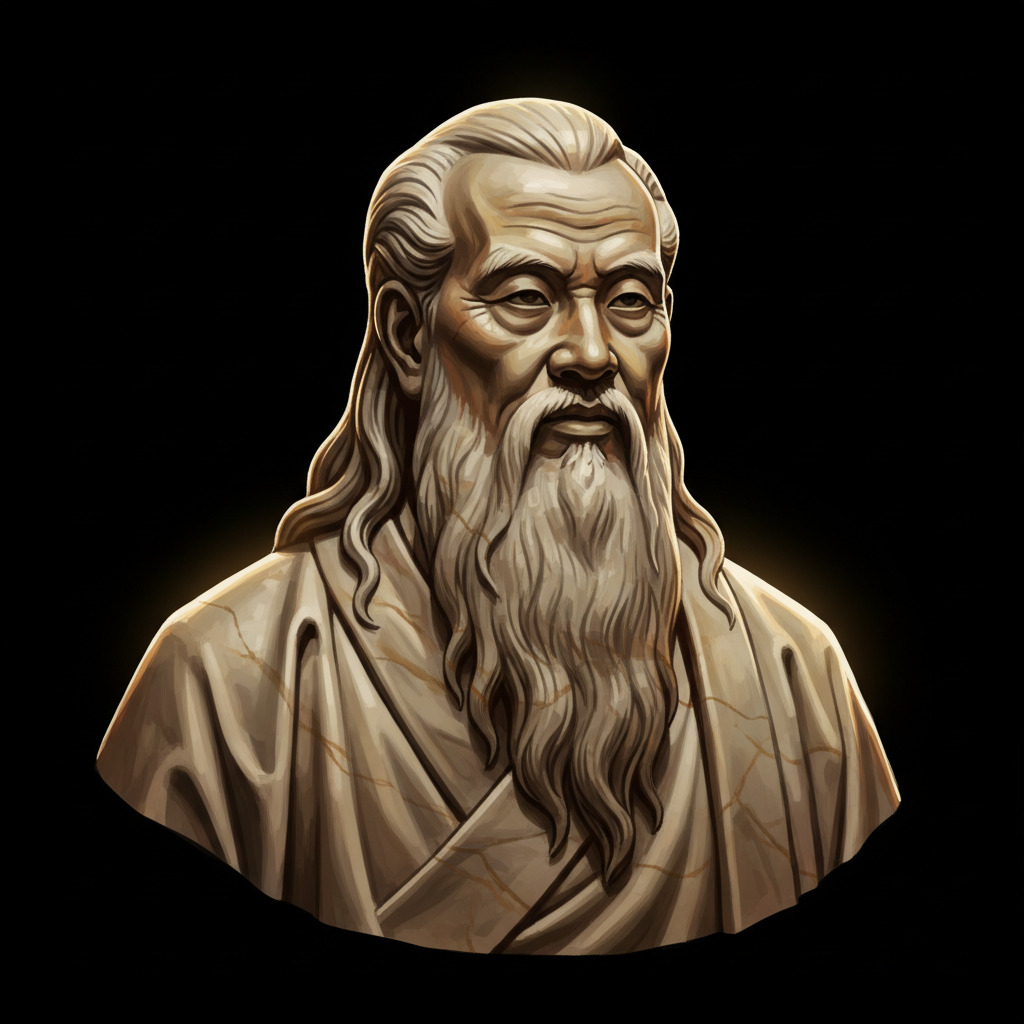
Laozi — "The sage wears rough clothing and holds the jewel in his heart."
The sage wears rough clothing and holds the jewel in his heart.
The sage wears rough clothing and holds the jewel in his heart.
Click any product to generate a realistic preview. Up to 3 at a time.
* Initial load can take up to 90 seconds — revising the preview in another color is nearly instant.
"Fame or integrity: which is more important? Money or happiness: which is more precious?"
"The best fighter is never angry."
"Yield and overcome; Bend and be straight; Empty and be full; Wear out and be new; Have little and gain; Have much and be confused."
"Fill your bowls to the brim and they will spill. Sharpen your blade to the sharpest and it will soon blunt."
"He who knows that enough is enough will always have enough."
Reputed founder of Taoism and author of the Tao Te Ching, whose wu wei (effortless action) shaped East Asian philosophy. Closely associated with Zhuangzi (later Taoist who extended Laozi's framework). For an intellectual contrast, see Confucius, near-contemporary Chinese sage of social ritual and duty — Confucius systematized social order through ritual and hierarchy; Laozi argued that all such systems were the disease, not the cure — the two founding poles of Chinese moral philosophy.
Found in 1 providers: deepseek
1 source checked
True worth hides beneath ordinary appearances. A wise person does not broadcast their wisdom, wealth, or virtue through fancy clothes or loud displays. Instead, they dress simply and carry their real treasure, their inner understanding and moral clarity, quietly within. Outward show is often inversely related to what someone actually holds inside. The person with genuine depth has no need to advertise it, while the shallow constantly need external markers to seem valuable.
Laozi reportedly worked as an archivist in the Zhou royal court, a quiet scholar surrounded by power yet choosing withdrawal over prominence. Legend says he left civilization on a water buffalo, rejecting status entirely. His Tao Te Ching repeatedly praises the uncarved block, the valley, the soft over the hard. This line captures his conviction that the genuine sage cultivates inner Te, inward power, while appearing unremarkable, deliberately avoiding the recognition and hierarchy that Confucian contemporaries chased.
Laozi lived during the late Zhou dynasty, roughly the 6th century BCE, as centralized authority crumbled into the Warring States period. Rival lords waged constant war and competed for talented advisors through lavish courts, titles, and silk robes. Scholars peddled doctrines for patronage. Against this backdrop of ostentatious ambition and performative virtue, praising rough clothing was a pointed rebuke, rejecting the era's arms race of outward prestige in favor of quiet, unrecognized cultivation.
AI-generated insights based on extensive research and information for context. Factual errors? Email [email protected].
Your cart is empty