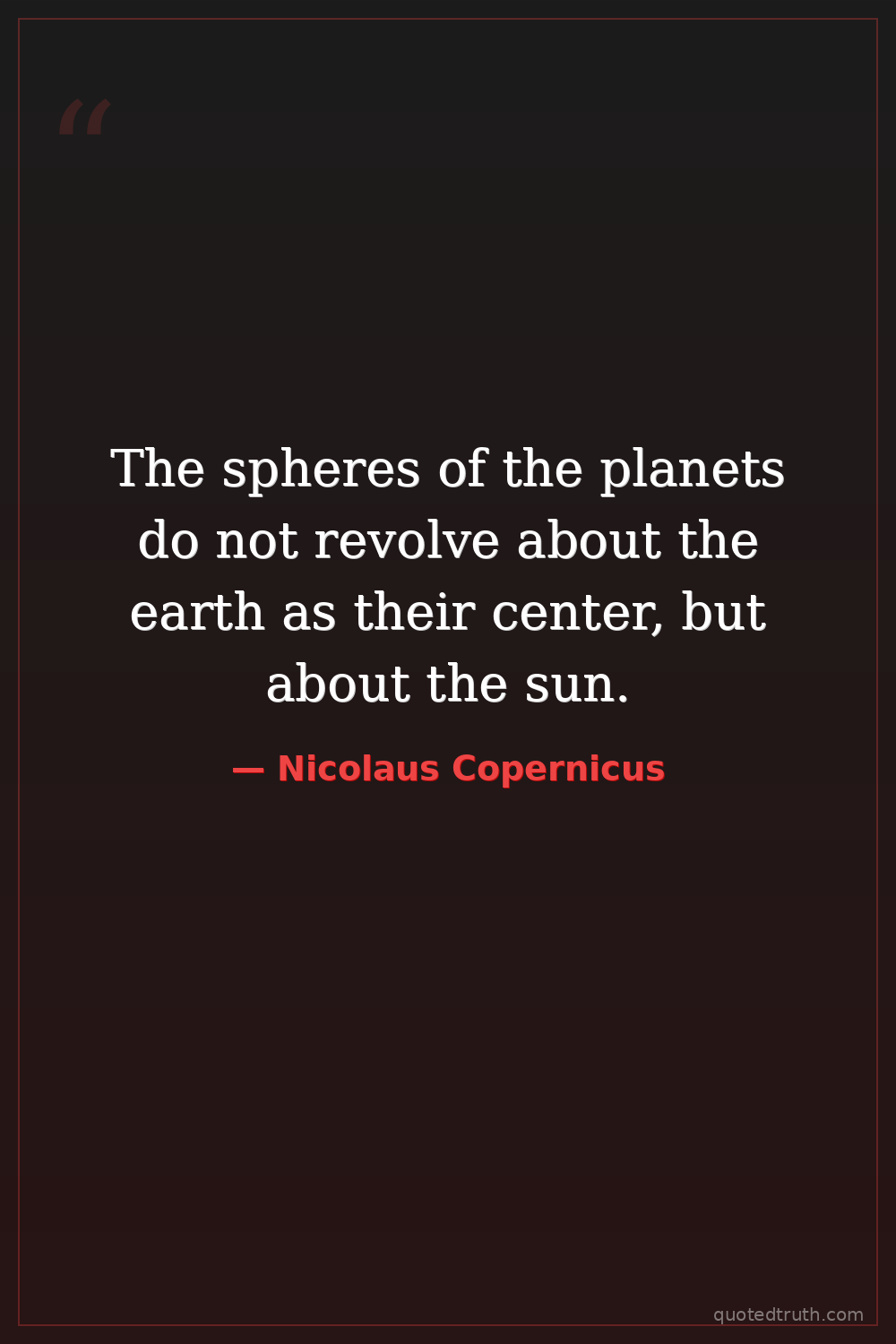
Nicolaus Copernicus — "The spheres of the planets do not revolve about the earth as their center, but a…"
The spheres of the planets do not revolve about the earth as their center, but about the sun.
The spheres of the planets do not revolve about the earth as their center, but about the sun.
Click any product to generate a realistic preview. Up to 3 at a time.
* Initial load can take up to 90 seconds — revising the preview in another color is nearly instant.
"It is the duty of a good astronomer to seek for truth in all things, and to follow it wherever it may lead."
"It is enough if the hypotheses save the phenomena."
"For it is the duty of an astronomer to gather by careful and skilled observation the history of the celestial movements, and then to investigate their causes or hypotheses about them, and then to pred…"
"Indeed, I am aware that a philosopher's thoughts are far removed from the judgment of the multitude, for his aim is to seek the truth in all things, to the extent permitted to human reason by God."
"For what could be more beautiful than the heavens, which contain all things of beauty?"
Found in 1 providers: grok
1 source checked
Planets orbit the sun, not Earth. This rejects the ancient assumption that Earth sits at the universe's center, replacing it with a sun-centered model. Every planet, including Earth, travels in a circular path around the sun. Simple in statement, this claim fundamentally restructured humanity's understanding of our place in the cosmos and launched modern astronomy.
Copernicus spent decades as a Polish canon and amateur astronomer, carefully observing planetary motion. His 1543 masterwork De Revolutionibus Orbium Coelestium presented this heliocentric model after roughly 30 years of calculation. He delayed publishing until near death, knowing the theological and philosophical backlash it would trigger. This sentence is the distilled core of his life's intellectual courage.
In the early 16th century, Ptolemy's Earth-centered cosmology, endorsed by the Catholic Church for over a millennium, was unquestioned doctrine. The Renaissance was reviving classical learning and encouraging empirical observation, but displacing Earth from the center challenged both scripture and Aristotelian philosophy. Copernicus published amid the Reformation, when institutional authority was already fracturing, making his challenge both dangerous and historically possible.
AI-generated insights based on extensive research and information for context. Factual errors? Email [email protected].
Your cart is empty