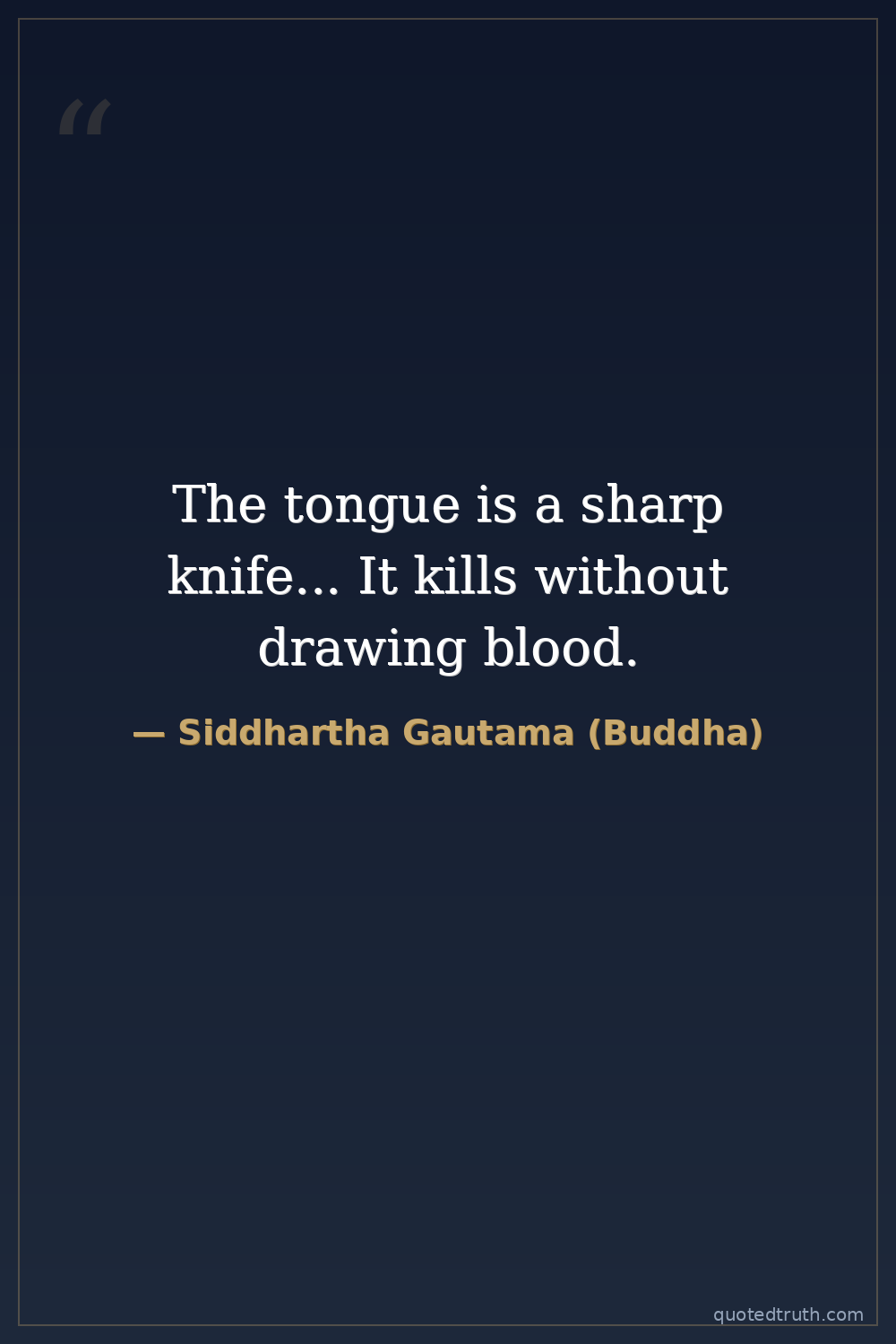
Siddhartha Gautama (Buddha) — "The tongue is a sharp knife... It kills without drawing blood."
The tongue is a sharp knife... It kills without drawing blood.
The tongue is a sharp knife... It kills without drawing blood.
Click any product to generate a realistic preview. Up to 3 at a time.
* Initial load can take up to 90 seconds — revising the preview in another color is nearly instant.
"All wrong-doing arises because of mind. If mind is transformed can wrong-doing remain?"
"Whatever a foe may do to a foe, or a hater to a hater, a wrongly directed mind will do us greater mischief."
"Do not overrate what you have received, nor envy others. He who envies others does not obtain peace of mind."
"If anything is worth doing, do it with all your heart."
"All experiences are preceded by mind, led by mind, made by mind."
Attributed, often cited in various Buddhist texts and teachings.
Date: c. 5th century BCE
Life & DeathFound in 1 providers: grok
1 source checked
Words can inflict serious harm even though they leave no physical wound. A single cruel or careless remark can damage reputations, destroy relationships, crush confidence, and scar someone emotionally for years. Unlike a blade, speech needs no strength or weapon to wound deeply. The saying warns that how we speak matters as much as what we do, urging restraint, mindfulness, and awareness that talking carelessly is itself a form of violence against others.
Right Speech is one of the eight steps on the Buddha's Noble Eightfold Path, the core framework he taught for ending suffering. He explicitly forbade lying, harsh words, divisive talk, and idle chatter, teaching that unwholesome speech generates bad karma and fuels the cycle of rebirth. As a wandering teacher who spent decades guiding disciples through dialogue, he treated mindful speech as inseparable from ethical conduct and mental discipline on the road to enlightenment.
The Buddha lived in 5th-century BCE northern India during the Sramana movement, when wandering ascetics openly challenged the ritual-heavy Brahmanical priesthood. Debate was the main tool of religious competition, and rival teachers often attacked each other verbally in public gatherings sponsored by kings and merchants. Rigid caste hierarchies also policed who could speak to whom. In that charged climate, teaching that harsh words were literal violence was a radical ethical correction aimed at debaters, householders, and monks alike.
AI-generated insights based on extensive research and information for context. Factual errors? Email [email protected].
Your cart is empty