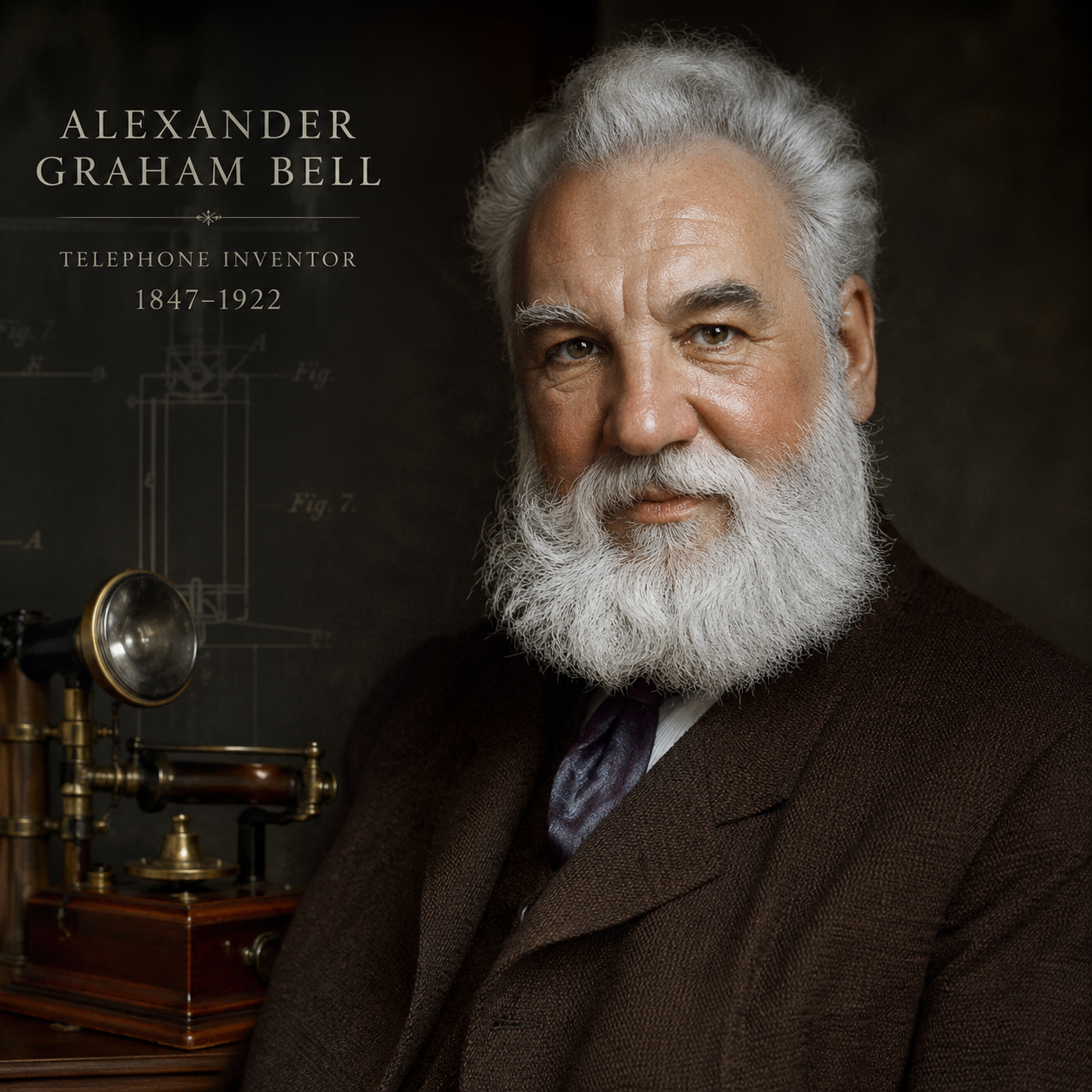
Alexander Graham Bell — "The true inventor is not the one who first conceives an idea, but the one who br…"
The true inventor is not the one who first conceives an idea, but the one who brings it to fruition.
The true inventor is not the one who first conceives an idea, but the one who brings it to fruition.
Click any product to generate a realistic preview. Up to 3 at a time.
* Initial load can take up to 90 seconds — revising the preview in another color is nearly instant.
"The most successful men in the end are those whose success is the result of steady accretion."
"The telephone will be a great convenience to business men, but it will never be used by the general public."
"What this power is I cannot say; all I know is that it exists and it becomes available only when a man is in that state of mind in which he knows exactly what he wants and is fully determined not to g…"
"I am a man of science, and I believe in the power of observation and experimentation."
"I have never seen the slightest scientific proof of the religious theories of the creation of the world, and I do not believe any such proof will be found."
Found in 1 providers: grok
1 source checked
Imagination alone doesn't make someone an inventor. True invention requires persistence through obstacles until an idea becomes a functioning, tangible reality. Anyone can conceive of communicating over distance — the inventor is the one who actually builds the telephone. Credit and recognition belong to those who do the hard work of completion, not just those struck by inspiration first.
Bell's 1876 telephone patent victory over Elisha Gray illustrates this exactly — Gray conceived a similar device but Bell filed with a working system. Bell spent years translating acoustics research, work with deaf students, and telegraphic experiments into a functioning prototype. His later inventions — the photophone, audiometer, and metal detector — all reflected this same pattern: rigorous execution beyond the initial concept.
The 1870s–1880s saw explosive parallel invention — Bell, Edison, Tesla, and Gray often raced toward identical breakthroughs simultaneously. Patent law made timing legally decisive, but the Industrial Revolution demanded more than priority claims: investors required working, manufacturable products. This era established invention as economic enterprise, not merely intellectual achievement. Bell's quote reflects a pragmatic ethos born directly from that fiercely competitive, rapidly commercializing industrial moment.
AI-generated insights based on extensive research and information for context. Factual errors? Email [email protected].
Your cart is empty