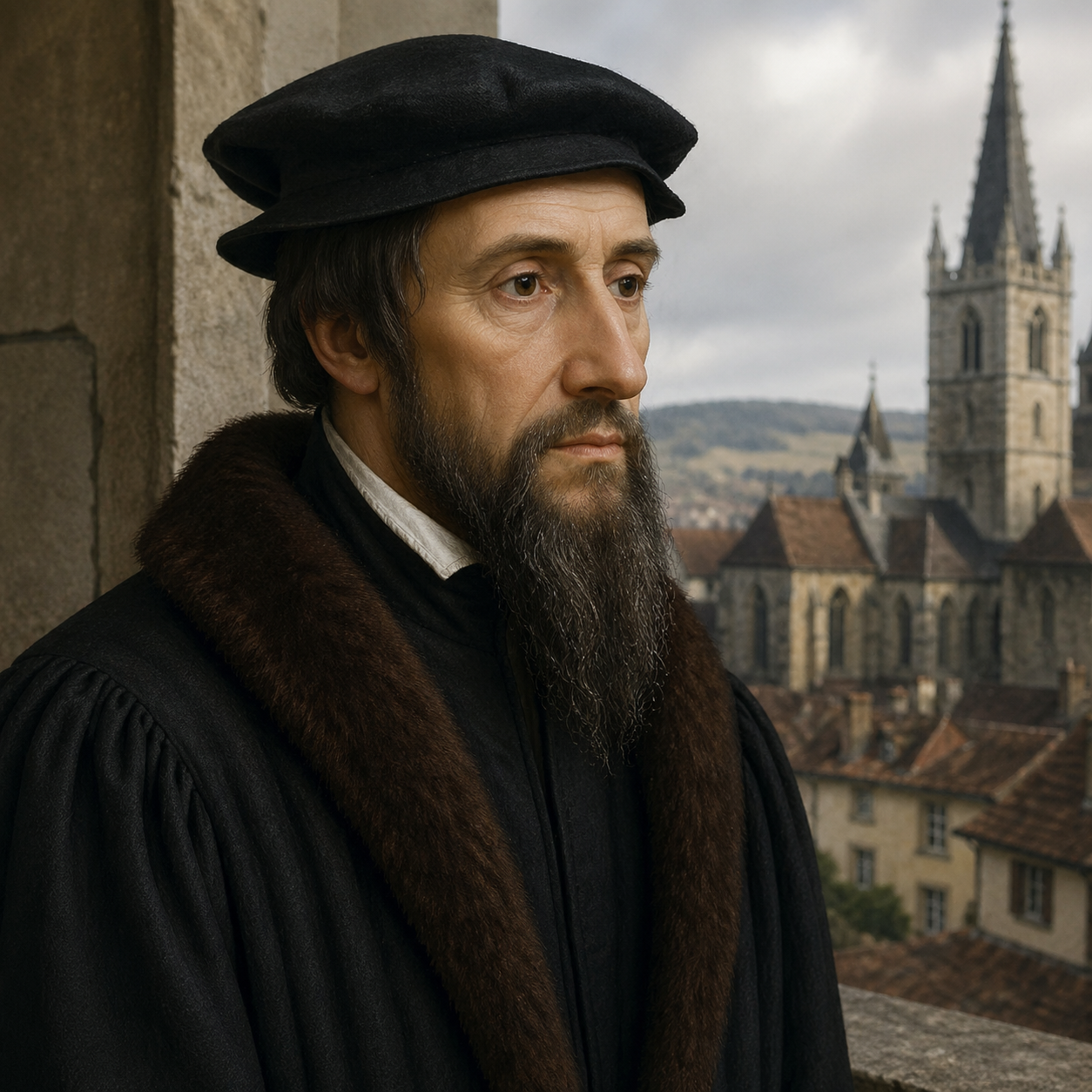
John Calvin — "The true knowledge of God consists in acknowledging him as our Father and Lord."
The true knowledge of God consists in acknowledging him as our Father and Lord.
The true knowledge of God consists in acknowledging him as our Father and Lord.
Click any product to generate a realistic preview. Up to 3 at a time.
* Initial load can take up to 90 seconds — revising the preview in another color is nearly instant.
"For the mind of man, when it has once been infected with this pest, is so utterly perverse that it is with difficulty restrained from framing for itself, after the example of the devil, some new and u…"
"God's providence is not only general, but extends to all the particular facts of life."
"Ignorance of predestination is a great evil, because it deprives us of the knowledge of God's glory."
"Whence it is sufficiently plain that they are not chosen for their own merit, but because God has gratuitously chosen them."
"The elect are saved by grace, and the reprobate are damned by justice."
French theologian whose Institutes of the Christian Religion (1536) systematized Protestant Reformed doctrine, including predestination. Closely associated with Martin Luther (Reformation founder, Calvin's predecessor). For an intellectual contrast, see Jacobus Arminius, Dutch Reformed theologian (1560-1609) — Arminius's rejection of strict double-predestination founded Arminianism — the theological tradition modern Methodism, most evangelicalism, and Pentecostalism descend from. The Calvinist-Arminian debate has divided Protestantism for 400 years.
Found in 1 providers: grok
1 source checked
This quote argues that genuine understanding of God is not merely intellectual or doctrinal—it is relational. Knowing God truly means recognizing him in two roles: as Father, offering intimacy, care, and covenant love, and as Lord, holding absolute authority and commanding obedience. Calvin insists real theology transforms how we relate to God personally, not just what we believe abstractly about him.
Calvin spent his career in Geneva systematizing Protestant theology through his Institutes of the Christian Religion. His entire framework rests on God's sovereignty and covenant relationship with humanity. This quote distills his dual emphasis: God as sovereign Lord—the bedrock of Calvinist predestination—and as Father to the elect, chosen by grace. That pairing defined his pastoral and theological life's work.
The sixteenth-century Reformation shattered Catholic Europe's assumption that the Church mediated all knowledge of God. Calvin wrote as Protestant and Catholic factions fought bloody wars over authority and salvation. Against scholastic theology defining God through philosophy, and Catholic priests controlling sacramental access, Calvin's claim that knowing God is simply acknowledging Father and Lord was a radical, democratizing act.
AI-generated insights based on extensive research and information for context. Factual errors? Email [email protected].
Your cart is empty