James Clerk Maxwell — "The true logic of this world is in the calculus of probabilities."
The true logic of this world is in the calculus of probabilities.
The true logic of this world is in the calculus of probabilities.
Click any product to generate a realistic preview. Up to 3 at a time.
* Initial load can take up to 90 seconds — revising the preview in another color is nearly instant.
"I have been thinking about the nature of things, and I have come to the conclusion that there is a good deal of it."
"The world may be utterly crazy, and life may be labour in vain; But I'd rather be silly than lazy, and would not quit life for its pain."
"It is an unscientific habit to give names to things before we know what they are."
"In the very beginning of science, the parsons, who managed things then, Being handy with hammer and chisel, made gods in the likeness o' men; Till Commerce arose and at length some men of exceptional …"
"The mind of man is like a mirror, which reflects the images of things, but does not always reflect them truly."
Found in 1 providers: grok
1 source checked
Reality does not operate on rigid certainties but on likelihoods. To truly understand how the world works, you must think in terms of odds, distributions, and statistical patterns rather than absolute cause-and-effect. Predicting outcomes, whether for particles, weather, or human behavior, requires reasoning about what is probable, not what is guaranteed. Probability is the honest framework for navigating a universe filled with noise, uncertainty, and countless interacting variables.
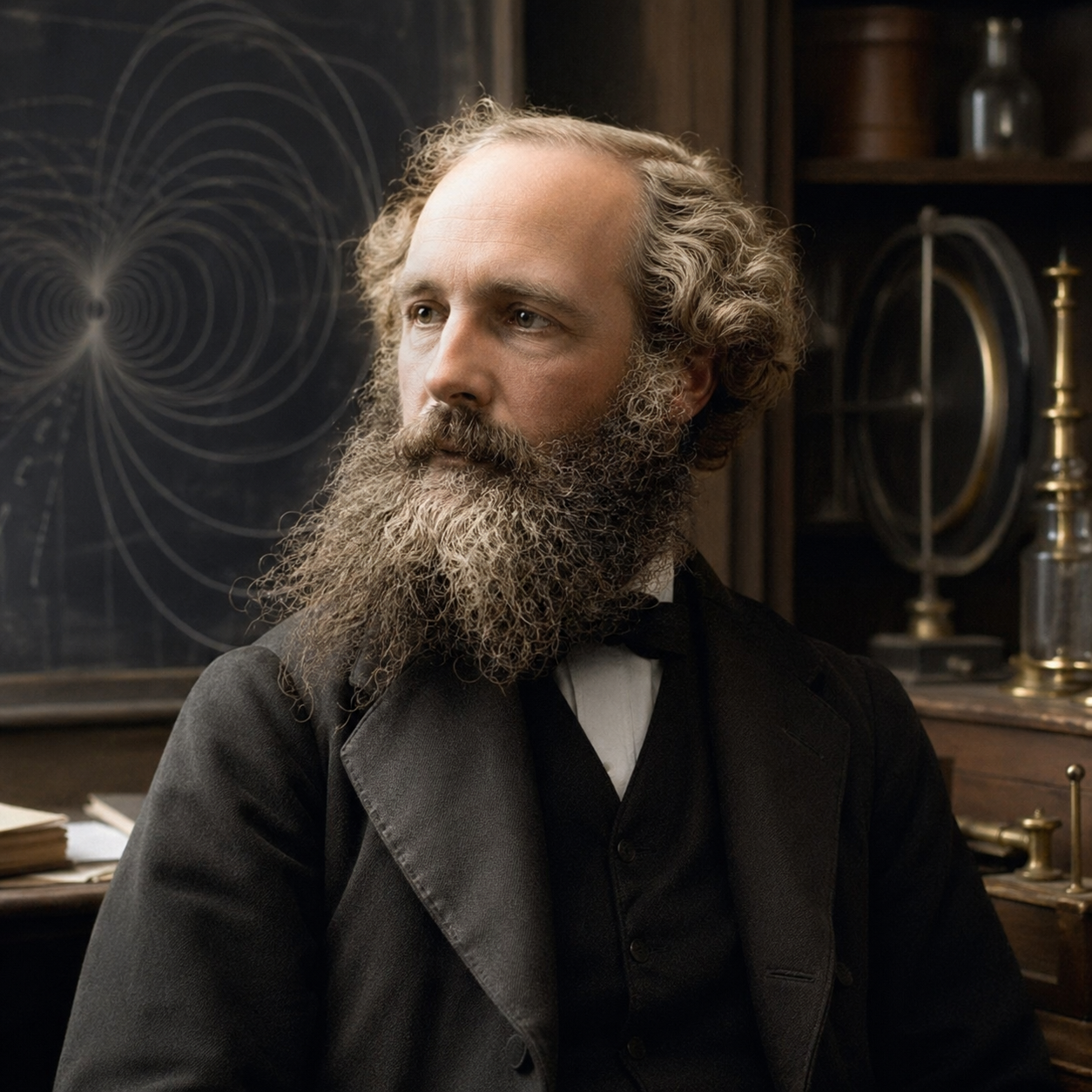
Maxwell pioneered statistical mechanics, deriving the Maxwell-Boltzmann distribution describing how gas molecules spread across velocities. Rather than tracking each particle, he treated molecular behavior probabilistically, revolutionizing physics. A devout Presbyterian and rigorous mathematician, he saw probability not as ignorance but as the proper language for complex systems. His electromagnetic equations were deterministic, yet his molecular work embraced randomness, foreshadowing quantum mechanics and cementing his belief that chance underlies natural law.
Maxwell worked in Victorian Britain (1831-1879), when Newtonian determinism dominated science and Laplace's clockwork universe was gospel. The Industrial Revolution demanded understanding of heat, steam, and gases, driving thermodynamics forward. Darwin's 1859 Origin introduced randomness into biology, and actuarial science was formalizing risk. Maxwell's embrace of probability defied the era's mechanistic confidence, planting seeds for twentieth-century physics where Einstein, Bohr, and Heisenberg would wrestle with whether God truly played dice.
AI-generated insights based on extensive research and information for context. Factual errors? Email [email protected].
Your cart is empty