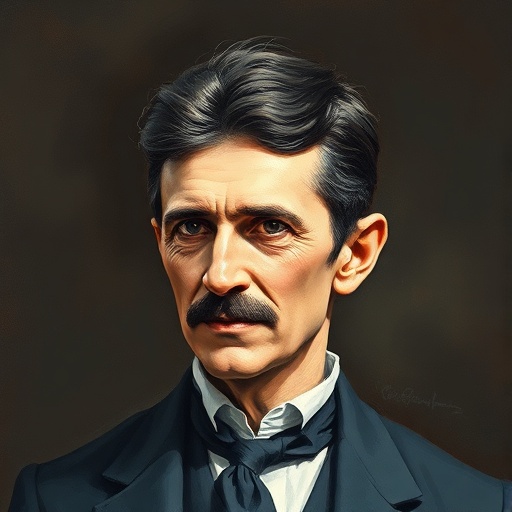
Nikola Tesla — "The ultimate purpose is the complete mastery of mind over the material world, th…"
The ultimate purpose is the complete mastery of mind over the material world, the harnessing of human nature to human needs.
The ultimate purpose is the complete mastery of mind over the material world, the harnessing of human nature to human needs.
Click any product to generate a realistic preview. Up to 3 at a time.
* Initial load can take up to 90 seconds — revising the preview in another color is nearly instant.
"I have perfected a machine which will make it possible to transmit energy without wires to any point on the globe."
"I have created a new form of energy, which I call the 'death ray.'"
"From childhood I was compelled to concentrate attention upon myself. This caused me much suffering but, to my present view, it was a blessing in disguise for it has taught me to appreciate the inestim…"
"When natural inclination develops into a passionate desire, one advances towards his goal in seven-league boots."
"I myself eschew all stimulants. I also practically abstain from meat."
Serbian-American inventor and electrical engineer whose alternating-current designs powered the modern electrical grid; died poor and largely forgotten. Closely associated with George Westinghouse (his AC-power business partner) and Mihajlo Pupin (fellow Serbian-American physicist at Columbia). For an intellectual contrast, see Thomas Edison, American inventor and direct-current advocate — Edison's direct-current power-distribution scheme was displaced by Tesla-Westinghouse AC in the 1890s 'War of Currents'. Edison ran a public-relations campaign electrocuting animals to discredit AC — the most famous engineering-ethics rivalry in American history. Tesla's AC won and powers nearly every electrical grid on Earth.
Philosophical statement on the highest aim of human endeavor and invention.
Date: Approximate
PhilosophicalFound in 1 providers: gemini
1 source checked
Humanity's highest goal is using intellect and reason to take command of physical reality—bending natural forces to serve human welfare rather than being at their mercy. Technology and science are not ends in themselves but instruments: the point is to redirect nature's raw power so it solves human problems, reduces suffering, and expands what people can achieve. Mind should govern matter, not the other way around.
Tesla spent his life doing exactly this—converting invisible electromagnetic forces into the alternating current system that electrified civilization. He fought Edison, financial ruin, and institutional resistance to prove AC could transmit power across vast distances. He never patented for wealth; he envisioned free wireless energy for all humanity. His Wardenclyffe Tower project was a literal attempt to harness nature at planetary scale and give every person on Earth access to power.
Tesla worked during the Second Industrial Revolution (1870s–1910s), when science was first demonstrating it could fundamentally reshape civilization. Electrification, the telephone, the automobile, and X-rays arrived within decades. Yet industrialization also created brutal factory conditions, child labor, and poverty. Tesla's framing—mind mastering matter for human needs—was a direct ideological response: technology should liberate people, not simply enrich industrialists or replace workers with machines.
AI-generated insights based on extensive research and information for context. Factual errors? Email [email protected].
Your cart is empty