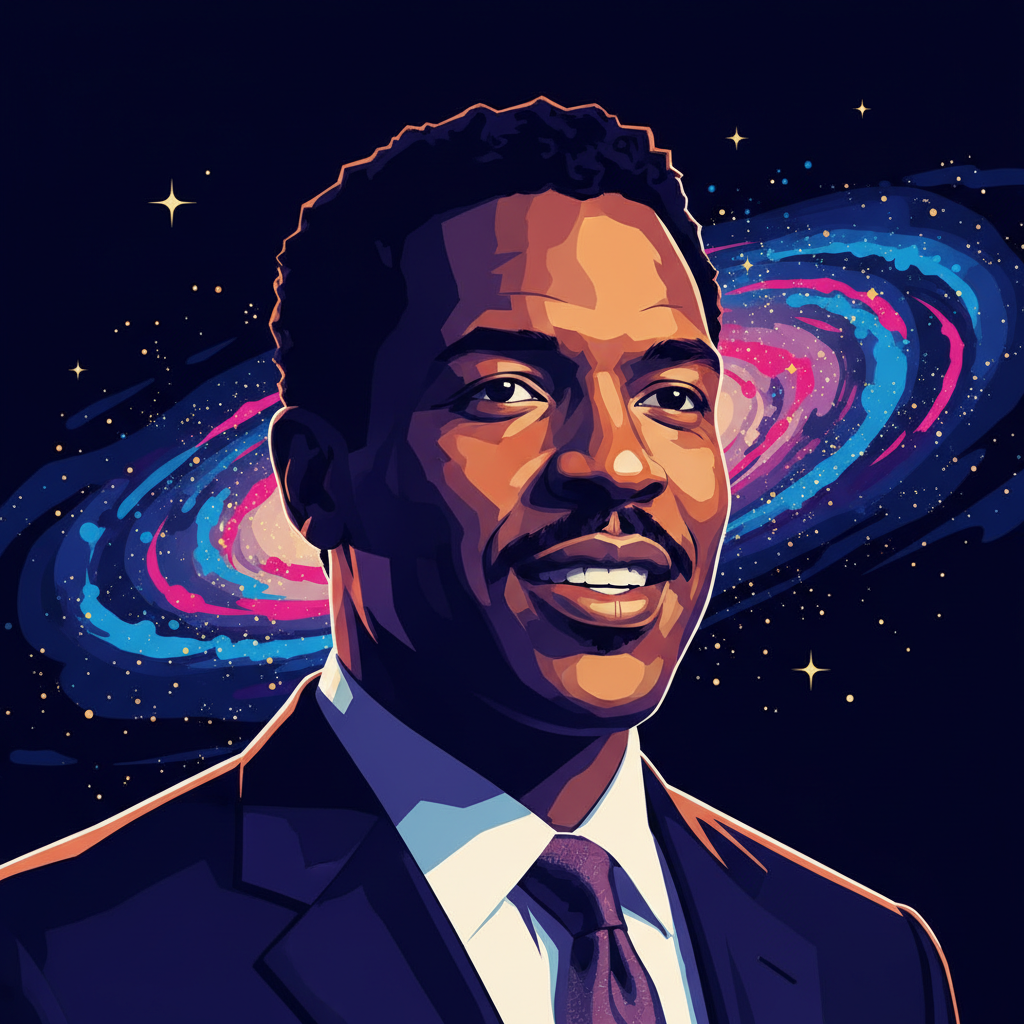
Neil deGrasse Tyson — "The universe is not about you. It's about everything."
The universe is not about you. It's about everything.
The universe is not about you. It's about everything.
Click any product to generate a realistic preview. Up to 3 at a time.
* Initial load can take up to 90 seconds — revising the preview in another color is nearly instant.
"Earth is a small planet, and we are not alone. We are not alone in the universe, and we are not alone on this planet."
"We don't have enough laws to stop stupid people from doing stupid things."
"If I had a superpower, it would be to make everyone scientifically literate. Imagine the world we'd live in."
"I'm not saying I'm a superhero, but I do have a cape. It's called a lab coat."
"The universe is a dangerous place. It's full of black holes and gamma-ray bursts."
American astrophysicist, Hayden Planetarium director, and Cosmos: A Spacetime Odyssey host who carries the Carl Sagan public-science mantle. Closely associated with Bill Nye (fellow science communicator) and Brian Greene (theoretical physicist and string-theory popularizer). For an intellectual contrast, see Ken Ham, founder of Answers in Genesis and the Creation Museum — Ham's career has been organized around defending biblical 6-day creationism — exactly the science-education position Tyson's mainstream-science communication is structured to refute.
Found in 1 providers: grok
1 source checked
The universe operates on scales of space and time that dwarf human existence entirely. Our problems, identities, and ambitions matter enormously to us but register as nothing cosmically. This is a call for perspective: the cosmos existed 13.8 billion years before humans arrived and will continue long after. True wonder emerges when you expand your view beyond personal concerns to appreciate the totality of existence.
Tyson has devoted his career to translating the cosmos for everyday audiences through StarTalk, Cosmos: A Spacetime Odyssey, and his directorship of New York's Hayden Planetarium. His signature concept of the cosmic perspective argues that understanding our insignificance is liberating, not depressing. He frequently invokes the pale blue dot framing—Earth orbiting an ordinary star among hundreds of billions, in one galaxy among trillions—as the foundation of intellectual humility.
Tyson rose to cultural prominence during peak self-focus: social media amplifying personal brands, influencer culture, political tribalism, and identity-centered discourse. Simultaneously, science delivered humbling revelations—the 2019 first black hole photograph, gravitational wave detection, thousands of confirmed exoplanets. His era also saw alarming anti-science movements including flat-earth resurgence and vaccine skepticism. Reminding audiences that the universe predates and transcends human concerns carried genuine urgency against that backdrop.
AI-generated insights based on extensive research and information for context. Factual errors? Email [email protected].
Your cart is empty