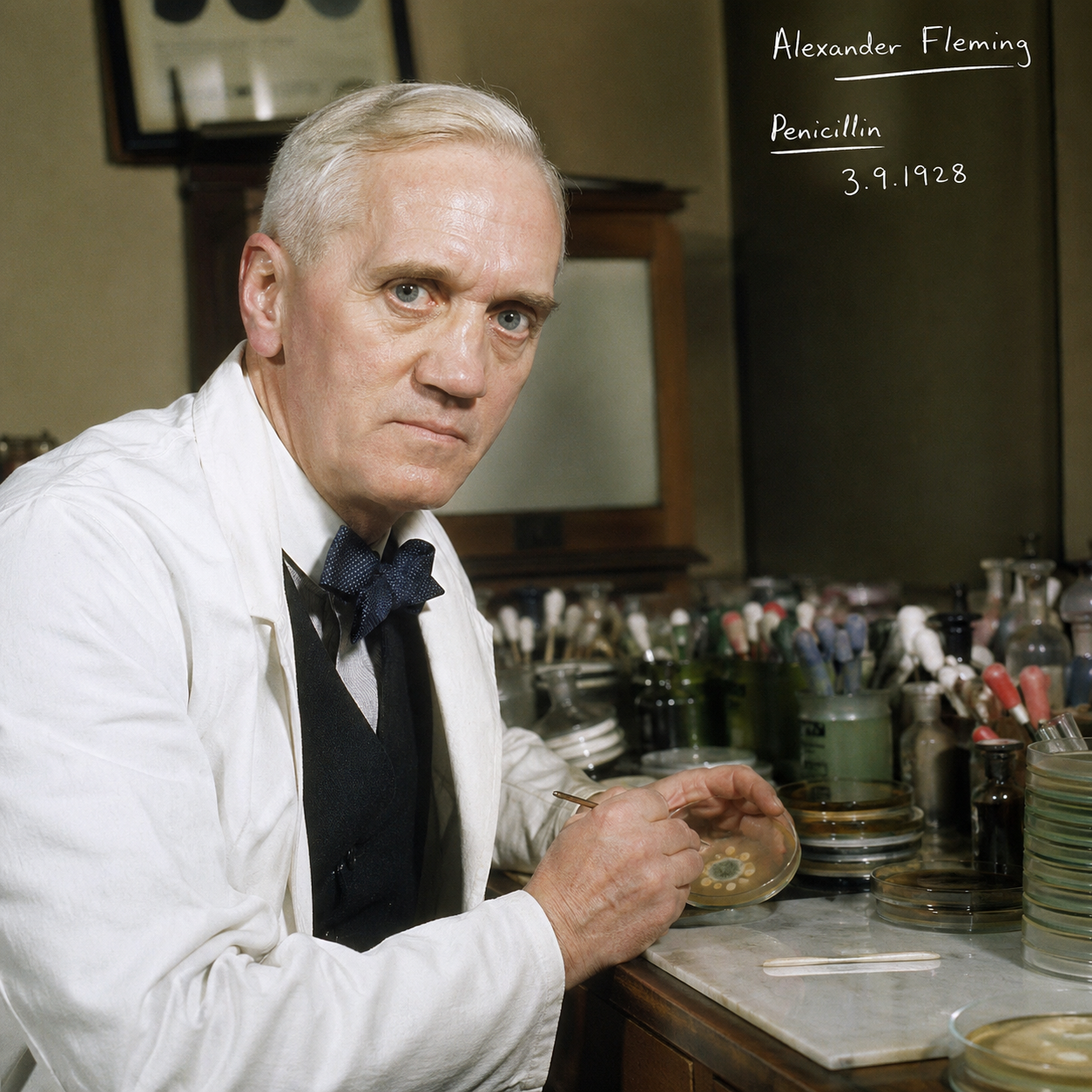
Alexander Fleming — "The unprepared mind cannot see the outstretched hand of opportunity."
The unprepared mind cannot see the outstretched hand of opportunity.
The unprepared mind cannot see the outstretched hand of opportunity.
Click any product to generate a realistic preview. Up to 3 at a time.
* Initial load can take up to 90 seconds — revising the preview in another color is nearly instant.
"It is the common lot of discoverers to be misunderstood."
"One sometimes finds what one is not looking for."
"It is a matter of great satisfaction to see penicillin saving so many lives."
"I have been fortunate in my life to have seen the benefits of my discovery."
"The greatest discovery of my life was not penicillin, but the fact that I was wrong about something."
Found in 1 providers: deepseek
1 source checked
Readiness determines whether you recognize opportunity when it arrives. Most people let chance encounters pass unnoticed because they lack the knowledge, training, or mental alertness to understand what they're seeing. Preparation isn't just technical skill—it's cultivating a mind attuned to recognizing significance in the unexpected. Luck alone means nothing without the awareness to act on it. The opportunity reaches out; the unprepared simply don't see the hand.
Fleming's 1928 penicillin discovery happened because a contaminated petri dish caught his trained eye rather than ending in the trash. Years earlier, he'd discovered lysozyme in nasal mucus—proof his mind actively hunted patterns others ignored. His wartime service treating infected battlefield wounds sharpened his obsession with bacterial killers. When that mold destroyed bacteria around it, his decades of preparation made him the one scientist who stopped to ask why.
Fleming worked during an era when bacterial infection was humanity's greatest killer. World War I claimed more lives to sepsis and gangrene than bullets. By the 1920s, germ theory was established but antibiotics didn't exist—a simple wound could be fatal. Medical science was racing to understand bacterial pathogens while surgery remained brutally limited by post-operative infection. Fleming's discovery arrived precisely when civilization most desperately needed a weapon against invisible microbial enemies.
AI-generated insights based on extensive research and information for context. Factual errors? Email [email protected].
Your cart is empty