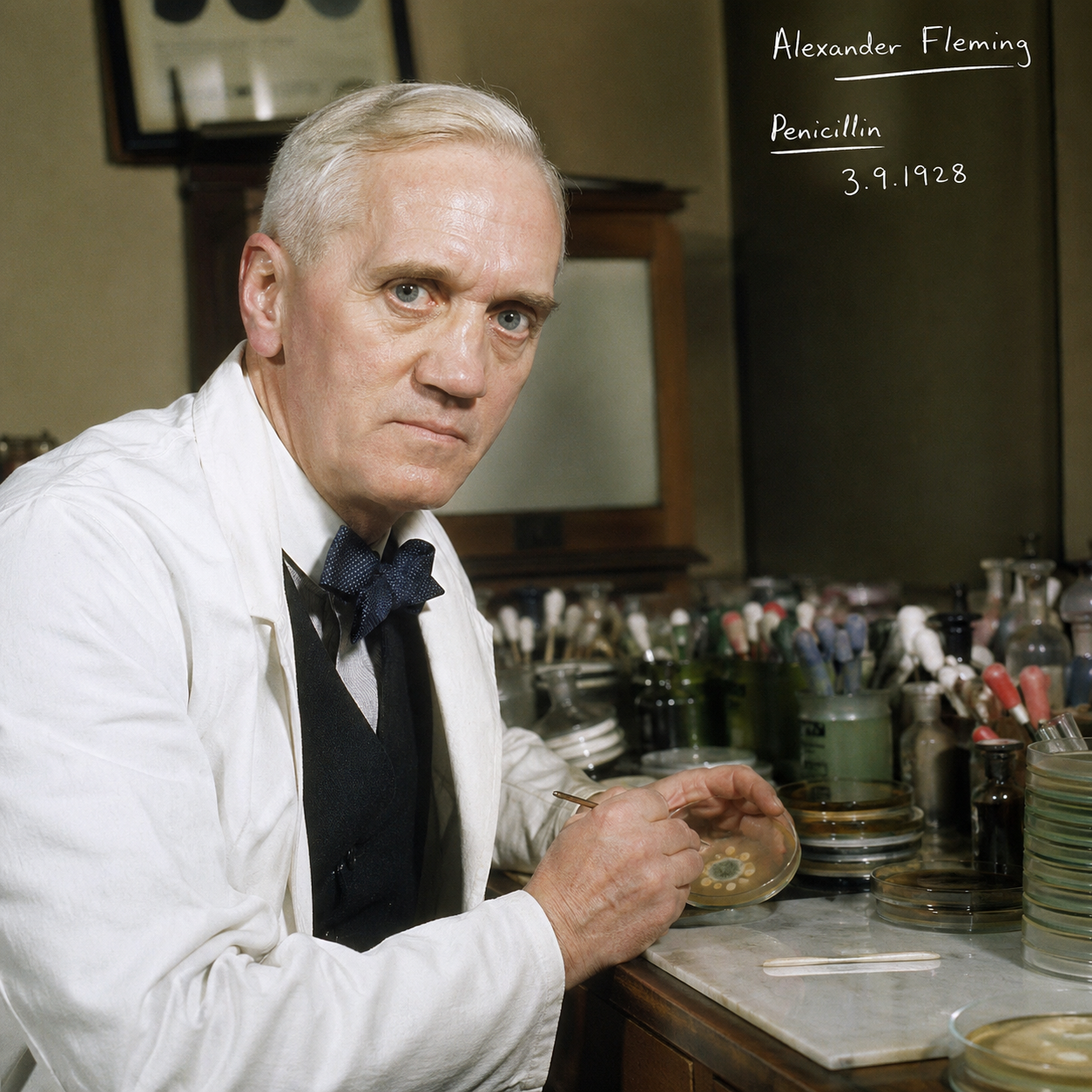
Alexander Fleming — "The mere fact that a substance has bactericidal powers does not mean that it can…"
The mere fact that a substance has bactericidal powers does not mean that it can be used for the treatment of septic infections.
The mere fact that a substance has bactericidal powers does not mean that it can be used for the treatment of septic infections.
Click any product to generate a realistic preview. Up to 3 at a time.
* Initial load can take up to 90 seconds — revising the preview in another color is nearly instant.
"I had no idea that I would be involved in such a great discovery. It was purely accidental."
"I had no idea at the time that I was making a discovery that would change the course of medicine."
"It is a remarkable fact that this substance, which is so potent against bacteria, is almost harmless to animal tissues."
"I am just a simple bacteriologist who got lucky."
"A good gulp of hot whisky at bedtime—it's not very scientific, but it helps."
Found in 1 providers: grok
1 source checked
Killing bacteria in a test tube is not the same as curing an infection in a living patient. A substance may destroy bacteria under controlled conditions yet fail clinically because it breaks down inside the body, cannot reach the infection site, damages healthy tissue, or loses potency in blood serum. Laboratory results must be validated through rigorous biological testing before any compound can be trusted as a real treatment.
Fleming discovered lysozyme in 1922 — an enzyme in tears and mucus that kills bacteria — but it couldn't penetrate deep tissues and proved clinically useless against most infections. That experience hardened his skepticism. When penicillin mold killed bacteria on his plate in 1928, he again stopped short of declaring a cure. His caution proved correct: it took Florey and Chain another decade to solve stability and dosing before penicillin became medicine.
In the 1920s–40s, bacteriologists were testing hundreds of compounds — coal tar dyes, heavy metals, antiseptics — that killed bacteria in vitro but poisoned patients or degraded inside the body. Paul Ehrlich's 'magic bullet' concept drove frenzied, often reckless experimentation. Septic infections from war wounds and routine surgery remained a leading cause of death. Fleming's warning was a direct corrective to widespread premature clinical optimism that had repeatedly wasted resources and harmed patients.
AI-generated insights based on extensive research and information for context. Factual errors? Email [email protected].
Your cart is empty