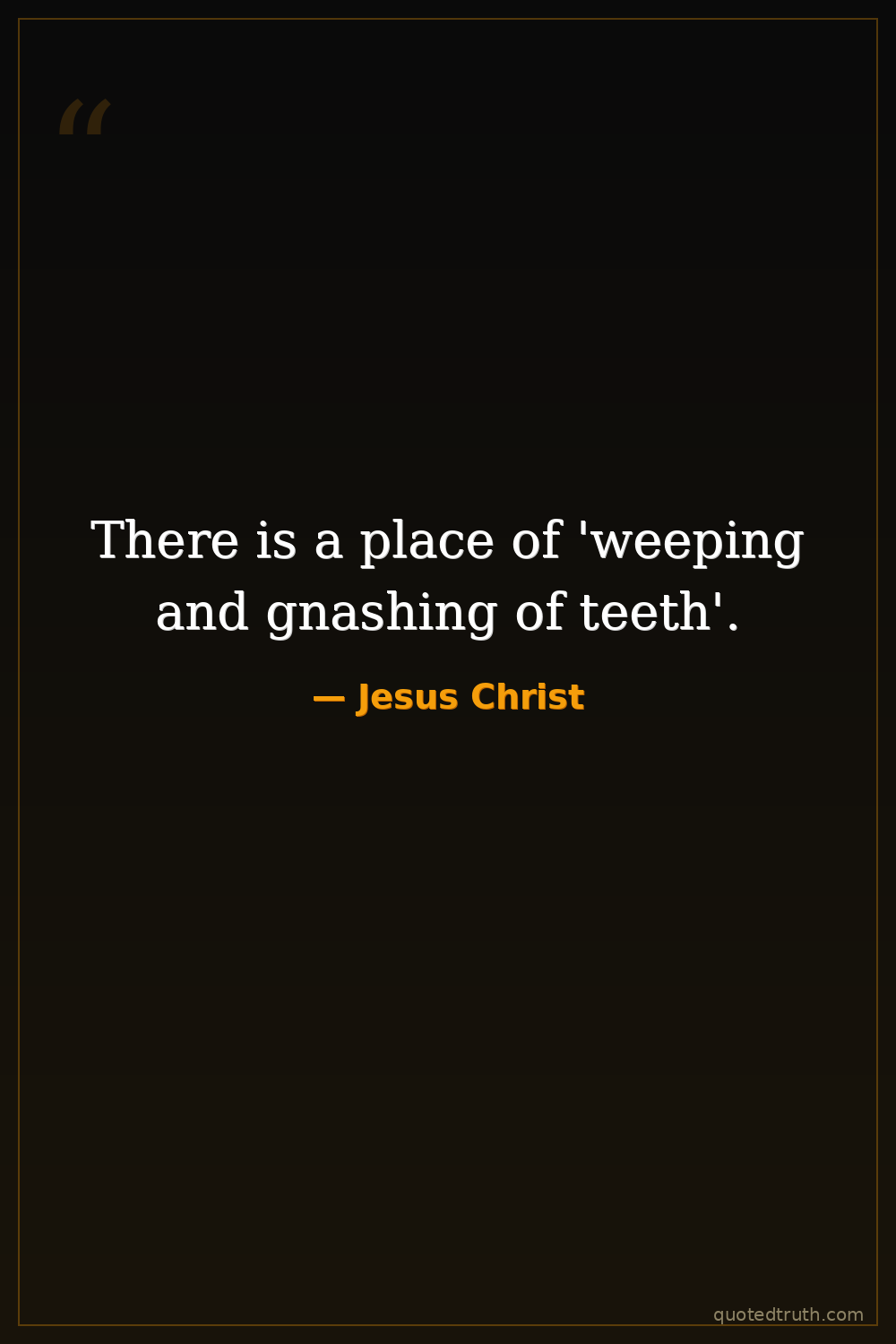
Jesus Christ — "There is a place of 'weeping and gnashing of teeth'."
There is a place of 'weeping and gnashing of teeth'.
There is a place of 'weeping and gnashing of teeth'.
Click any product to generate a realistic preview. Up to 3 at a time.
* Initial load can take up to 90 seconds — revising the preview in another color is nearly instant.
"For what is exalted among men is an abomination in the sight of God."
"For to everyone who has, more will be given, and he will have abundance. But from the one who has not, even what he has will be taken away."
"Truly, I say to you, it will be more bearable on the day of judgment for the land of Sodom and Gomorrah than for that town."
"But if anyone slaps you on the right cheek, turn to him the other also."
"Let the dead bury their own dead."
Gospel of Matthew 13:42, 50; 22:13; 24:51; 25:30, describing the fate of the wicked.
Date: c. 30-33 CE
ShockingFound in 1 providers: gemini
1 source checked
This warns of a real destination marked by deep regret and anguish for those who reject divine truth or live unjustly. The imagery conveys sorrow so intense it produces tears and a grinding of teeth from frustration, rage, or pain. It's a sobering declaration that choices carry lasting consequences beyond this life, and that moral accountability is not a metaphor but a destination one can actually arrive at.
Jesus used this phrase repeatedly in Matthew's Gospel to describe the fate awaiting the unfaithful, hypocrites, and those cast out of the kingdom. As a Jewish rabbi and the founder of Christianity, he taught divine judgment alongside radical mercy, insisting listeners choose between two paths. His willingness to name hell concretely reflected his conviction that eternal stakes underwrote every ethical demand he made of his followers.
In first-century Roman-occupied Judea, apocalyptic expectation ran high among Jews suffering under imperial rule and temple corruption. Pharisees, Sadducees, and Essenes debated resurrection, judgment, and the afterlife fiercely. Jesus spoke into this charged climate, where Gehenna—a smoldering refuse valley outside Jerusalem—served as a vivid local metaphor for divine punishment. His audiences, steeped in prophetic literature like Daniel and Isaiah, immediately grasped the weight of such imagery invoking final reckoning.
AI-generated insights based on extensive research and information for context. Factual errors? Email [email protected].
Your cart is empty