Martin Luther — "They must be driven from our country."
They must be driven from our country.
They must be driven from our country.
Click any product to generate a realistic preview. Up to 3 at a time.
* Initial load can take up to 90 seconds — revising the preview in another color is nearly instant.
"So when the devil throws your sins in your face and declares that you deserve death and hell, tell him this: 'I admit that I deserve death and hell, what of it? For I know One who suffered and made sa…"
"You abominable abomination."
"The dog is the most faithful of animals and would be much esteemed were it not so common. Our Lord God has made His greatest gifts the commonest."
"God does many things that he does not disclose to us in his word; he also wills many things which he does not disclose himself as willing in his word. Thus he does not will the death of a sinner, acco…"
"The stomach is the greatest lord on earth."
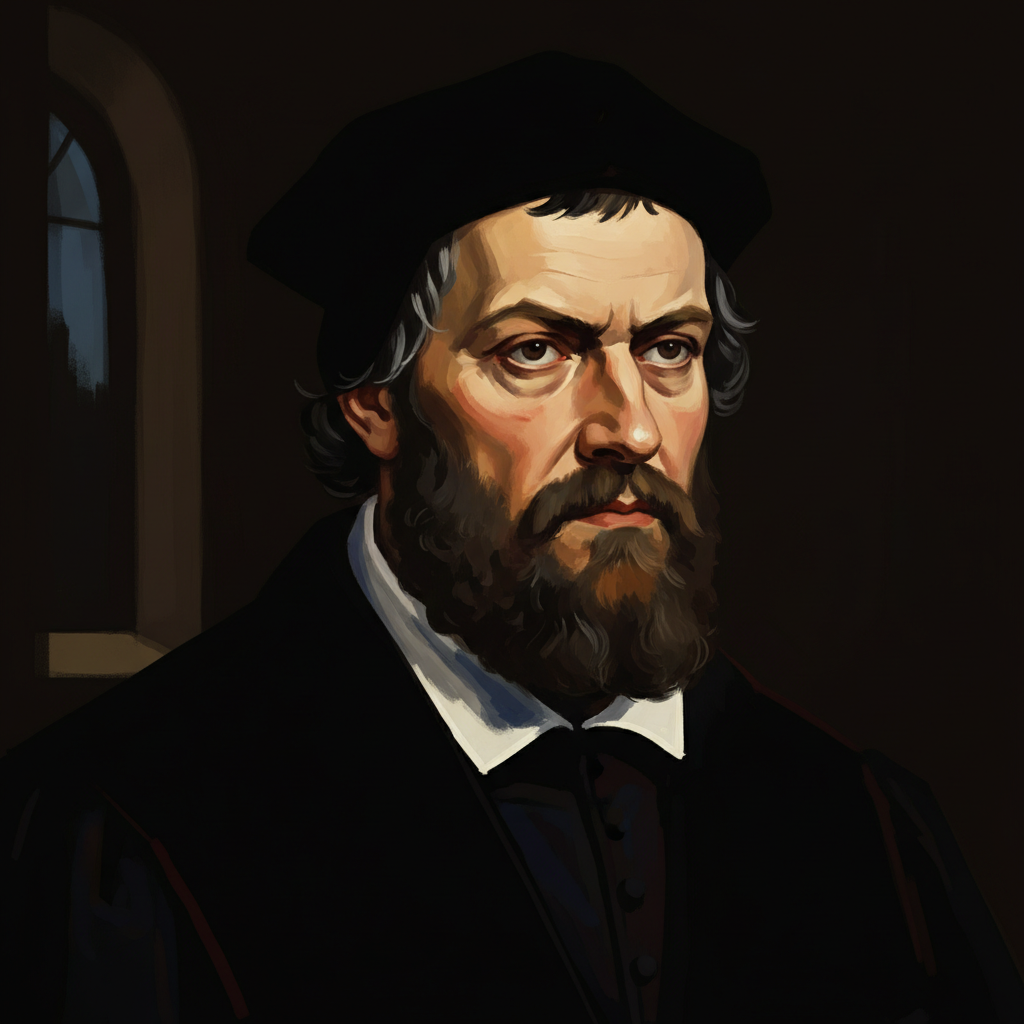
German theologian whose 95 Theses (1517) launched the Protestant Reformation and broke the Catholic Church's monopoly on Western Christianity. Closely associated with Philipp Melanchthon (Lutheran systematizer) and John Calvin (later Reformer who built on Luther's break). For an intellectual contrast, see Pope Leo X, Renaissance pope (1513-1521) — Leo X's indulgence sales triggered Luther's break and Leo excommunicated him in 1521 — Luther's entire Reformation is structured as a direct answer to the indulgence-funded Vatican Leo represented.
Found in 1 providers: gemini
1 source checked
This statement calls for the expulsion of a specific group of people from a nation. It frames removal as a necessity rather than a choice, treating certain inhabitants as threats who cannot be tolerated within the community. The language is blunt and absolute, leaving no room for coexistence, negotiation, or reform. It expresses a hardened stance where physical separation is viewed as the only acceptable solution to perceived social, religious, or political problems.
Luther wrote this in his 1543 treatise On the Jews and Their Lies, urging German princes to expel Jewish communities, burn synagogues, and destroy homes. Though celebrated for challenging papal authority and translating the Bible into German, his late writings reveal a darker side of his character. His theological convictions hardened into virulent antisemitism when Jews refused to convert to his reformed Christianity, producing rhetoric later cited approvingly by Nazi propagandists.
The early modern period saw Jews across Europe confined to ghettos, expelled from Spain (1492) and numerous German territories, and subjected to blood libel accusations. Reformation upheaval intensified religious polarization, as Protestants and Catholics each sought doctrinal purity within their territories. The 1555 Peace of Augsburg's principle of cuius regio, eius religio reinforced the idea that rulers should enforce uniform faith, making minority communities vulnerable to state-sanctioned expulsion throughout Luther's era.
AI-generated insights based on extensive research and information for context. Factual errors? Email [email protected].
Your cart is empty