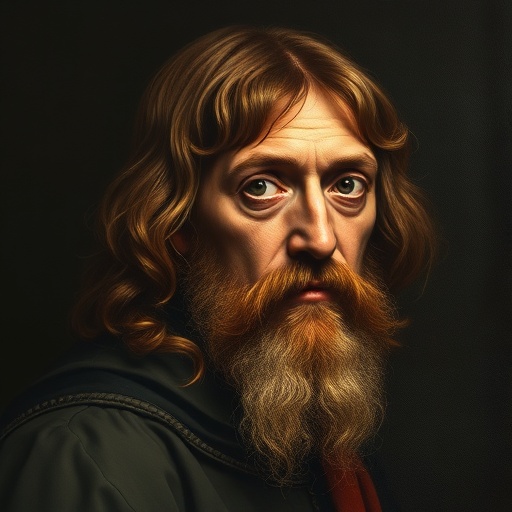
Nicolaus Copernicus — "Thus, the Sun, remaining in one place, illuminates all the planets equally, as i…"
Thus, the Sun, remaining in one place, illuminates all the planets equally, as if it were a candle placed in the middle of a room.
Thus, the Sun, remaining in one place, illuminates all the planets equally, as if it were a candle placed in the middle of a room.
Click any product to generate a realistic preview. Up to 3 at a time.
* Initial load can take up to 90 seconds — revising the preview in another color is nearly instant.
"For I have found that the motions of the planets are more regular and orderly if the Earth is assumed to move."
"The Sun, the Moon, and the five wandering stars are all governed by the same laws."
"And if the earth were to stand still, the appearance of the heavens would be very different."
"Knowledge makes a bloody entrance."
"The earth has a spherical shape, for it is bounded on all sides by the circumference of a circle."
De revolutionibus orbium coelestium (paraphrased concept, not exact quote)
Date: 1543
Nature & WorldFound in 1 providers: grok
1 source checked
The Sun sits fixed at the center while all planets orbit around it, receiving its light equally from that single source — the way a candle illuminates an entire room from its middle. This challenges the ancient assumption that Earth is the cosmic hub. The analogy strips away mathematical complexity and makes a revolutionary claim intuitive: a stationary central light source is simply the most logical, elegant explanation for observed planetary motion.
Copernicus spent decades as a church canon in Frombork, Poland, quietly developing heliocentrism while fulfilling administrative duties. He withheld De revolutionibus until his deathbed in 1543, fearing ridicule. This quote captures his method: replacing tangled Ptolemaic epicycles with geometric elegance. His training at Kraków, Bologna, and Padua gave him confidence that mathematical simplicity signals truth. The candle metaphor reflects his instinct to ground abstract astronomy in everyday physical intuition.
Ptolemaic geocentrism had dominated Western thought for 1,400 years, backed by Church doctrine and Aristotelian physics. When Copernicus wrote, the Protestant Reformation was fracturing religious authority and Renaissance humanism was reviving alternative Greek cosmologies. Urgent navigation demands made accurate planetary tables critical. Displacing Earth from the center was philosophically explosive — implying humans were not creation's focal point, a claim the Church would later prosecute Galileo for openly defending.
AI-generated insights based on extensive research and information for context. Factual errors? Email [email protected].
Your cart is empty