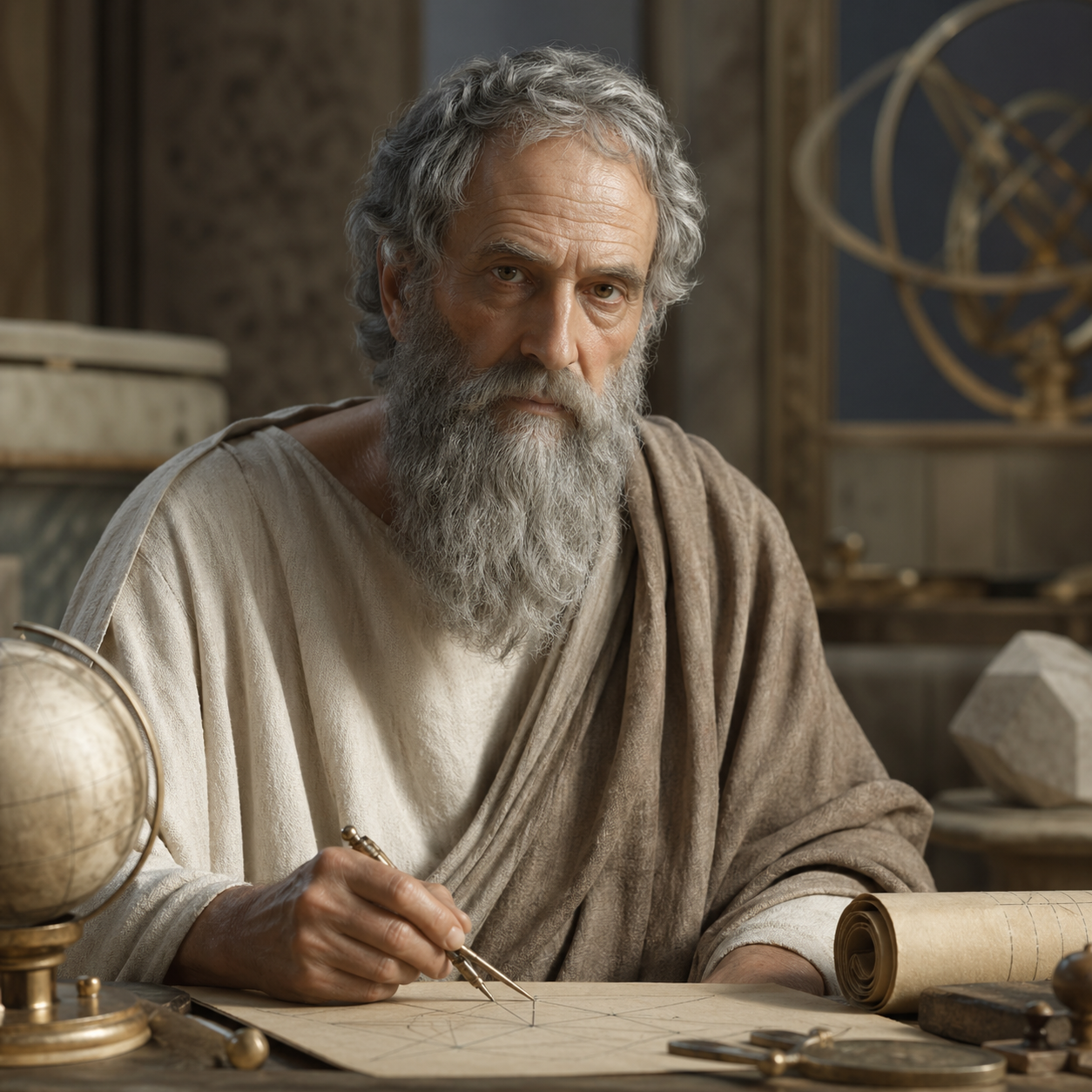
Euclid — "To draw a straight line at right angles to a given straight line from a given po…"
To draw a straight line at right angles to a given straight line from a given point on it.
To draw a straight line at right angles to a given straight line from a given point on it.
Click any product to generate a realistic preview. Up to 3 at a time.
* Initial load can take up to 90 seconds — revising the preview in another color is nearly instant.
"The only purpose of the 'Elements' is to demonstrate mathematically certain fundamental propositions."
"Trilateral figures are those contained by three straight lines, quadrilateral those contained by four, and multilateral those contained by more than four straight lines."
"Things which are equal to the same thing are also equal to one another."
"If equals be subtracted from equals, the remainders are equal."
"The elements of geometry are derived from a small set of axioms and postulates."
Found in 1 providers: grok
1 source checked
From any point on a line, you can always construct a perfect perpendicular — a line at exactly 90 degrees. This captures something fundamental: perpendicularity is not an approximation or a convention, but a precise, reproducible geometric truth that anyone, anywhere, can construct with only a straightedge and compass.
This is literally Euclid's Postulate-derived Proposition 11 from Elements. It embodies his entire philosophy: build complex truths from minimal, self-evident rules. Euclid didn't discover perpendiculars — he proved they could always be constructed rigorously, reflecting his obsession with logical certainty over intuition.
Around 300 BCE Alexandria, Greek thinkers were systematizing knowledge under Ptolemy I's patronage. Land surveying, architecture, and astronomy all demanded precise angle measurement. Formalizing perpendicular construction gave builders and scholars a provable, repeatable standard — transforming practical craft into deductive science during a pivotal intellectual flourishing.
AI-generated insights based on extensive research and information for context. Factual errors? Email [email protected].
Your cart is empty