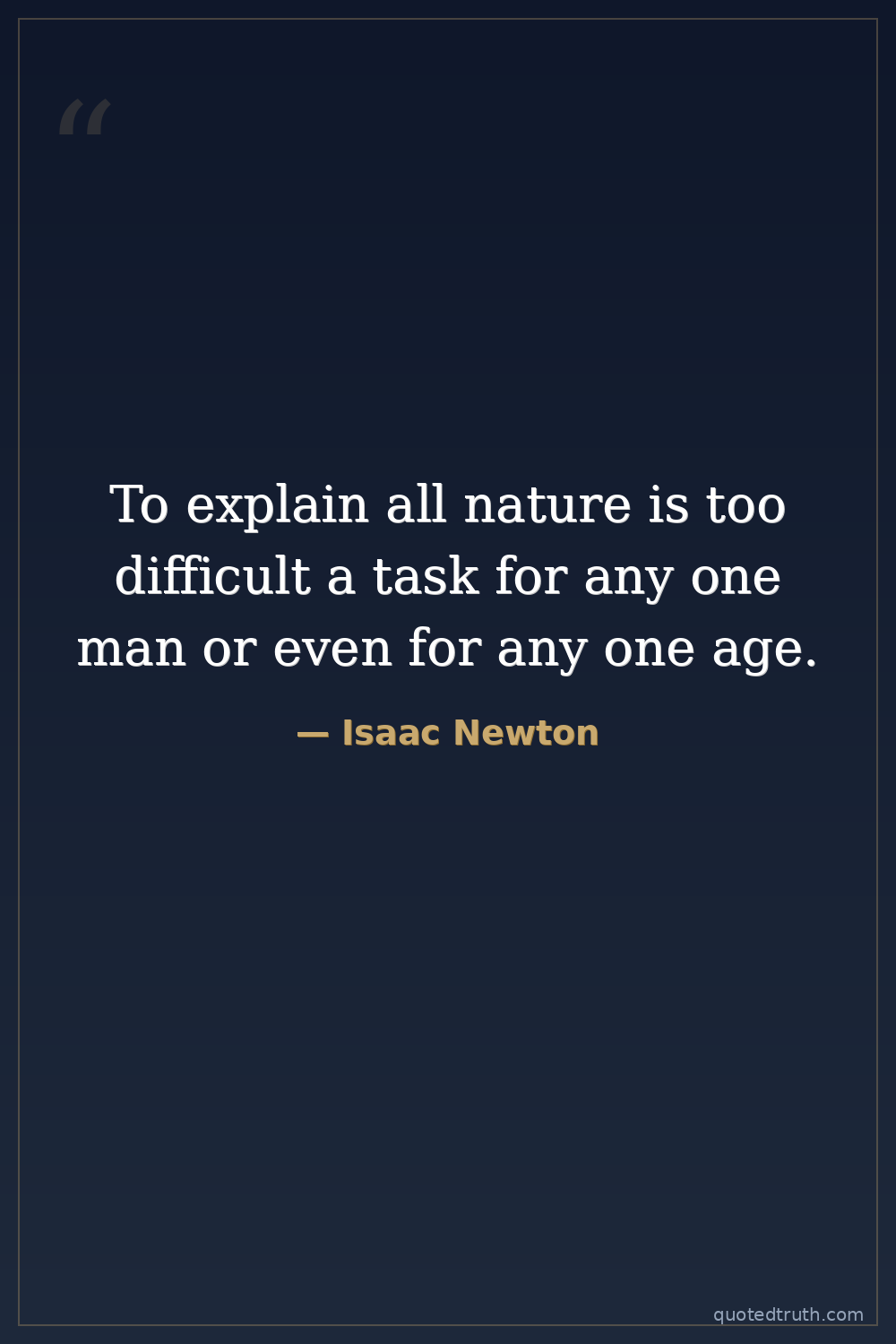
Isaac Newton — "To explain all nature is too difficult a task for any one man or even for any on…"
To explain all nature is too difficult a task for any one man or even for any one age.
To explain all nature is too difficult a task for any one man or even for any one age.
Click any product to generate a realistic preview. Up to 3 at a time.
* Initial load can take up to 90 seconds — revising the preview in another color is nearly instant.
"I feign no hypotheses."
"The changing of bodies into light, and light into bodies, is very conformable to the course of nature, which seems delighted with transmutations."
"The best and safest method of philosophizing seems to be, first to inquire diligently into the properties of things, and to establish those properties by experiments, and then to proceed more slowly t…"
"My powers are ordinary. Only my application brings me success."
"The particles of light are exceedingly small, and move with exceeding swiftness."
Found in 2 providers: grok,deepseek
2 sources checked
Understanding everything about how the universe works is beyond any single person's reach—and beyond any single era's collective effort. Science is a multi-generational relay race, not a solo sprint. No matter how brilliant one mind is, nature is always more complex than any individual lifetime of inquiry can fully map. Progress requires humility about limits and trust that future generations will push further than the present one ever could.
Newton established calculus, optics, and universal gravitation—arguably the greatest scientific output of any single person. Yet he spent decades on alchemy and biblical prophecy, chasing problems he couldn't crack. His famous beach-boy metaphor—seeing himself as a child finding smooth pebbles while the ocean of truth lay before him—mirrors this quote directly. Newton knew better than anyone how much his breakthroughs still left unexplained, which made him both great and honest.
Newton worked during the Scientific Revolution, when natural philosophy was only beginning to displace theological explanations of the world. Galileo had died the year Newton was born; the Royal Society was founded when he was a teenager. There was no chemistry, no germ theory, no thermodynamics yet—vast domains of nature remained untouched. The idea that humans could even partially decode nature's laws was still radical, making Newton's humility about the remaining gap all the more striking.
AI-generated insights based on extensive research and information for context. Factual errors? Email [email protected].
Your cart is empty