Laozi — "To know yet to think that one does not know is the highest [attainment]. Not to …"
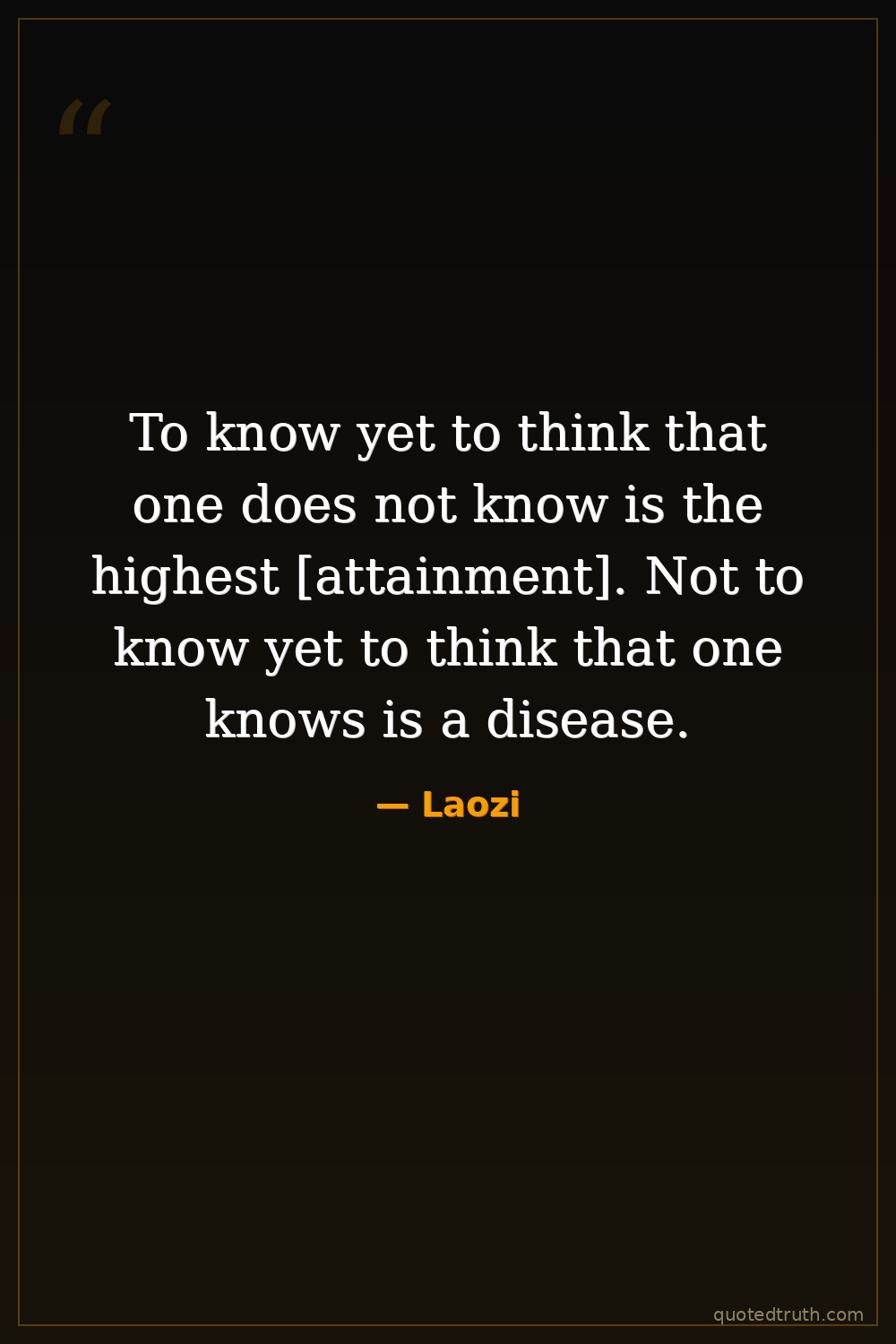
To know yet to think that one does not know is the highest [attainment]. Not to know yet to think that one knows is a disease.
To know yet to think that one does not know is the highest [attainment]. Not to know yet to think that one knows is a disease.
Click any product to generate a realistic preview. Up to 3 at a time.
* Initial load can take up to 90 seconds — revising the preview in another color is nearly instant.
"He who knows glory, yet keeps to ignominy, is the valley of the world."
"The greatest flaw is to desire more."
"The soft and the weak overcome the hard and the strong."
"If a nation is to be great, it must be like a great river, it must flow freely in every direction."
"The best rulers are those the people barely know exist. The next best are those the people praise and acclaim. The next best are those the people fear. The worst are those the people despise."
Reputed founder of Taoism and author of the Tao Te Ching, whose wu wei (effortless action) shaped East Asian philosophy. Closely associated with Zhuangzi (later Taoist who extended Laozi's framework). For an intellectual contrast, see Confucius, near-contemporary Chinese sage of social ritual and duty — Confucius systematized social order through ritual and hierarchy; Laozi argued that all such systems were the disease, not the cure — the two founding poles of Chinese moral philosophy.
Found in 2 providers: gemini,grok
2 sources checked
Genuine wisdom begins with recognizing the limits of your own understanding. Someone who holds real knowledge but stays humble enough to question it keeps learning and avoids error. The opposite mindset—mistaking half-knowledge for certainty—is treated as a sickness of the mind, because it shuts the door to growth, blinds you to mistakes, and leads confident action into disaster.
Laozi worked as an archivist in the Zhou royal court, surrounded by records yet famously reticent to claim mastery. Taoism he founded centers on wu-wei and humility before the ineffable Tao, insisting the sage empties the mind rather than fills it with doctrine. Calling false certainty a disease fits his suspicion of clever officials and scholars whose performed expertise, he believed, corrupted rulers and unsettled the natural order.
Laozi lived during the late Zhou dynasty, a fracturing era sliding toward the Warring States period. Rival schools—Confucians, Legalists, Mohists—competed to sell kings doctrines promising stable rule, and court advisors projected total certainty to win patronage. Against that marketplace of loud expertise, prizing the admission of ignorance was a pointed rebuke, warning rulers that confident ideologues were precisely the men most likely to wreck a state.
AI-generated insights based on extensive research and information for context. Factual errors? Email [email protected].
Your cart is empty