Isaac Newton — "To me there has never been a higher source of earthly honor or distinction than …"
To me there has never been a higher source of earthly honor or distinction than that connected with advances in science.
To me there has never been a higher source of earthly honor or distinction than that connected with advances in science.
Click any product to generate a realistic preview. Up to 3 at a time.
* Initial load can take up to 90 seconds — revising the preview in another color is nearly instant.
"The frame of nature, and the system of the world, we are to observe by the phenomena, and not to frame by imagination."
"God in the beginning formed matter in solid, massy, hard, impenetrable, moveable particles, of such sizes and figures, and with such other properties, and in such proportion to space, as most conduced…"
"It is not the business of philosophy to account for the truth of things by hypotheses, but to deduce them from phenomena."
"He who thinks half-heartedly will not believe in God; but he who thinks seriously will believe in God, and will not doubt that God is the author of the world."
"Nothing can be divided into fewer parts than it hath."
Found in 1 providers: deepseek
1 source checked
The quote declares that no earthly achievement earns greater honor than contributing to scientific knowledge. It elevates intellectual discovery above wealth, military conquest, noble birth, or political power as the highest form of human distinction. Science, in this view, is not merely a profession but the pinnacle of meaningful human endeavor — the most legitimate path to lasting recognition and respect among peers and posterity.
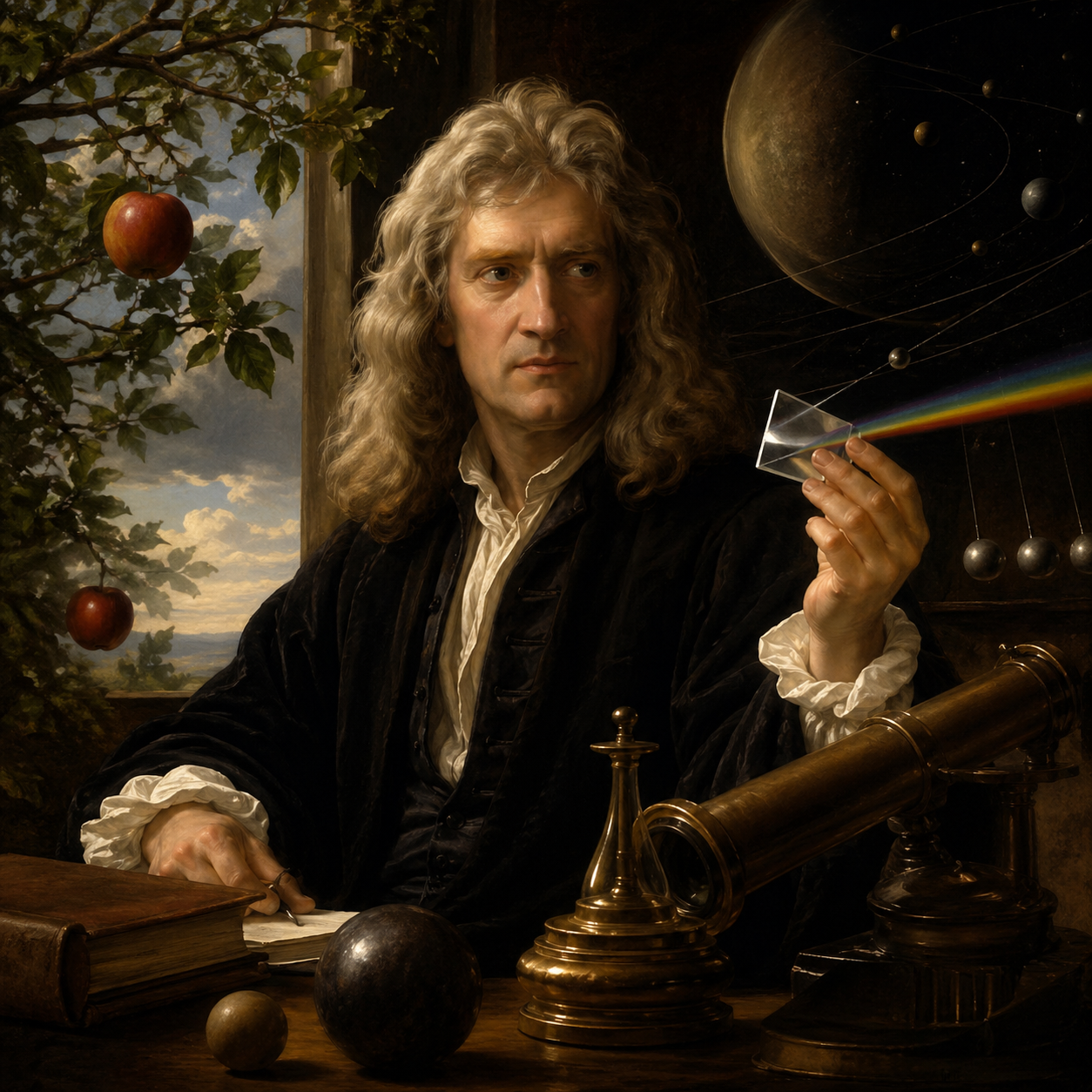
Newton embodied this belief through his life's work. His discoveries — calculus, the laws of motion, universal gravitation, and optics — redefined human understanding of the physical world. Knighted in 1705, he became one of the first scientists honored primarily for intellectual achievement rather than birth or military service. As President of the Royal Society, he shaped science as a respected institution, placing discovery at the center of his identity.
Newton lived through the Scientific Revolution, a period when Europe fundamentally shifted how it understood nature. Before this era, honor flowed from aristocratic lineage, military valor, or church authority. The founding of the Royal Society in 1660 and publication of Newton's Principia in 1687 legitimized science as a path to prestige. Rulers and philosophers alike began recognizing that mastering nature's laws — not just commanding armies — could define a civilization's greatness.
AI-generated insights based on extensive research and information for context. Factual errors? Email [email protected].
Your cart is empty