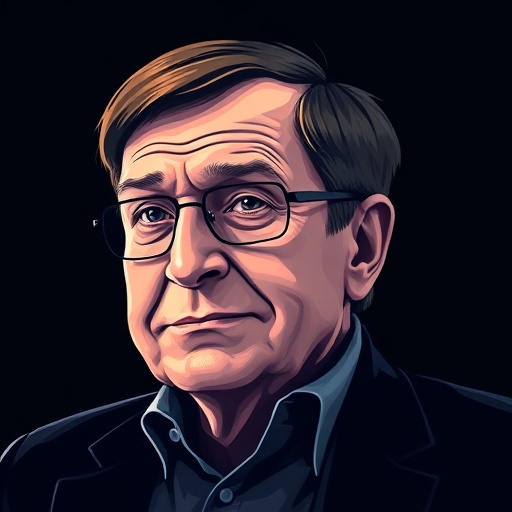
Stephen Hawking — "We are all connected to the cosmos, and it is a wonderful thing."
We are all connected to the cosmos, and it is a wonderful thing.
We are all connected to the cosmos, and it is a wonderful thing.
Click any product to generate a realistic preview. Up to 3 at a time.
* Initial load can take up to 90 seconds — revising the preview in another color is nearly instant.
"I believe that we are alone in the universe, but I hope we are not."
"The ultimate goal of science is to provide a single theory that describes the whole universe."
"The universe is a vast and complex place, and we are only just beginning to understand it."
"I have no idea. People who boast about their IQ are losers."
"I believe that the universe is infinite, and that there are an infinite number of universes."
British theoretical physicist whose Hawking radiation work and A Brief History of Time (1988) brought black-hole physics to a mass audience while he lived with ALS for 55 years. Closely associated with Roger Penrose (his collaborator on singularity theorems) and Carl Sagan (fellow popularizer who wrote Brief History's foreword). For an intellectual contrast, see William Lane Craig, American philosopher of religion — Craig's Kalam cosmological argument depends on the Big Bang requiring a divine first cause; Hawking's no-boundary proposal was specifically designed to remove the moment that would require one — the cleanest cosmology-vs-natural-theology contrast in modern thought.
Found in 1 providers: grok
1 source checked
Every atom in your body was forged inside a dying star. This quote captures that physical truth: humans aren't observers of the universe, we're made of it. We share the same origin, the same laws of physics, the same fate as everything else in existence. Rather than feeling small or insignificant, Hawking invites awe — our connection to the cosmos is something to marvel at, not fear.
Hawking spent his career probing the universe's most extreme phenomena — black holes, Hawking radiation, the Big Bang's origins. Diagnosed with ALS at 21 and given two years to live, he defied his physical limitations for over five decades, his intellect ranging freely across cosmic scales. His bestseller A Brief History of Time brought cosmology to millions. He genuinely believed that curiosity about the universe was one of humanity's most redemptive and defining traits.
Hawking's most productive decades spanned Cold War nuclear anxiety, the moon landings, and the dawn of the information age. As humanity's destructive potential grew — nuclear arsenals, environmental damage, rising tribalism — his reminder of cosmic unity offered a counterweight. The 1980s and 90s also saw cosmology go mainstream: COBE mapped the cosmic microwave background, Hubble launched, and physics became pop culture, making his message of shared cosmic origin newly resonant for mass audiences.
AI-generated insights based on extensive research and information for context. Factual errors? Email [email protected].
Your cart is empty