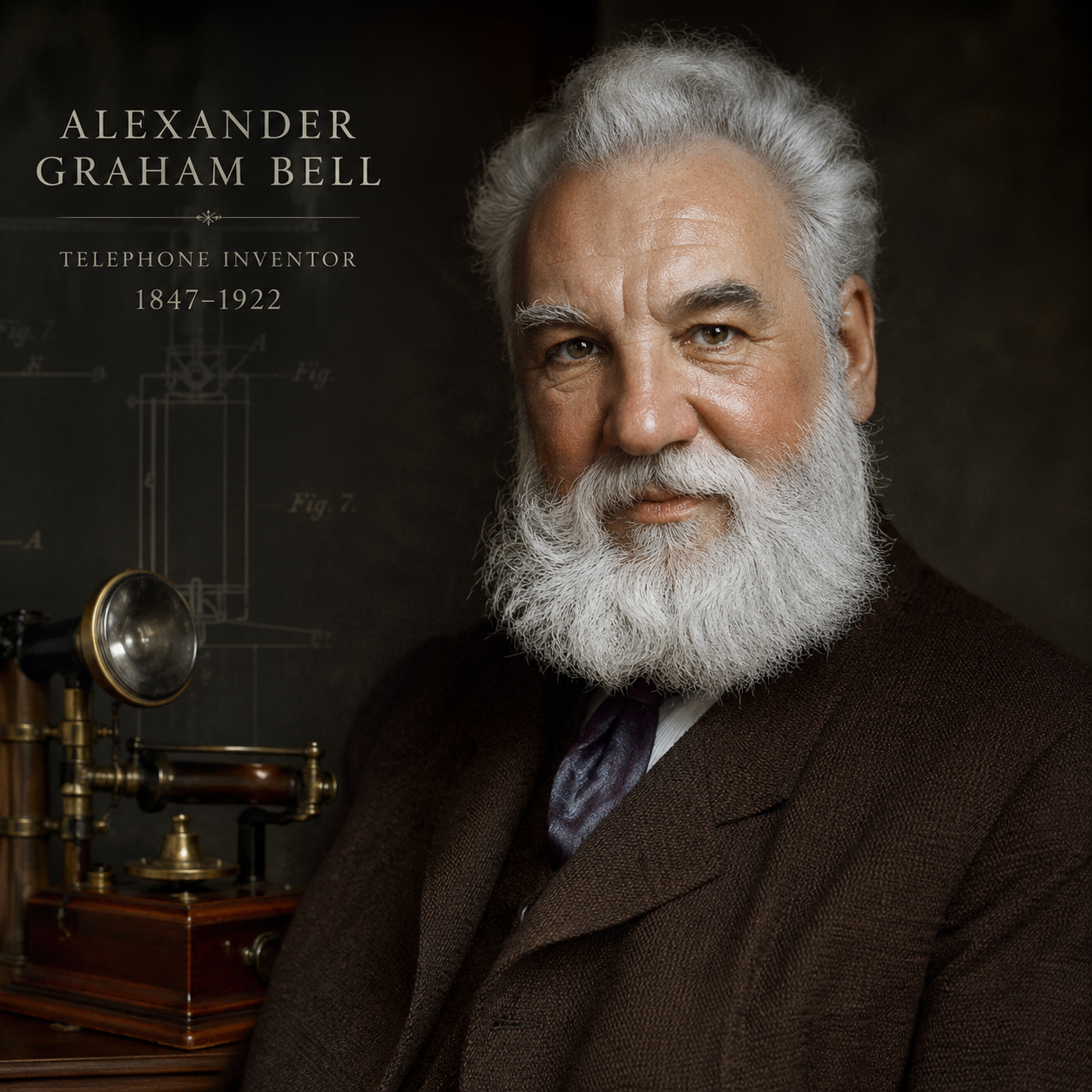
Alexander Graham Bell — "We are all too much inclined, I think, to put off until tomorrow the things that…"
We are all too much inclined, I think, to put off until tomorrow the things that we ought to do today.
We are all too much inclined, I think, to put off until tomorrow the things that we ought to do today.
Click any product to generate a realistic preview. Up to 3 at a time.
* Initial load can take up to 90 seconds — revising the preview in another color is nearly instant.
"The invention of the telephone was the result of long and patient investigation."
"Man is a tool-using animal. Without tools he is nothing, with tools he is all."
"Man is the result of slow growth; that is why he occupies the position he does in animal life. What does a pup amount to that has gained its growth in a few days or weeks, beside a man who only attain…"
"What this power is I cannot say; all I know is that it exists and it becomes available only when a man is in that state of mind in which he knows exactly what he wants and is fully determined not to g…"
"I have always been a great believer in luck, and I find that the harder I work, the more I have of it."
Found in 1 providers: grok
1 source checked
The quote calls out a universal human habit: procrastinating on things we know we should do now. Rather than preaching, Bell frames it as a shared tendency — we are all guilty of it. The message is direct: deferring necessary action is a trap most people fall into, often disguising delay as planning. Acting today, not tomorrow, is the only reliable way to accomplish anything meaningful.
Bell's entire career was a race against time. On February 14, 1876, he filed his telephone patent hours before rival Elisha Gray submitted a competing caveat — that single day determined who history remembers as the inventor. This urgency defined him. He pursued simultaneous projects obsessively: the photophone, metal detector, hydrofoil. Bell understood viscerally that procrastination doesn't just delay progress — in a world of simultaneous invention, it erases credit entirely.
The late 19th century was the most competitive era of invention in American history. Multiple inventors frequently worked on identical ideas — Bell and Gray on the telephone, Edison and Swan on the lightbulb, Tesla and Marconi on radio. Patent races were existential; a single day's delay transferred decades of credit. Railroads, telegraphs, and manufacturing scaled so fast that hesitation meant permanent displacement by a faster competitor.
AI-generated insights based on extensive research and information for context. Factual errors? Email [email protected].
Your cart is empty