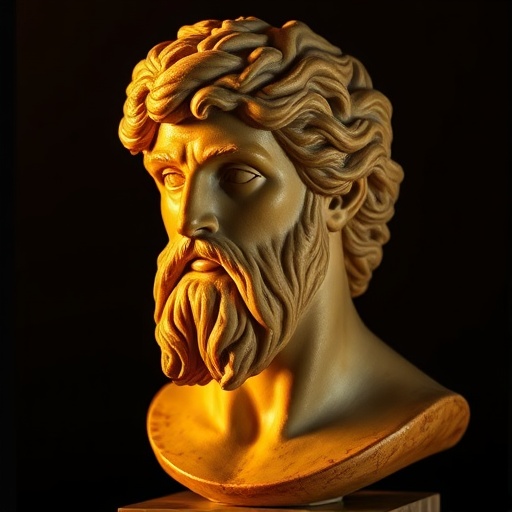
Pythagoras — "We come from God, and we return to God."
We come from God, and we return to God.
We come from God, and we return to God.
Click any product to generate a realistic preview. Up to 3 at a time.
* Initial load can take up to 90 seconds — revising the preview in another color is nearly instant.
"All is number."
"A fool is known by his speech, and a wise man by silence."
"Do not go to bed until you have gone over the day three times in your mind. What wrong did I do? What good did I accomplish? What did I forget to do?"
"The universe is a living creature, endowed with soul and reason."
"Do not stir the fire with a sword."
Greek philosopher and mathematician whose school in Croton combined geometry (the Pythagorean theorem), number-mysticism, and a religious-vegetarian way of life. Closely associated with Thales of Miletus (earlier pre-Socratic and the first philosopher). For an intellectual contrast, see Heraclitus, pre-Socratic Greek philosopher of flux — Heraclitus called Pythagoras 'the chief of swindlers' — among the founding insults of the philosophical-rivalry tradition. Their 'all is flux' vs 'all is number' poles still organize the philosophy of mathematics today (Platonist vs anti-realist).
Found in 1 providers: grok
1 source checked
Human existence is bracketed by the divine: our souls originate from a higher, eternal source and eventually travel back to it after death. Life in a physical body is a temporary passage rather than the whole story. What we experience here is a journey away from and then back toward that origin, suggesting our true identity is spiritual, not merely biological, and that mortality is a return home rather than an ending.
Pythagoras founded a religious-philosophical brotherhood that taught the soul was immortal and transmigrated through reincarnations before rejoining the divine. Beyond geometry, he treated mathematics as sacred, believing numbers revealed the eternal order linking humans to the cosmos. His followers practiced purification rituals, silence, and dietary rules aimed at freeing the soul for its return. This saying captures the mystical core beneath his scientific reputation, where math and theology were inseparable disciplines.
In 6th-century BCE Greece, traditional Olympian religion was being challenged by mystery cults like Orphism, which taught soul-body dualism and afterlife judgment. Pythagoras absorbed these currents while traveling through Egypt and Babylon, regions with their own resurrection and soul-journey traditions. Founding his community at Croton in southern Italy, he blended emerging rational inquiry with older sacred beliefs, during an age when philosophy, mathematics, and religion had not yet separated into distinct fields.
AI-generated insights based on extensive research and information for context. Factual errors? Email [email protected].
Your cart is empty