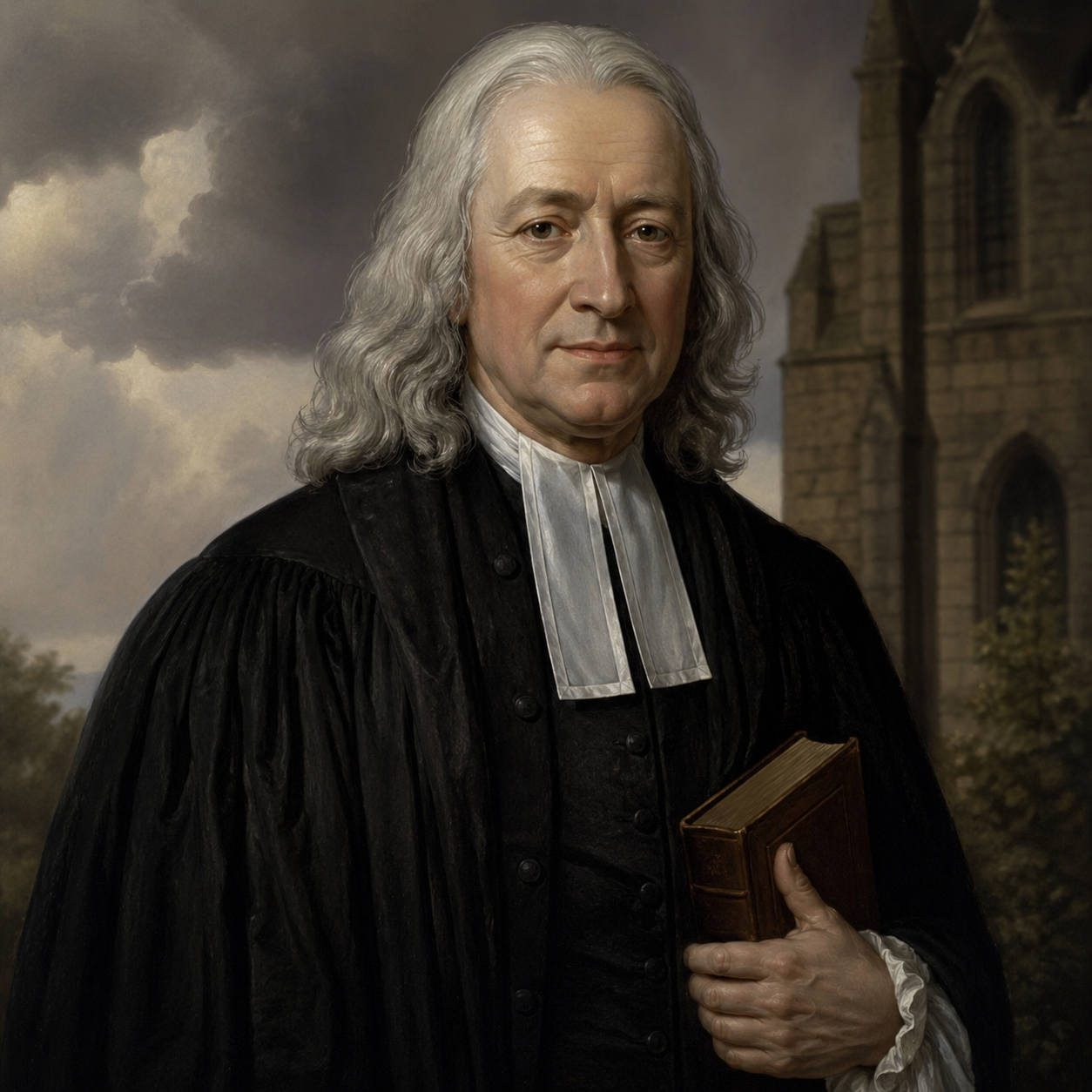
John Wesley — "What a work has God wrought in our day!"
What a work has God wrought in our day!
What a work has God wrought in our day!
Click any product to generate a realistic preview. Up to 3 at a time.
* Initial load can take up to 90 seconds — revising the preview in another color is nearly instant.
"I will not speak to you as a Methodist, but as a man of common sense."
"I was much surprised to find that the Bishop of London, in his late Pastoral Letter, has taken occasion to caution the Clergy of his diocese against 'enthusiasm,' and to warn them against 'the new doc…"
"Preach not doctrines, but Christ."
"I am a debtor both to the wise and to the unwise."
"Though I am an old man, I am but a little child; for I am just beginning to learn the alphabet of salvation."
English Anglican cleric and founder of Methodism, whose open-air preaching and class-meeting structure created the largest 18th-century evangelical revival. Closely associated with Charles Wesley (his hymn-writing brother) and George Whitefield (early co-revivalist, later doctrinal opponent). For an intellectual contrast, see George Whitefield, Calvinist evangelical revivalist — Whitefield's predestinarian Calvinism vs Wesley's free-grace Arminian theology split the early Methodist movement permanently in the 1739-41 break. The founding evangelical Calvinist-Arminian schism — the two parallel evangelical traditions American Christianity descends from.
Found in 1 providers: grok
1 source checked
God has accomplished something remarkable and unprecedented in our lifetime. This expresses awe and gratitude at witnessing spiritual transformation on a massive scale—movements, revivals, changed lives—that feel divinely orchestrated rather than humanly engineered. It's a declaration that history itself is bending toward something significant, and the speaker recognizes themselves as a witness to extraordinary divine activity unfolding in real time.
Wesley spent decades riding 250,000 miles on horseback across Britain, preaching to coal miners, prisoners, and the poor whom established churches ignored. He personally witnessed tens of thousands converted through open-air revivals. His Methodist movement grew from a small Oxford study group to over 100,000 members by his death in 1791, making this exclamation deeply personal—he literally watched the transformation happen.
The 18th century saw Britain's Industrial Revolution uprooting rural communities into squalid urban slums, while the Church of England largely served the comfortable gentry. Simultaneously, the Great Awakening swept Britain and America. Wesley's Methodist revival emerged as a direct response to mass spiritual neglect, offering working-class people dignity, literacy, and community—a genuine social and religious earthquake amid profound economic upheaval.
AI-generated insights based on extensive research and information for context. Factual errors? Email [email protected].
Your cart is empty