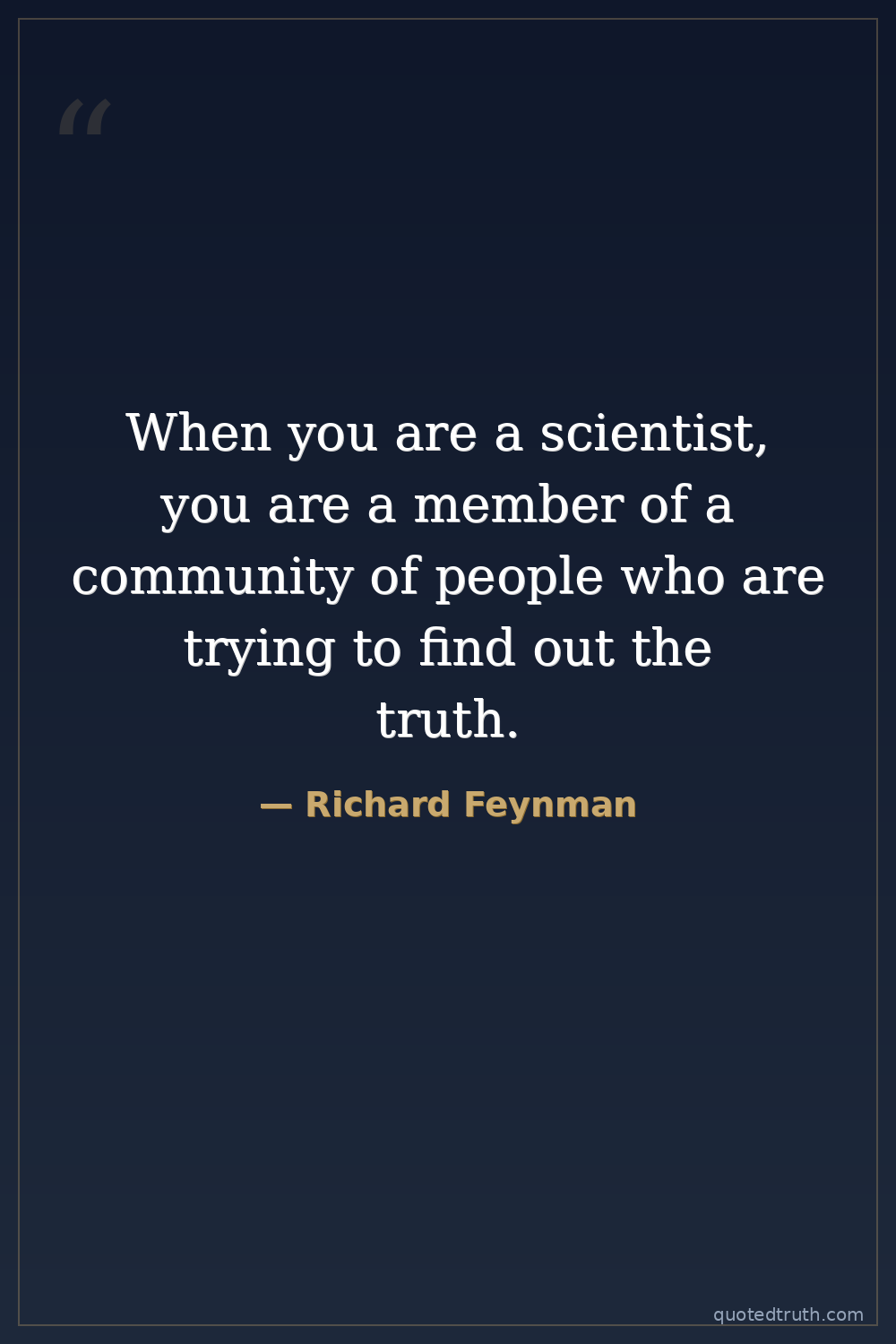
Richard Feynman — "When you are a scientist, you are a member of a community of people who are tryi…"
When you are a scientist, you are a member of a community of people who are trying to find out the truth.
When you are a scientist, you are a member of a community of people who are trying to find out the truth.
Click any product to generate a realistic preview. Up to 3 at a time.
* Initial load can take up to 90 seconds — revising the preview in another color is nearly instant.
"Oh. That's interesting. (This entire scene is very typical of Dirac. In fact, that is comparatively a lot of words for him to have said to a stranger.)"
"I'm not a serious person. I'm just a serious scientist."
"I took the wavicles—the little particles of waves—and put them in a box."
"For a successful technology, reality must take precedence over public relations, for nature cannot be fooled."
"I don't have to be consistent."
American theoretical physicist who shared the 1965 Nobel for QED, developed Feynman diagrams, and wrote the Feynman Lectures on Physics. Closely associated with Julian Schwinger (co-Nobelist for QED) and Murray Gell-Mann (Caltech rival and Eightfold-Way physicist). For an intellectual contrast, see Deepak Chopra, physician and quantum-mysticism author — Feynman's Caltech 'cargo cult science' commencement address is the precise template for what he saw as misuse of physics terminology — Chopra-style appropriation of quantum vocabulary for metaphysical claims is the canonical example of what Feynman called 'fooling yourself'.
Found in 1 providers: grok
1 source checked
Being a scientist means belonging to a collaborative pursuit of truth rather than working in isolation. Science is inherently communal — findings must be shared, tested, and challenged by peers. Truth-seeking isn't a solo act but a collective enterprise where individual discoveries belong to the broader human project of understanding reality.
Feynman embodied this communal spirit through his role in the Manhattan Project, his decades at Caltech and Cornell, and his famous Challenger investigation. Known for bongo drums and accessible lectures, he valued intellectual honesty above prestige. His Feynman Lectures democratized physics, sharing truth freely rather than hoarding expertise.
Feynman worked through the post-WWII golden age of American science — Cold War funding, Sputnik panic, and the space race transformed science from niche pursuit to national priority. The scientific community grappled with ethical responsibilities after the atomic bomb, making the idea of science as a truth-seeking brotherhood rather than a weapon-making apparatus deeply resonant.
AI-generated insights based on extensive research and information for context. Factual errors? Email [email protected].
Your cart is empty