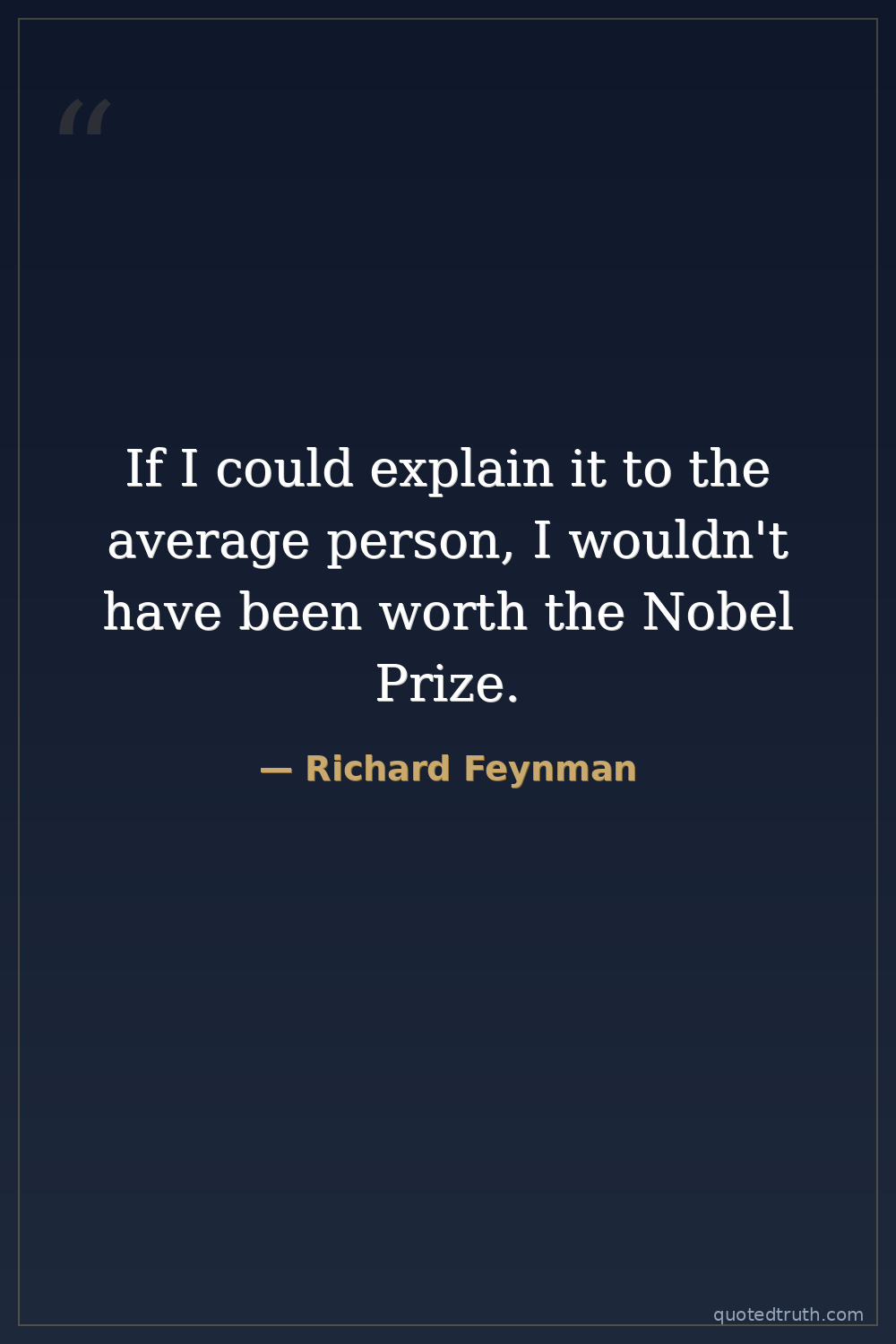
Richard Feynman — "If I could explain it to the average person, I wouldn't have been worth the Nobe…"
If I could explain it to the average person, I wouldn't have been worth the Nobel Prize.
If I could explain it to the average person, I wouldn't have been worth the Nobel Prize.
Click any product to generate a realistic preview. Up to 3 at a time.
* Initial load can take up to 90 seconds — revising the preview in another color is nearly instant.
"I was very surprised when I got the Nobel Prize. I didn't think I deserved it."
"I'm not a humanitarian. I'm a scientist."
"I have a lot of fun. I've always had a lot of fun. I don't know why I should stop."
"If you want to master something, teach it."
"I'm a great believer in the idea that if you don't understand something, you should try to explain it to someone else."
American theoretical physicist who shared the 1965 Nobel for QED, developed Feynman diagrams, and wrote the Feynman Lectures on Physics. Closely associated with Julian Schwinger (co-Nobelist for QED) and Murray Gell-Mann (Caltech rival and Eightfold-Way physicist). For an intellectual contrast, see Deepak Chopra, physician and quantum-mysticism author — Feynman's Caltech 'cargo cult science' commencement address is the precise template for what he saw as misuse of physics terminology — Chopra-style appropriation of quantum vocabulary for metaphysical claims is the canonical example of what Feynman called 'fooling yourself'.
Found in 1 providers: grok
1 source checked
True expertise operates at a level of complexity that resists simple explanation without sacrificing accuracy. Deep knowledge isn't dumbed down — it's built on layers of specialized understanding that took years to develop. If the cutting edge of a field were easily explained to everyone, it wouldn't represent a frontier worth pushing. Difficulty of explanation signals genuine intellectual depth and novelty.
Feynman won the 1965 Nobel Prize in Physics for quantum electrodynamics — a mathematical framework so abstract it describes particle interactions through Feynman diagrams that even physicists spent years mastering. Yet Feynman was simultaneously legendary as a popularizer of science. This quote captures his honest tension: he knew some physics genuinely couldn't be simplified without becoming wrong.
Post-WWII physics entered an era of extreme specialization. Quantum mechanics, nuclear theory, and particle physics accelerated beyond public comprehension, shaped by Manhattan Project secrecy and Cold War research. Science communication was valued, but the gap between frontier physics and public understanding grew rapidly. Feynman navigated both worlds — Caltech lectures and Bongo drums alongside path integrals.
AI-generated insights based on extensive research and information for context. Factual errors? Email [email protected].
Your cart is empty