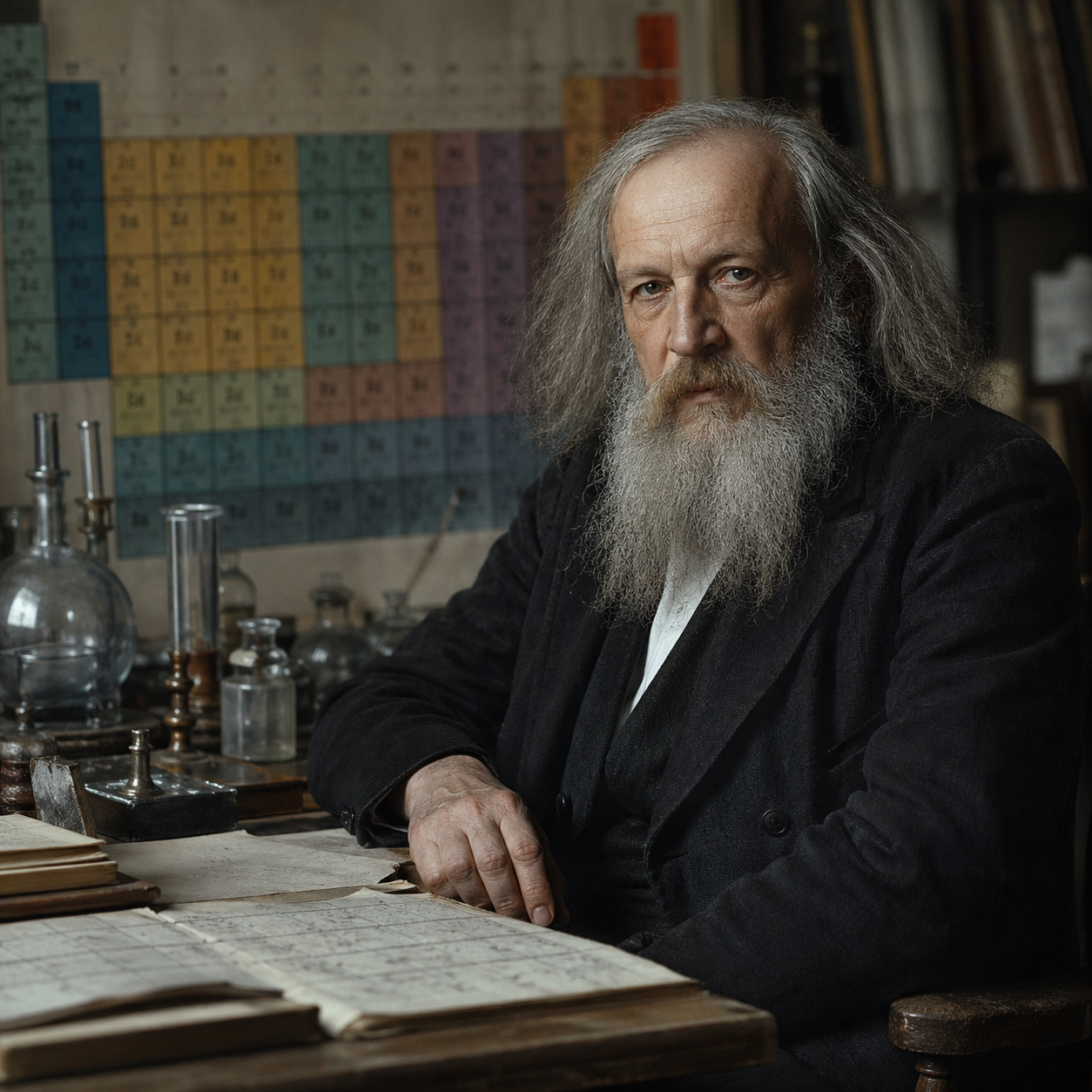
Dmitri Mendeleev — "Work, look for peace and calm in work: you will find it nowhere else."
Work, look for peace and calm in work: you will find it nowhere else.
Work, look for peace and calm in work: you will find it nowhere else.
Click any product to generate a realistic preview. Up to 3 at a time.
* Initial load can take up to 90 seconds — revising the preview in another color is nearly instant.
"The periodic law is the most important generalization in chemistry, and it has no equal in any other branch of science."
"The spirit of scientific inquiry must be cultivated in all children."
"It is the function of the scientist to do 3 things: to observe, to generalize, and to predict."
"When we see the order of the elements, we must admit that there is a higher reason."
"The most all penetrating spirit before which will open the possibility of tilting not tables, but planets, is the spirit of free human inquiry. Believe only in that."
Found in 2 providers: deepseek,gemini
2 sources checked
True inner peace doesn't come from leisure, escape, or waiting for ideal conditions. It's found in the act of dedicated, absorbing work itself. When you immerse yourself in meaningful labor, the restlessness, anxiety, and dissatisfaction that plague idle minds fade away. Rather than chasing calm externally through relaxation or distraction, you should seek it through focused effort and purposeful engagement with your craft or responsibilities.
Mendeleev embodied this philosophy through his obsessive dedication to science, famously working for days straight before conceiving the periodic table in 1869. Born into poverty as the youngest of many children, he found stability and identity through relentless study and research. Beyond chemistry, he worked tirelessly on Russian agriculture, petroleum, and economics. His life demonstrated that meaningful work provided both his livelihood and his psychological refuge from personal hardships.
Mendeleev lived during 19th-century Imperial Russia (1834-1907), an era of rapid industrialization, scientific revolution, and social upheaval. Serfdom was abolished in 1861, and Russia raced to modernize against Western Europe. The Protestant work ethic and Victorian industriousness shaped global attitudes. Amid political instability, revolutionary movements, and Tsarist repression, work represented both personal salvation and national duty for educated Russians seeking to advance their backward empire through science and industry.
AI-generated insights based on extensive research and information for context. Factual errors? Email [email protected].
Your cart is empty