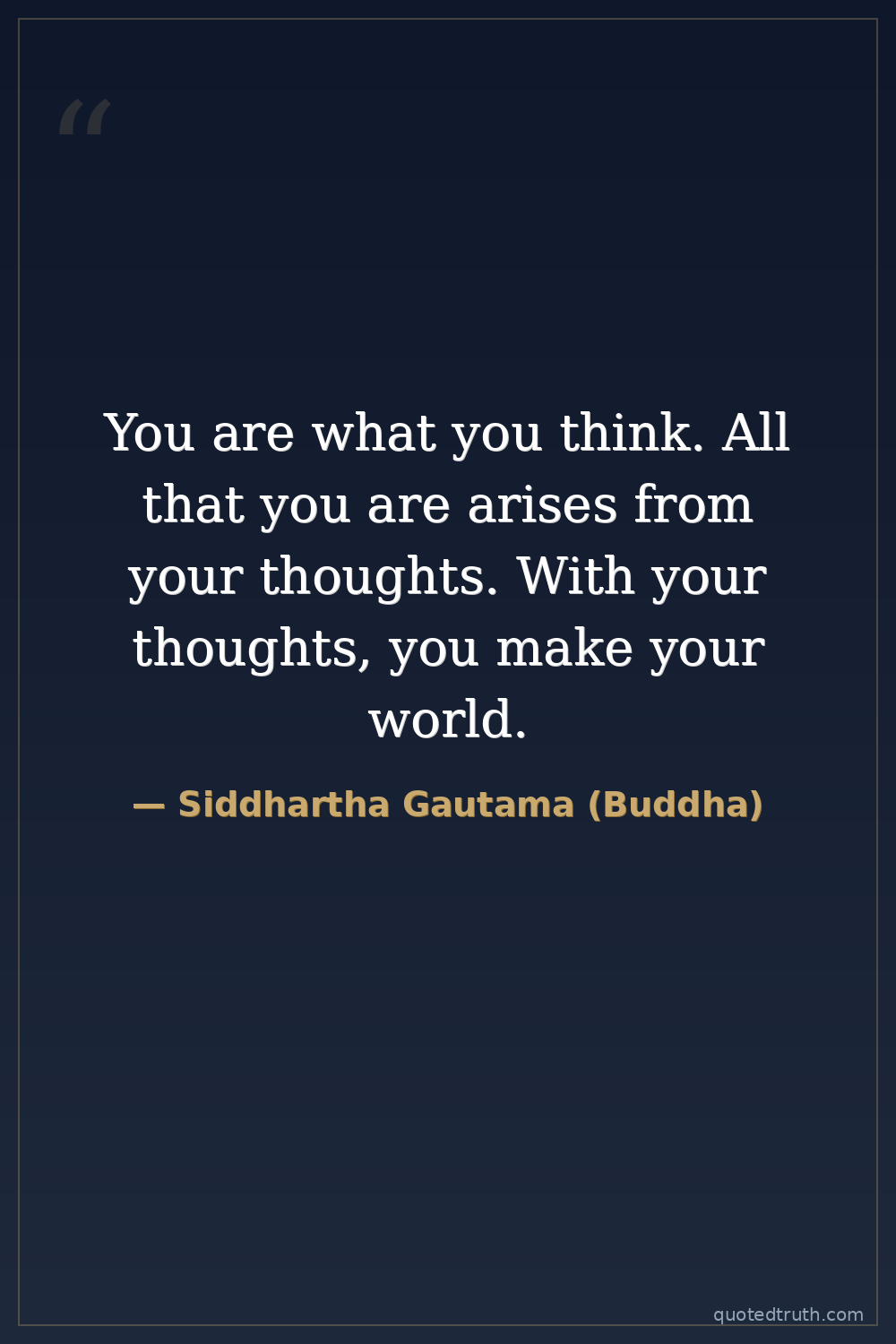
Siddhartha Gautama (Buddha) — "You are what you think. All that you are arises from your thoughts. With your th…"
You are what you think. All that you are arises from your thoughts. With your thoughts, you make your world.
You are what you think. All that you are arises from your thoughts. With your thoughts, you make your world.
Click any product to generate a realistic preview. Up to 3 at a time.
* Initial load can take up to 90 seconds — revising the preview in another color is nearly instant.
"The virtues, like the Muses, are always seen in groups. A good principle was never found solitary in any breast."
"All conditioned things are impermanent — when one sees this with wisdom, then one turns away from suffering."
"There is nothing more dreadful than the habit of doubt. Doubt separates people. It is a poison that disintegrates friendships and breaks up pleasant relations."
"'As I am, so are they; as they are, so am I.' Comparing others with oneself, do not kill nor cause others to kill."
"Holding on to anger is like grasping a hot coal with the intent of throwing it at someone else; you are the one who gets burned."
Found in 1 providers: deepseek
1 source checked
Your identity and experience are shaped by your mental patterns. The thoughts you hold consistently become the filter through which you interpret everything, and they drive your choices, emotions, and actions. Change the thoughts, and you change how reality feels and unfolds for you. Rather than being a passive recipient of circumstances, you are actively constructing your subjective world moment by moment through what you choose to dwell on and believe.
This reflects the Buddha's central insight after his awakening under the Bodhi tree: suffering originates in the mind, not external conditions. As a prince who renounced palace luxury to investigate human suffering, he spent years meditating and discovered that craving and deluded thinking cause dukkha. His teachings on Right Thought in the Eightfold Path and mind-training through meditation directly express this principle that mental cultivation is the root of liberation.
In 5th-6th century BCE northern India, the Vedic tradition emphasized external rituals, caste-bound duty, and priestly sacrifice as paths to spiritual merit. The Buddha emerged during the Shramana movement, which rejected ritualism in favor of inner inquiry. His claim that thought, not birth or sacrifice, shapes one's world radically democratized spirituality and challenged Brahmin authority, aligning with contemporaries like Mahavira who also centered personal mental discipline over inherited religious structures.
AI-generated insights based on extensive research and information for context. Factual errors? Email [email protected].
Your cart is empty