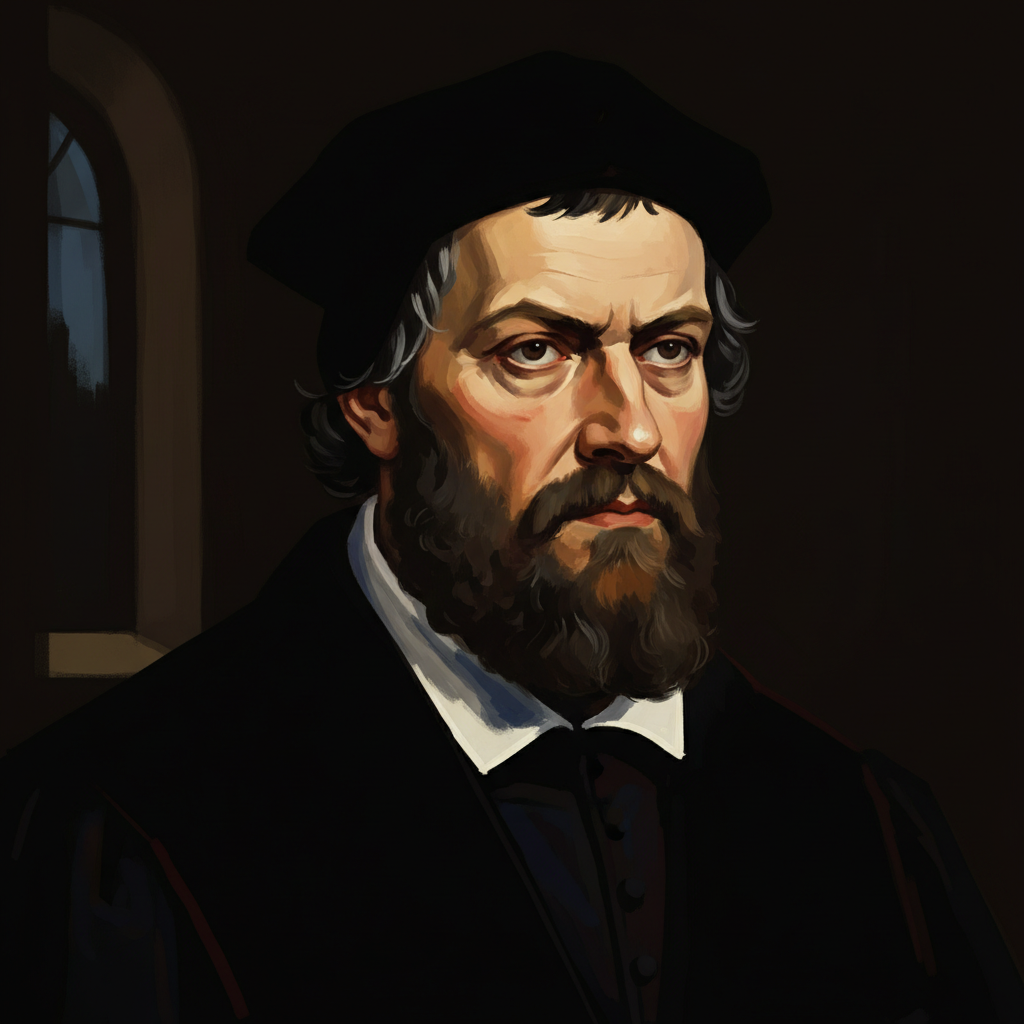
Martin Luther — "You have as much laughter as you have faith."
You have as much laughter as you have faith.
You have as much laughter as you have faith.
Click any product to generate a realistic preview. Up to 3 at a time.
* Initial load can take up to 90 seconds — revising the preview in another color is nearly instant.
"The Bible is alive, it speaks to me; it has feet, it runs after me; it has hands, it lays hold on me."
"The very devil himself would thank you for such an event, and no one but the miserable devil and his devilish scum."
"The greatest danger to the church is when it is rich."
"The Holy Spirit unveiled the Scriptures for me in this tower at the lavatory."
"The pope is the Antichrist."
German theologian whose 95 Theses (1517) launched the Protestant Reformation and broke the Catholic Church's monopoly on Western Christianity. Closely associated with Philipp Melanchthon (Lutheran systematizer) and John Calvin (later Reformer who built on Luther's break). For an intellectual contrast, see Pope Leo X, Renaissance pope (1513-1521) — Leo X's indulgence sales triggered Luther's break and Leo excommunicated him in 1521 — Luther's entire Reformation is structured as a direct answer to the indulgence-funded Vatican Leo represented.
Found in 1 providers: gemini
1 source checked
Genuine joy and laughter grow from deep trust in something greater than yourself. The more confident you are that life is held together by meaning, grace, or a reliable God, the lighter you can be about daily troubles. Anxiety shrinks your capacity to laugh; conviction expands it. Humor, in this view, isn't a distraction from serious belief but the natural overflow of feeling fundamentally safe and forgiven.
Luther was famous for earthy humor, hearty laughter, and beer-soaked table talk alongside his theological fire. He battled crushing depressive episodes he called Anfechtungen, and discovered that trust in divine grace, not grim striving, freed him. His Table Talk volumes brim with jokes, insults, and belly laughs. For Luther, faith wasn't dour religiosity; it was liberation that naturally produced cheerfulness, so a joyless Christian signaled a faith-starved soul.
Early sixteenth-century Europe lived under plague, war, and a Church that monetized fear of purgatory through indulgences. Piety was performed through fasting, flagellation, and dread. Luther's 1517 Ninety-Five Theses cracked that system open, and the Reformation reframed salvation as a free gift received by faith. Against that backdrop, linking laughter to faith was genuinely radical: it rejected centuries of somber penitential culture and insisted joy itself was evidence of right relationship with God.
AI-generated insights based on extensive research and information for context. Factual errors? Email [email protected].
Your cart is empty