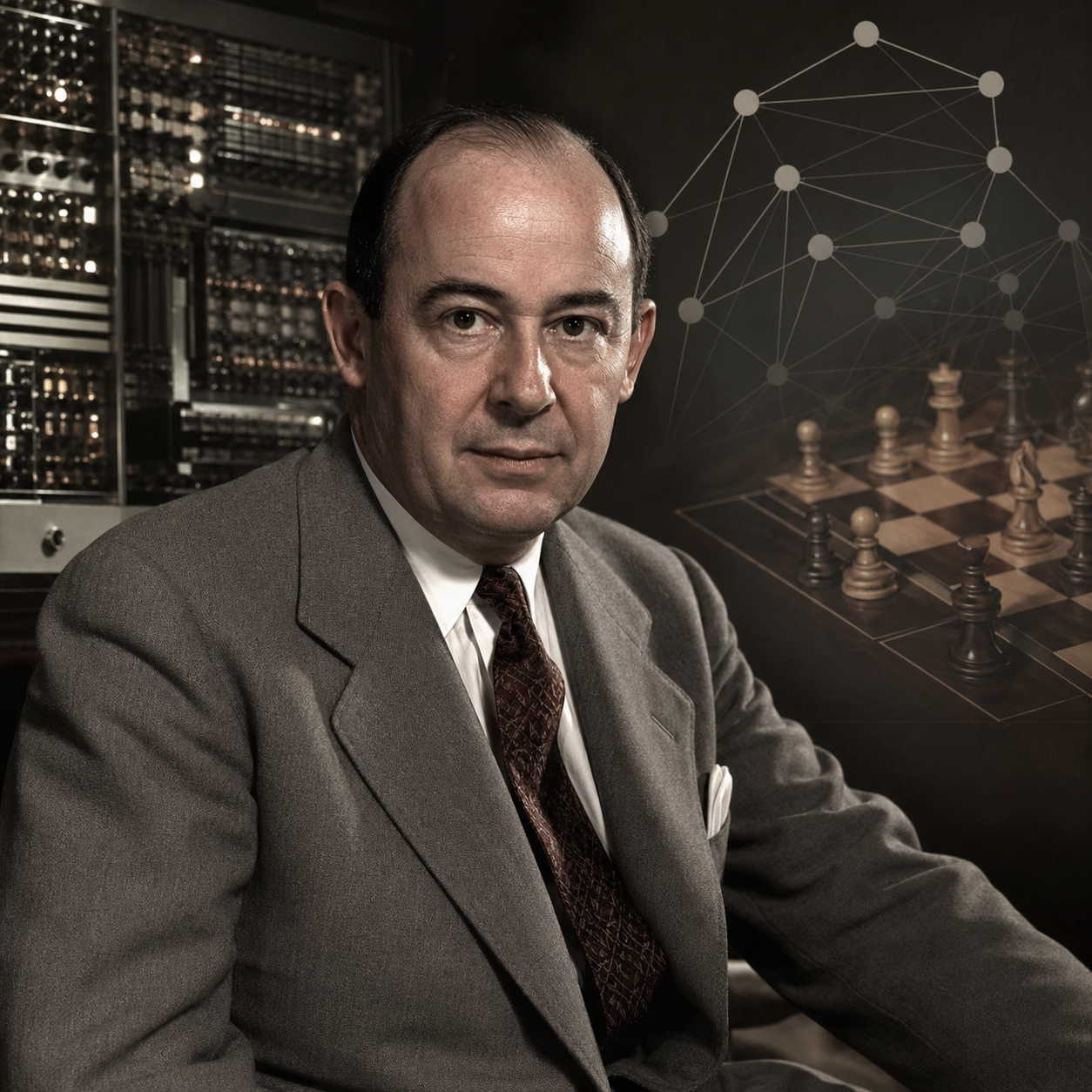
John von Neumann — "Young man, in mathematics you don't understand things. You just get used to them…"
Young man, in mathematics you don't understand things. You just get used to them.
Young man, in mathematics you don't understand things. You just get used to them.
Click any product to generate a realistic preview. Up to 3 at a time.
* Initial load can take up to 90 seconds — revising the preview in another color is nearly instant.
"Anyone who considers arithmetical methods of producing random digits is, of course, in a state of sin."
"The world is not as simple as we would like it to be."
"It is just as important to know what not to do as it is to know what to do."
"There's no sense in being precise when you don't even know what you're talking about."
"The only way to do great work is to love what you do."
Anecdote recounted by several mathematicians, including Paul Halmos.
Date: 1930s-1950s
GeneralFound in 3 providers: deepseek,grok,gemini
3 sources checked
Mathematical comprehension isn't about achieving a sudden intuitive 'click.' Instead, proficiency comes from repeated exposure until abstract concepts feel familiar and workable. You don't need to fully grasp why something is true at a gut level — you build comfort through practice and pattern recognition until the strange becomes routine. True fluency is earned through habituation. This pushes back against the idea that struggling to understand means you're failing.
Von Neumann, a prodigy who mastered calculus before age eight and earned dual PhDs by 23, worked across quantum mechanics, game theory, nuclear weapons design, and computer architecture — fields where intuition routinely fails. Reportedly said to a student struggling with a concept, this reflects his own experience: his legendary mental speed came from deep familiarity with abstraction, not from pausing until things made sense at some comfortable intuitive level.
Von Neumann's active years (1920s–1957) coincided with mathematics breaking decisively from classical intuition. Gödel's incompleteness theorems shattered certainty in foundations; quantum mechanics defied physical common sense; the Manhattan Project demanded rapid mastery of unfamiliar mathematics under wartime pressure. Computing emerged as an entirely new discipline with no inherited intuitions. In an era where abstraction was accelerating faster than intuition could keep pace, habituation wasn't merely a learning style — it was the only viable path.
AI-generated insights based on extensive research and information for context. Factual errors? Email [email protected].
Your cart is empty