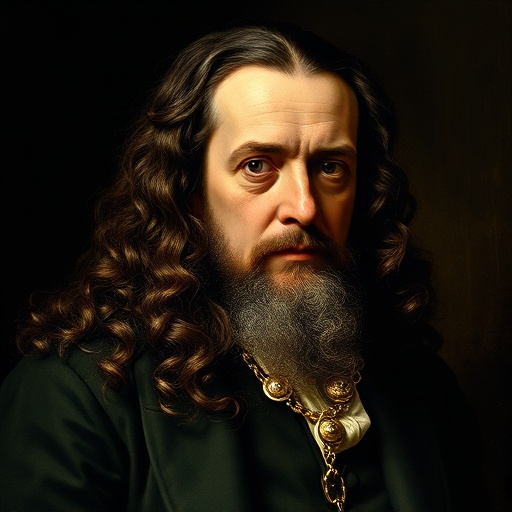
Gottfried Wilhelm Leibniz
Calculus, optimism
Sayings by Gottfried Wilhelm Leibniz
To love is to be delighted by the happiness of another.
I do not conceive of any reality at all as without genuine unity.
He who hasn't tasted bitter things hasn't earned sweet things.
Make me the master of education, and I will undertake to change the world.
There is nothing waste, nothing sterile, nothing dead in the universe; no chaos, no confusions, save in appearance.
I am not one of those people whose minds are so limited that they are unable to conceive of more than one kind of substance.
It is a bad thing to be a heretic, but it is worse to be a schismatic.
The art of discovering the causes of phenomena, or true hypothesis, is like the art of deciphering, in which an ingenious conjecture often greatly shortens the road.
I hold that the mark of a genuine idea is that its possibility can be proved, either a priori by conceiving its cause or reason, or a posteriori when experience teaches us that it is actual in nature.
I am so much for peace that I would rather be silent than say something which might disturb it.
Virtue is the habit of acting according to wisdom.
Time is the order of successive phenomena.
The ultimate reason of things must lie in a necessary substance, in which the detail of changes exists only eminently, as in its source; and this is what we call God.
I have said more than once, that I hold space to be something merely relative, as time is; that I hold it to be an order of coexistences, as time is an order of successions.
The knowledge which we have of God and of ourselves shows us that He is the greatest and the best of beings; and from this it follows that He must have chosen the best possible plan in producing the universe.
For since it is impossible for a creature to be perfect, the universe would be even less perfect if it contained only perfect creatures.
I also take it for granted that every created thing, and consequently the created monad also, is subject to change, and indeed that this change is continual in each one.
There is a certain destiny of everything, regulated by the foreknowledge and providence of God, who has established an infallible connection between the antecedent and the consequent.
I maintain that the monads, which are the true atoms of nature, have no windows through which anything could enter or depart.
When God calculates and exercises his thought, the world is made.