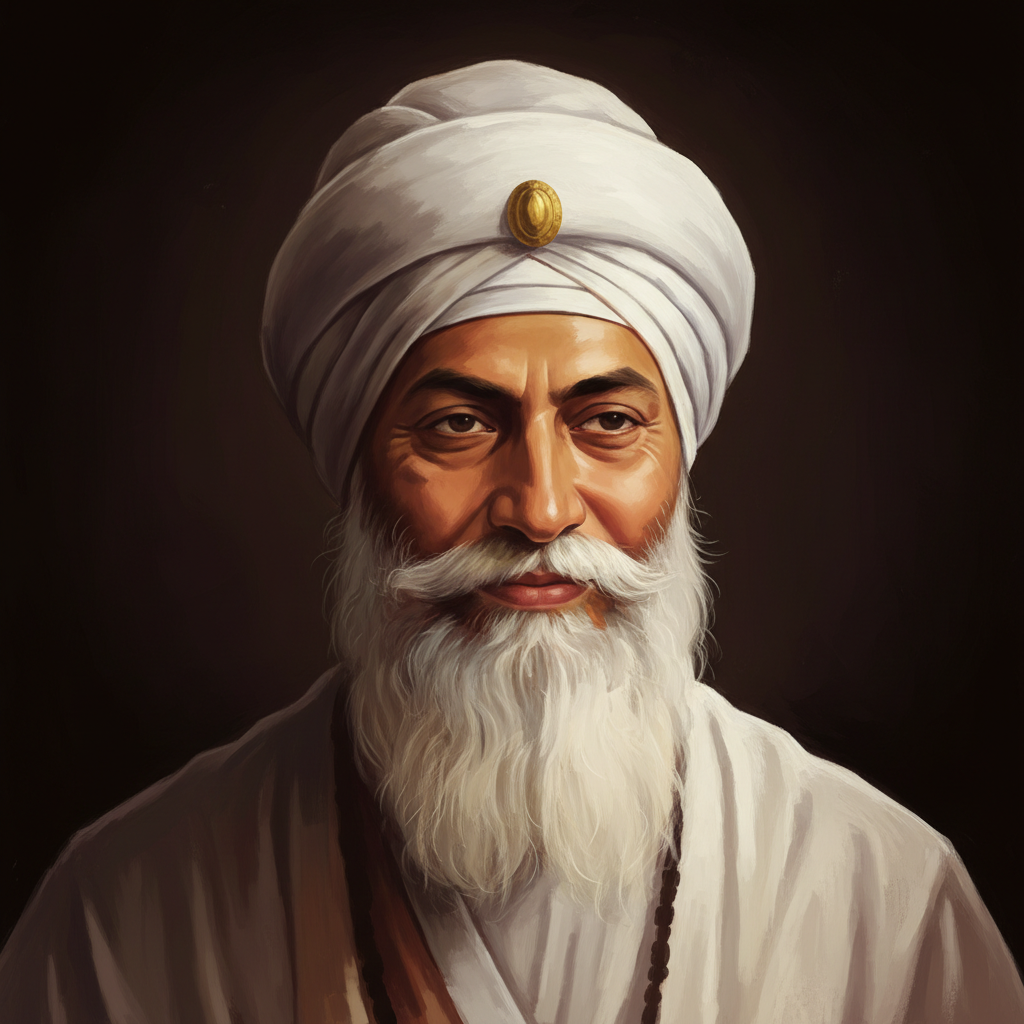
Guru Nanak — "If there are hundreds of moons and thousands of suns, without the Guru, there is…"
If there are hundreds of moons and thousands of suns, without the Guru, there is only utter darkness.
If there are hundreds of moons and thousands of suns, without the Guru, there is only utter darkness.
Click any product to generate a realistic preview. Up to 3 at a time.
* Initial load can take up to 90 seconds — revising the preview in another color is nearly instant.
"The world is suffering in falsehood, and only truth can save it."
"He who serves the Guru, he alone finds peace."
"Death would not be called bad, O people, if one knew how to truly die."
"The mind is a mirror, and the world is its reflection."
"I bow at His feet constantly and pray to Him. The Guru, the True Guru, has shown me the Way."
Founder of Sikhism and the first of the Ten Sikh Gurus, whose teachings of one universal God and rejection of caste shaped Punjab. Closely associated with Kabir (mystical poet whose verses appear in the Sikh Guru Granth Sahib). For an intellectual contrast, see Brahmanical orthodoxy, the Hindu caste-and-ritual establishment of his era — Sikhism was founded as a deliberate alternative to both Hindu ritual hierarchy and Islamic exclusivism — Nanak's universalism was a structural rejection of caste and priestly mediation.
Found in 1 providers: gemini
1 source checked
Even overwhelming natural light—hundreds of moons, thousands of suns—cannot illuminate the inner self. Physical brightness reveals the outer world, but without a true teacher to dispel ignorance, a person remains spiritually blind. The quote argues that knowledge of the divine and of one's own nature requires guided wisdom, not sensory perception. No amount of external brilliance substitutes for the inner awakening a Guru provides; without that, existence is functionally darkness.
Guru Nanak founded Sikhism on the principle that a living Guru's teaching is essential to perceive the formless divine (Ik Onkar). He traveled across South Asia and the Middle East on four udasis, challenging empty ritual in both Hindu and Muslim practice, insisting direct experience required a guide. As the first of ten Sikh Gurus, he embodied this role himself—this verse crystallizes the Sikh conviction that Guru-shabad, not sensory knowledge, is the only true light.
Guru Nanak (1469–1539) lived in Punjab under the Delhi Sultanate's collapse and the Mughal invasion—Babur's 1526 conquest occurred in his lifetime. Hindu-Muslim tension, caste rigidity, and ritualistic Brahminism dominated religious life, while Sufi and Bhakti movements stressed devotional experience over orthodoxy. Amid political violence and sectarian divide, his insistence that a Guru's inner light trumped scriptural authority, priestly caste, and imperial power offered a radical unifying alternative rooted in lived spiritual realization.
AI-generated insights based on extensive research and information for context. Factual errors? Email [email protected].
Your cart is empty