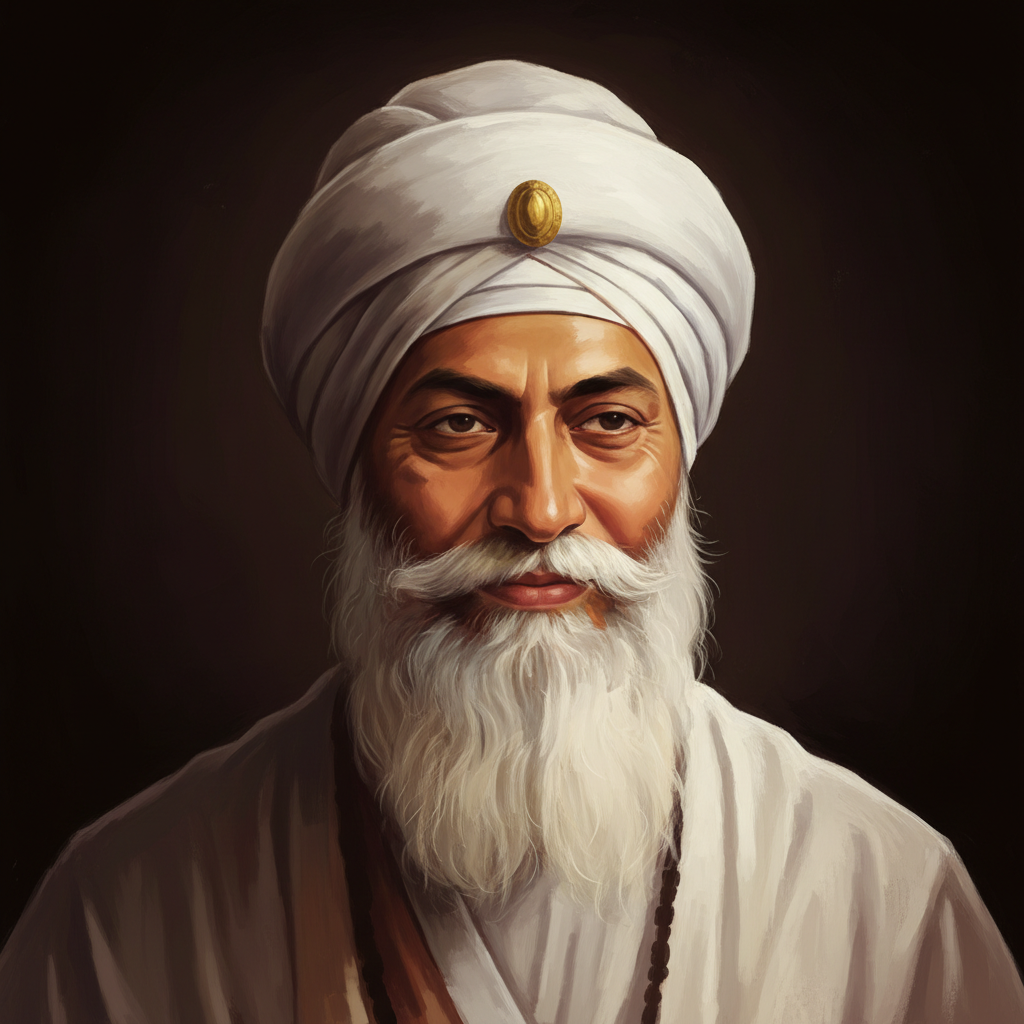
Guru Nanak — "He who meditates on the Lord's Name, his sins are washed away."
He who meditates on the Lord's Name, his sins are washed away.
He who meditates on the Lord's Name, his sins are washed away.
Click any product to generate a realistic preview. Up to 3 at a time.
* Initial load can take up to 90 seconds — revising the preview in another color is nearly instant.
"Speak only that which will bring you honor."
"May peace prevail on Earth. And may my noisy neighbors finally get some headphones."
"Burn worldly love, rub the ashes and make ink of it, make the heart the pen, the intellect the writer, write that which has no end or limit."
"Religion consists not in words; He who looks on all men as equal is religious."
"He who speaks truth, lives truth, and meditates on truth, he alone is pure."
Founder of Sikhism and the first of the Ten Sikh Gurus, whose teachings of one universal God and rejection of caste shaped Punjab. Closely associated with Kabir (mystical poet whose verses appear in the Sikh Guru Granth Sahib). For an intellectual contrast, see Brahmanical orthodoxy, the Hindu caste-and-ritual establishment of his era — Sikhism was founded as a deliberate alternative to both Hindu ritual hierarchy and Islamic exclusivism — Nanak's universalism was a structural rejection of caste and priestly mediation.
Found in 1 providers: grok
1 source checked
Sincere, focused remembrance of the divine name cleanses a person of past wrongdoing. The idea is that genuine inner devotion—not rituals, offerings, or external ceremonies—transforms the heart and dissolves the weight of past mistakes. By concentrating the mind on the sacred, a practitioner aligns with something greater than the ego, and that alignment itself purifies. Liberation from guilt comes through discipline of attention and love, not through priests or institutions.
Guru Nanak built Sikhism around Naam Simran—constant remembrance of the divine name—as the central spiritual practice. Born in 1469 in Punjab, he rejected caste rituals, idol worship, and priestly intermediaries after his mystical experience at the Bein river. He traveled across India, Tibet, and Arabia teaching that one formless God is accessible directly through devoted recitation. This line distills his core teaching: inner meditation, not outward ceremony, is the true path to spiritual cleansing.
Nanak lived from 1469 to 1539, during Mughal expansion into Punjab and constant tension between entrenched Hindu caste orthodoxy and Islamic rule. Ordinary people were crushed between Brahminical ritual gatekeeping, pilgrimages, and Muslim conversion pressure. Religious identity often decided social worth. By preaching that anyone—regardless of caste, gender, or religion—could reach God through simple inner remembrance, Nanak offered a radical democratic spirituality that bypassed both temple priests and mullahs during a volatile, sectarian era.
AI-generated insights based on extensive research and information for context. Factual errors? Email [email protected].
Your cart is empty