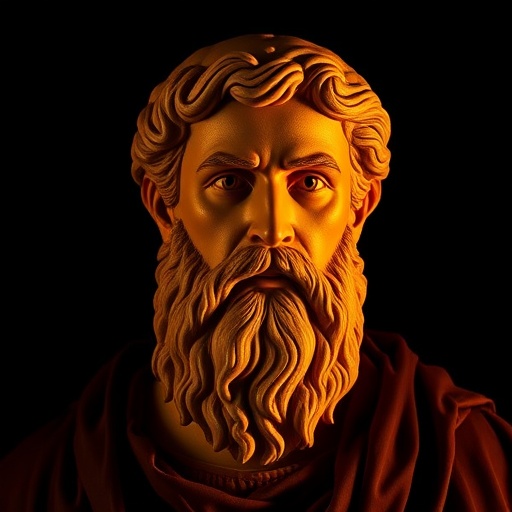
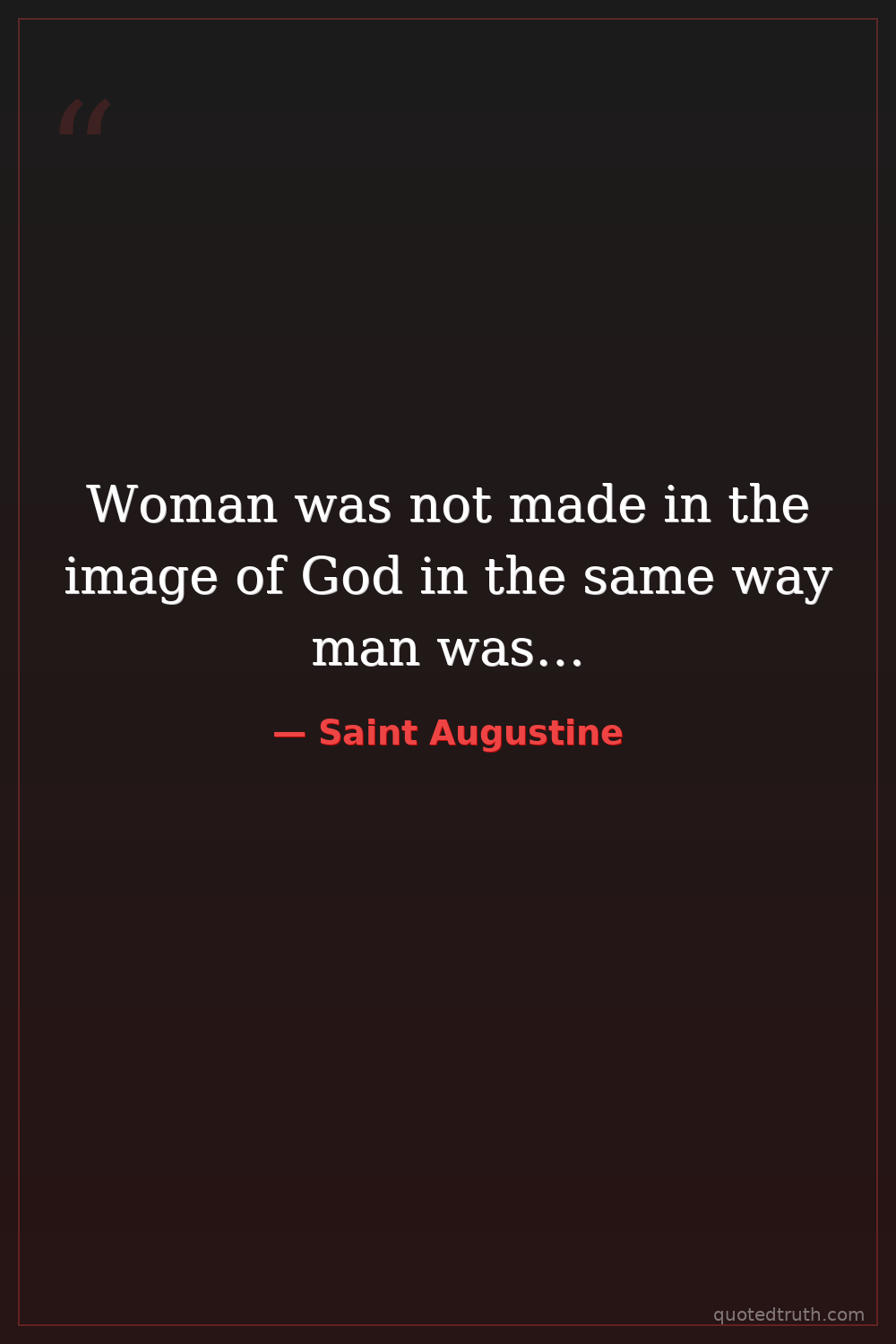
Saint Augustine — "Woman was not made in the image of God in the same way man was…"
Woman was not made in the image of God in the same way man was…
Woman was not made in the image of God in the same way man was…
Click any product to generate a realistic preview. Up to 3 at a time.
* Initial load can take up to 90 seconds — revising the preview in another color is nearly instant.
"Give me chastity and continence, but not yet."
"Sin is looking for the right thing in the wrong place."
"For pride is the beginning of sin."
"Having children is the only worthy fruit of sexual intercourse."
"The punishment of every disordered mind is its own disorder."
Found in 1 providers: gemini
1 source checked
This quote asserts that while both men and women possess rational souls capable of knowing God, women bear a qualified reflection of the divine image. Augustine argued that the full expression of imago Dei—particularly its governing, rational authority—was realized more completely in man. He drew on Paul's writings to suggest women embody God's image differently, especially in their social role as helpers, rather than as fully independent image-bearers.
Augustine's theology was shaped by Paul's epistles and Neoplatonic thought. In De Trinitate, he distinguished between woman's rational soul—where she shares the imago Dei—and her social role as man's helper, where she reflects it only partially. Though his mother Monica was a towering spiritual influence in his life, Augustine consistently embedded women in a subordinate theological hierarchy, reinforcing patriarchal readings of Genesis that shaped Catholic doctrine for over a millennium.
Augustine wrote during the late Roman Empire (354–430 AD), as Christianity transitioned from persecuted sect to official state religion. Classical philosophy—Aristotle described women as biologically deficient—pervaded educated thought. Roman law granted women limited legal standing. The Church, codifying doctrine after the Council of Nicaea (325 AD), turned heavily to Genesis and Paul's letters to define gender roles, making hierarchical readings of imago Dei foundational to emerging Christian orthodoxy.
AI-generated insights based on extensive research and information for context. Factual errors? Email [email protected].
Your cart is empty