What it means
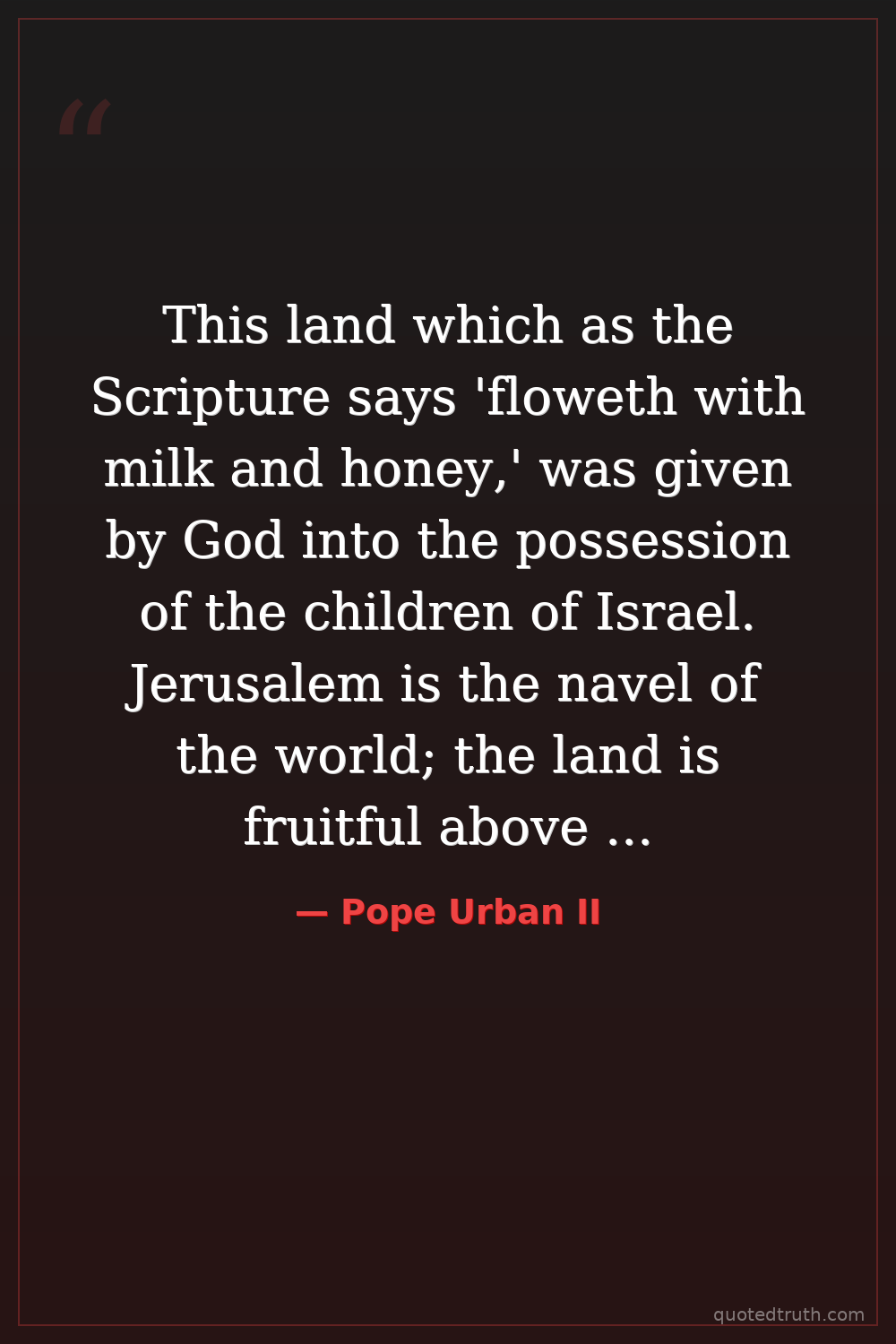
The quote frames Jerusalem and the Holy Land as divinely appointed, extraordinarily fertile, and cosmically central — a paradise God gave the Israelites and, by extension, rightful Christian territory. Urban uses biblical imagery of milk and honey to elevate the geography from mere land to sacred inheritance. The rhetorical effect is clear: if this place is heaven on earth, reclaiming it from Muslim rule becomes not conquest but restoration of divine order.
Relevance to Pope Urban II
Urban II was a Cluniac monk-turned-pope who called the First Crusade at Clermont in 1095. His entire papacy centered on church reform and reasserting Christian authority. This quote mirrors his Council of Clermont speech almost verbatim — he used scripture-saturated language deliberately to make crusading feel spiritually compulsory. As a theologian and political strategist, he knew that framing Jerusalem as cosmic center and paradise would override noblemen's hesitations with religious fervor.
The era
In 1095, Seljuk Turks controlled Jerusalem while threatening Byzantine Constantinople. Medieval maps literally placed Jerusalem at the earth's center. The Crusades emerged from overlapping motivations: religious devotion, papal authority expansion, noble land hunger, and Byzantine appeals for help. For an audience steeped in scripture, calling Jerusalem the navel of the world and referencing Exodus's milk-and-honey promise transformed military expedition into sacred pilgrimage with guaranteed spiritual reward.
AI-generated insights based on extensive research and information for context. Factual errors? Email [email protected].