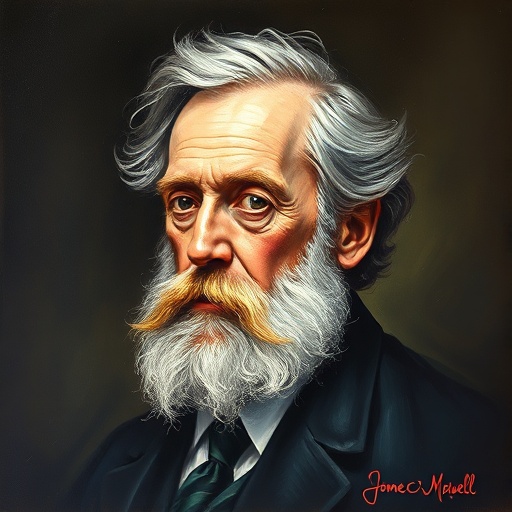
James Clerk Maxwell — "I have also a paper afloat, with an electromagnetic theory of light, which, till…"
I have also a paper afloat, with an electromagnetic theory of light, which, till I am convinced to the contrary, I hold to be great guns.
I have also a paper afloat, with an electromagnetic theory of light, which, till I am convinced to the contrary, I hold to be great guns.
Click any product to generate a realistic preview. Up to 3 at a time.
* Initial load can take up to 90 seconds — revising the preview in another color is nearly instant.
"The velocity of light is a quantity of which we have now a more accurate knowledge than of any other physical constant."
"The greatest discovery ever made was the discovery of ignorance."
"The molecules of a gas are like angry bees in a jar, but far more mathematical."
"Mathematicians my flatter themselves that they possess new ideas which mere human language is as yet unable to express."
"The human mind is seldom satisfied, and is certainly never exercising its highest functions, when it is doing the work of a calculating machine."
Found in 1 providers: gemini
1 source checked
Maxwell is announcing that he has a paper in circulation proposing that light itself is an electromagnetic phenomenon. He is confident in the idea and considers it powerful and important, using the slang 'great guns' to mean impressive or formidable. Until someone presents evidence that disproves it, he intends to stand firmly behind the theory. It mixes scientific conviction with a casual, almost playful self-assurance about a revolutionary claim.
Maxwell unified electricity, magnetism, and light into a single framework through his equations, predicting that electromagnetic waves travel at the speed of light. This quote captures the exact moment he recognized the magnitude of that insight. Known for quiet Scottish humility paired with dry wit, he rarely boasted, so calling his own work 'great guns' reveals genuine excitement. The theory became the foundation for radio, relativity, and modern physics, validating his confidence entirely.
In the 1860s, physics treated electricity, magnetism, and optics as separate domains, and the luminiferous ether was assumed to carry light. Faraday's field concepts were still contested, and mathematical physics was maturing in Victorian Britain alongside the industrial telegraph boom. Maxwell's synthesis arrived as scientists hungered for unifying laws, though full acceptance waited until Hertz produced radio waves in 1887. His paper marked a turning point from mechanical to field-based understanding of nature.
AI-generated insights based on extensive research and information for context. Factual errors? Email [email protected].
Your cart is empty