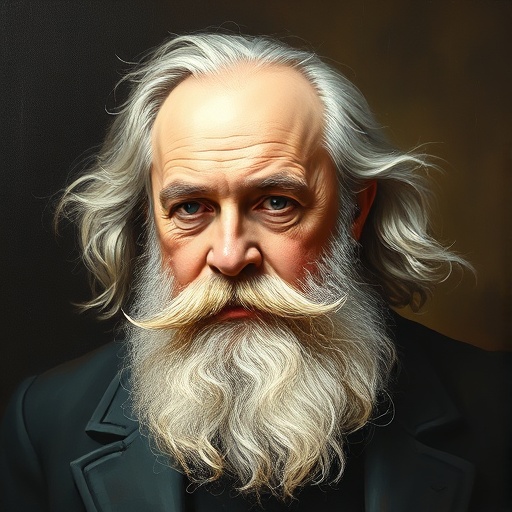
Dmitri Mendeleev — "Doctor, you have science, I have faith."
Doctor, you have science, I have faith.
Doctor, you have science, I have faith.
Click any product to generate a realistic preview. Up to 3 at a time.
* Initial load can take up to 90 seconds — revising the preview in another color is nearly instant.
"The edifice of science not only requires material, but also a plan. Without the material, the plan alone is but a castle in the air—a mere possibility; whilst the material without a plan is but useles…"
"The weight of the atom is not the only criterion; there are other considerations."
"I have no need of proof; the laws of nature, unlike the laws of grammar, admit of no exception."
"The essence of chemistry lies not in the pursuit of knowledge alone, but also in the pursuit of truth."
"It was clear that in the United States there was a development not of the best, but of the middle and worst sides of European civilization; the notorious general voting, the tendency to politics... al…"
Found in 1 providers: gemini
1 source checked
The speaker draws a clear line between two ways of understanding the world: the doctor relies on empirical evidence and medical knowledge, while the speaker rests on personal belief and trust in something beyond proof. It acknowledges the doctor's expertise without surrendering to it, claiming that conviction and hope can coexist with, or even stand apart from, rational analysis when facing uncertainty or mortality.
Strikingly paradoxical for Mendeleev, the chemist who organized elements into the periodic table through rigorous observation and pattern recognition. Yet he was a deeply spiritual Russian Orthodox believer who saw no conflict between laboratory work and religious conviction. Reportedly spoken near his death in 1907 to an attending physician, it captures his lifelong view that science explained nature's order while faith addressed meaning, suffering, and what lay beyond measurable phenomena.
Late 19th and early 20th century Russia was torn between rapid scientific modernization and enduring Orthodox tradition. Positivism, Darwinism, and industrial progress challenged church authority, while intellectuals debated whether reason alone sufficed. Mendeleev lived through Tsarist reforms, revolutionary stirrings, and the dawn of atomic physics. His generation wrestled openly with reconciling empirical triumphs against spiritual heritage, making such deathbed declarations culturally resonant rather than contradictory.
AI-generated insights based on extensive research and information for context. Factual errors? Email [email protected].
Your cart is empty